- Animals
- ›Chordates
- ›Vertebrates
- ›Ray-finned Fishes
- ›Tarpons, Eels, and Allies
- ›True Eels
- ›Congroidei
- ›Snake Eels
- ›Snake Eels
- ›Myrichthys
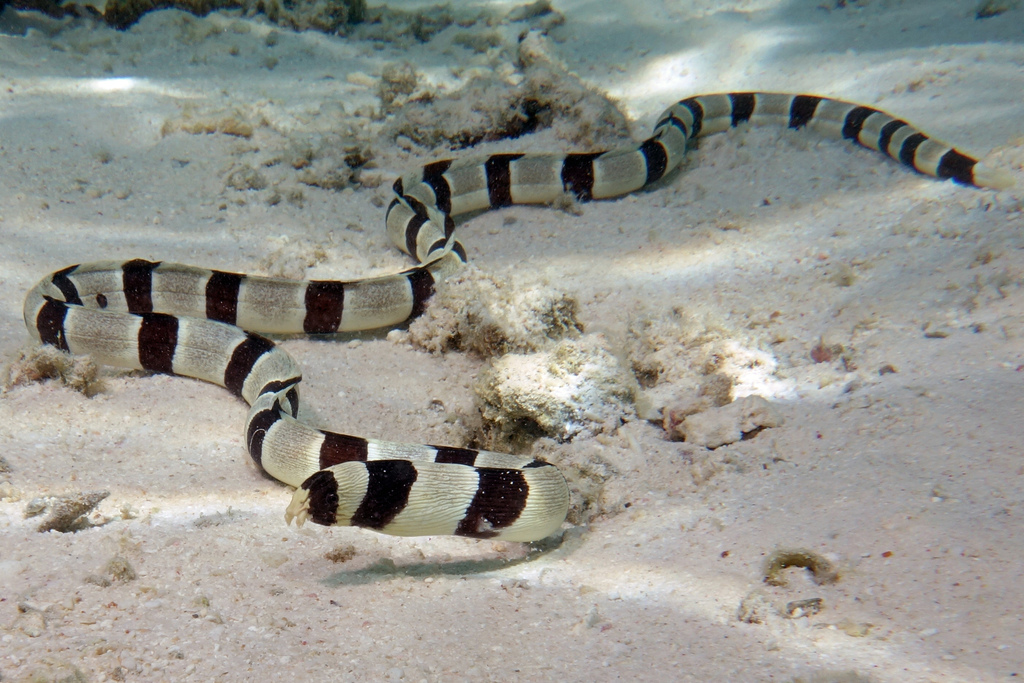
Harlequin Snake Eel
Myrichthys colubrinus
Myrichthys colubrinus, most commonly known as the banded snake eel, but is also referred to as the ringed snake eel or harlequin eel, is of the order of Anguiliformes. Anguiliformes include fishes that have long tubular body shapes. M. colubrinus is from the family Ophichthidae. Ophichthidae is one of the most ecologically diverse families present in the Anguiliformes order. Ophicthidae makes up approximately 260 species with 50 different genera. Animals from this family are commonly referred to as snake eels or worm eels due to their extended body shape, narrow heads and lack of defined fins, except for the large dorsal fin that runs down most of the length of their bodies and small pectoral fins. They are also notable for having particularly sharp and hard snouts and tails to support a burrowing lifestyle. Due to the fact that there are so many individuals within this family, identification can be challenging. This is especially notable when the eels are in their larval form. Many look incredibly similar to the point that identifying unique species from each other is not easy.
From the article Myrichthys colubrinus on Wikipedia (CC BY-SA), quoted section by section
Range & habitat
Ophichthidae are one of the most widely spread families scattering across the Indo-Pacific region at a variety of depth. They are most commonly found within the coastal regions of these oceans from Australia to Japan and Hawaii. Some species are even found along the coast of Mexico. Other individuals in the family are known to bury into the sandy sea floor of tropical and subtropical waters. They have been discovered to be anywhere from tidal zones to locations up to 800 meters below the surface. The family Ophichthidae is highly populous in tropical waters close to the coast. Distribution is difficult to discern because many eels in the same family as the banded snake eel often only have their heads poking out of the sands of which they’ve buried themselves.
The banded snake eels was recorded recently off of the coast of Hawaii but are known to be a very widespread species having been spotted in the Indian Ocean, Red Sea and along the southern coast of Africa. Many island chains such as the Line Islands, Society Islands and Tuamotu archipelago include them as well. Lastly they have been seen in the western pacific by the coats of New South Wales Australia and Japan.
Wikipedia: “Distribution”
What it does
The larval and developmental stages are widely not understood for the Myricthys genus. Looking at the Ophicthidae family we know that eels are all primarily nocturnal. This is also true of their larva. All Ophicthids are known to have pelagic leptocephalus larvae. It is also considered that Ophicthidae eels have a long larval stage, with the larvae and eggs of the eel being very hard to identify in a species specific way without genetic testing. Further information about breeding habits has not been researched.
Wikipedia: “Reproduction”
Where it lives
Recorded sightings
—
geo-referenced records in GBIF, from museums, herbaria and field observers.
Drag the globe to turn it. Dots are where records exist, not a range map; darker means more records.
In the stacks
Searching the stacks…
Every page naming Myrichthys colubrinus in the Biodiversity Heritage Library →
This page is assembled live from iNaturalist, GBIF, Wikipedia, the Source Library and the Internet Archive. It is not yet part of the hand-edited codex. iNaturalist taxon 180786.