- Animals
- ›Chordates
- ›Vertebrates
- ›Ray-finned Fishes
- ›Tarpons, Eels, and Allies
- ›Halosaurs and Deep-sea Spiny Eels
- ›Deep-sea Spiny Eels
- ›Notacanthus
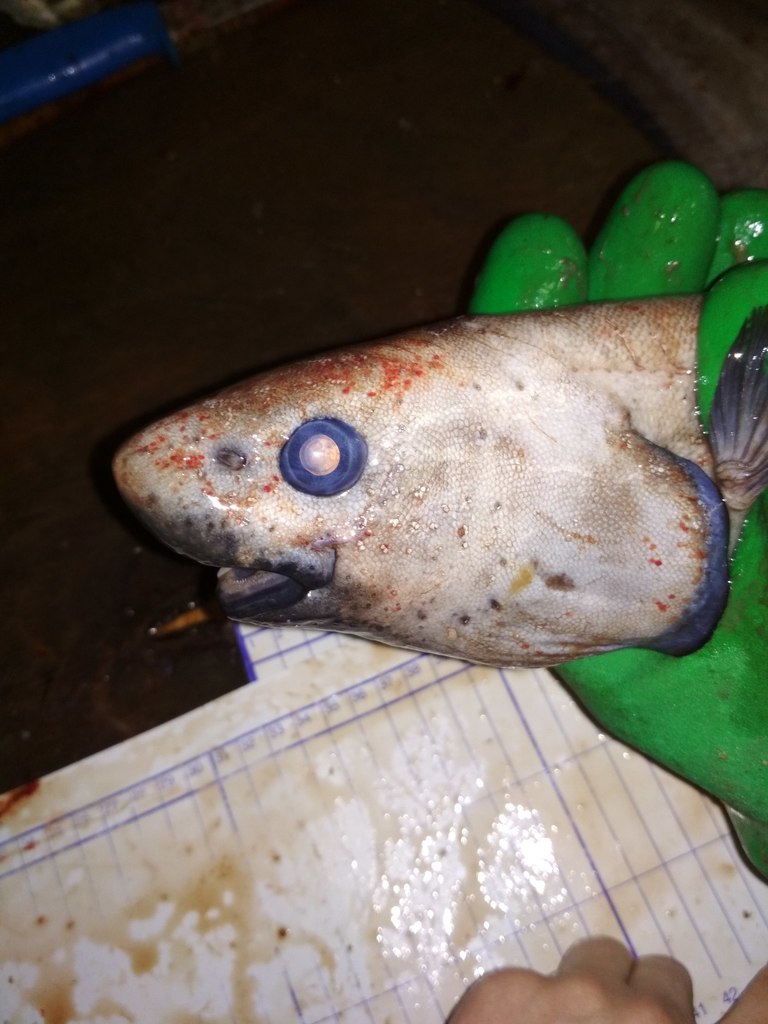
Snubnosed Spiny Eel
Notacanthus chemnitzii
The snub-nosed spiny eel (Notacanthus chemnitzii) is a member of the family Notacanthidae, the deep-sea spiny eels, which are not true eels (Anguilliformes). The snub-nosed spiny eel exists in waters all over the world, except in the tropics, ranging in color from light tan to bluish grey in small ones to dark brown in large ones. Its primary food is sea anemones. The eel usually lives in deep waters, mostly more than 200 m below the surface. Female snub-nosed spiny eels reach maturity around 18 years old, and are larger than 55 cm in length at maturity. Males reach maturity around 14 years and are larger than 66 cm in length.
From the article Snub-nosed spiny eel on Wikipedia (CC BY-SA), quoted section by section
Description
The snub-nosed spiny eel has 19-37 premaxillary teeth on each side. They have multiple rows of palatine and dentary teeth. Snub-nosed spiny eels have eyes that are approximately half the length of their snout. Their dorsal fins have 8-12 spines, and their anal fins have 20-21 spines.
Wikipedia: “Morphology”
Range & habitat
The snub-nosed spiny eel can be found at a depth of 125 to 3285 m below the surface. The snub-nosed spiny eel is found in the subarctic Atlantic, around Iceland, Greenland, Norway, and Eastern Canada. The most northern record of the snub-nosed spiny eel was in the northeast Atlantic off Bjørnsund, Norway. The snub-nosed spiny eel has been found in waters of Russia near the Kuril Islands, the Sea of Okhotsk and the Barents Sea. It is a rare species in many regions. Spawning fishes can be found in the northwestern Atlantic from October until March.
== References ==
Wikipedia: “Distribution and habitat”
Where it lives
Recorded sightings
—
geo-referenced records in GBIF, from museums, herbaria and field observers.
Drag the globe to turn it. Dots are where records exist, not a range map; darker means more records.
In the stacks
Searching the stacks…
Every page naming Notacanthus chemnitzii in the Biodiversity Heritage Library →
This page is assembled live from iNaturalist, GBIF, Wikipedia, the Source Library and the Internet Archive. It is not yet part of the hand-edited codex. iNaturalist taxon 225999.