- Animals
- ›Chordates
- ›Vertebrates
- ›Ray-finned Fishes
- ›Spiny-rayed fishes
- ›Puffers and Filefishes
- ›Triggerfishes, Boxfishes, and Filefishes
- ›Filefishes
- ›Monacanthus
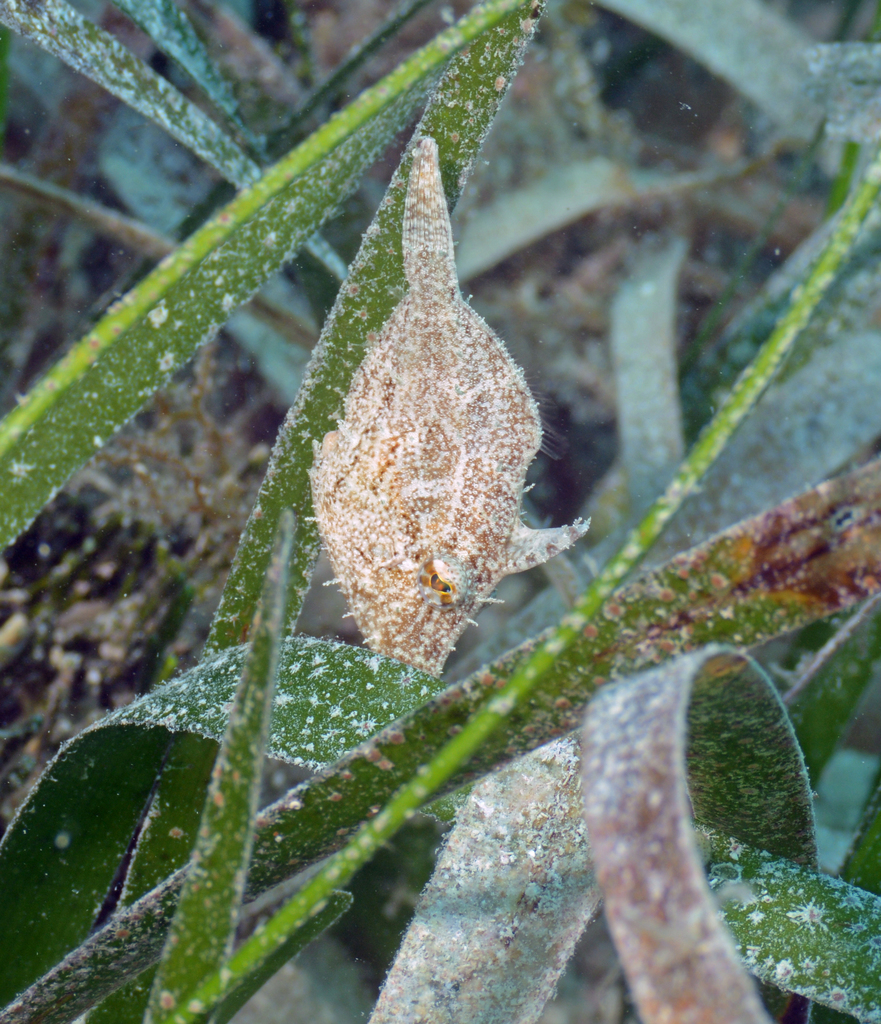
Fringed Filefish
Monacanthus ciliatus
Monacanthus ciliatus, commonly known as the fringed filefish, the cuckold or the leather-fish, is a species of bony fish commonly found in shallow water in the western Atlantic Ocean, the Caribbean Sea and the Gulf of Mexico.
From the article Monacanthus ciliatus on Wikipedia (CC BY-SA), quoted section by section
Description
The fringed filefish is a laterally flattened fish with a deeply keeled body and a dewlap on the underside. It typically grows to a length of 10 to 14 cm (4 to 6 in), with a maximum length of 20 cm (8 in). The eyes are large, the snout is short and pointed, and the mouth is small, with strong teeth. The dorsal fin is in two parts; the front section is just behind the eyes and consists of two spines, the first one being long and erectile and the second one being tiny; the second part starts further back and consists entirely of soft rays. The pectoral fins are small and the pelvic fin resembles a spine. The caudal fin is short and fan-shaped and consists of branched soft rays. The skin is clad in very small scales, which gives the fish a leathery appearance. The skin is also dotted with scattered small, pointed, fleshy growths. The colour of the fish varies with the surroundings, being greenish in seagrass meadows and brown or tan on reefs or in sandy areas. There are irregular darker longitudinal stripes and there is often a large black spot on the dewlap.
Range & habitat
The fringed filefish is found in shallow parts of the western Atlantic Ocean between Newfoundland and Argentina, in the Caribbean Sea and the Gulf of Mexico. It is also recorded from the eastern Atlantic coasts of Europe and Africa. It is most commonly found in seagrass meadows, but also frequents coral rubble, sandy areas and sometimes rocky areas. It is a demersal fish and its depth range is 5 to 20 m (16 to 66 ft).
Wikipedia: “Distribution and habitat”
Where it lives
Recorded sightings
—
geo-referenced records in GBIF, from museums, herbaria and field observers.
Drag the globe to turn it. Dots are where records exist, not a range map; darker means more records.
In the stacks
Searching the stacks…
Every page naming Monacanthus ciliatus in the Biodiversity Heritage Library →
This page is assembled live from iNaturalist, GBIF, Wikipedia, the Source Library and the Internet Archive. It is not yet part of the hand-edited codex. iNaturalist taxon 131515.