- Animals
- ›Chordates
- ›Vertebrates
- ›Ray-finned Fishes
- ›Spiny-rayed fishes
- ›Jacks, Flounders, Barracudas, and Allies
- ›Flatfishes
- ›Righteye Flounders
- ›Pleuronectinae
- ›Pseudopleuronectes
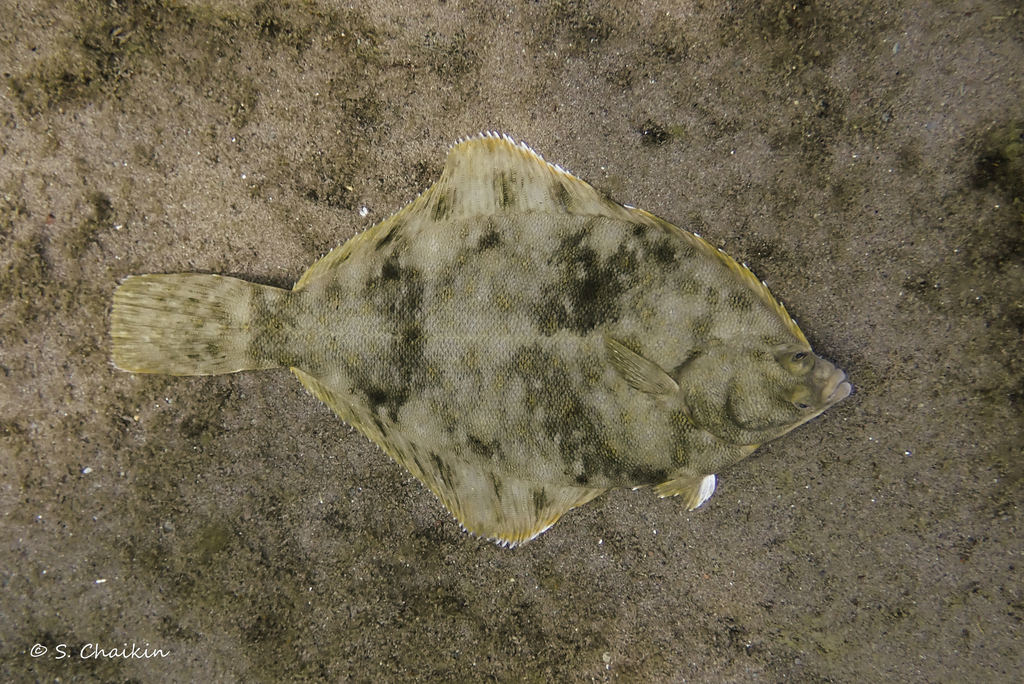
Winter Flounder
Pseudopleuronectes americanus
The winter flounder (Pseudopleuronectes americanus), also known as the black back, is a right-eyed ("dextral") flatfish of the family Pleuronectidae. It is native to coastal waters of the western north Atlantic coast, from Labrador, Canada to Georgia, United States, although it is less common south of Delaware Bay. It is the most common near-shore (shallow-water) flounder in the waters from Newfoundland down through Massachusetts Bay, reaching a maximum size around 61 cm in length and 2.25 kg in weight. The species grows larger on Georges Bank, where they can reach a length of 70 cm and weight of 3.6 kg. Although winter flounder historically supported large commercial and recreational fisheries, biomass and landings have decreased since the 1980s.
From the article Winter flounder on Wikipedia (CC BY-SA), quoted section by section
What it does
Winter flounder lay up to 3.3 million demersal, adhesive eggs that are retained within their spawning grounds. Depending on temperature, larvae of approximately 3 mm in length hatch in two to three weeks. These larvae are planktonic at first, but transition to a bottom-oriented lifestyle over time. Around five to six weeks after hatching, the left eye of the larval flounder begins to migrate to the right side of the body. The "flounder-like" juveniles then settle onto the seafloor and move into saltwater coves, coastal salt ponds, estuaries, and protected bays, where they may grow up to 100 mm within the first year. Adult winter flounder may grow as large as 70 cm and reach ages of 15+ years. Growth varies across their distribution, with northern populations generally growing slower than those at the southern end of their range.
Wikipedia: “Life cycle”
Where it lives
Recorded sightings
—
geo-referenced records in GBIF, from museums, herbaria and field observers.
Drag the globe to turn it. Dots are where records exist, not a range map; darker means more records.
In the stacks
This page is assembled live from iNaturalist, GBIF, Wikipedia, the Source Library and the Internet Archive. It is not yet part of the hand-edited codex. iNaturalist taxon 51371.