- Animals
- ›Chordates
- ›Vertebrates
- ›Ray-finned Fishes
- ›Spiny-rayed fishes
- ›Jacks, Flounders, Barracudas, and Allies
- ›Flatfishes
- ›Righteye Flounders
- ›Pleuronectinae
- ›Pseudopleuronectes
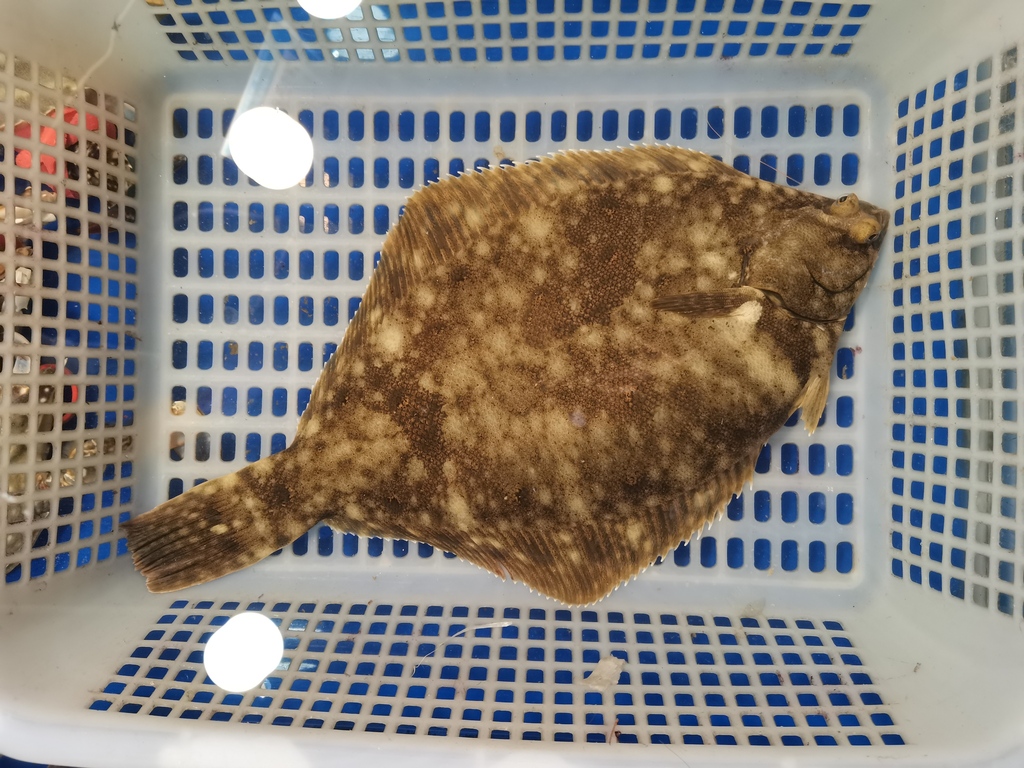
Marbled Flounder
Pseudopleuronectes yokohamae
The marbled flounder, Pseudopleuronectes yokohamae, is a flatfish of the family Pleuronectidae. It is a demersal fish that lives on saltwater sand and mud bottoms. Its natural habitat is the temperate coastal waters of the northwestern Pacific, from southern Hokkaido, Japan, to the Yellow Sea, Gulf of Bohai, East China Sea and Korean Peninsula. It can grow up to 45 centimetres (18 in) in length, and its maximum recorded weight is 1.9 kilograms (4.2 lb).
From the article Marbled flounder on Wikipedia (CC BY-SA), quoted section by section
What it does
The diet of the marbled flounder consists primarily of benthic organisms such as amphipods, polychaetes, shrimps, crabs and other benthos crustaceans.
Wikipedia: “Diet”
At the table
In Japan, the marbled flounder is found in Beppu Bay, and considered a specialty in the town of Hiji, where it is called shiroshita karei ("under-the-castle flounder"), because it is caught under the waters of Hiji Castle. The town holds an annual flounder festival. It is eaten raw in sashimi, in soups, or deep fried.
== References ==
Wikipedia: “As food”
Where it lives
Recorded sightings
—
geo-referenced records in GBIF, from museums, herbaria and field observers.
Drag the globe to turn it. Dots are where records exist, not a range map; darker means more records.
In the stacks
This page is assembled live from iNaturalist, GBIF, Wikipedia, the Source Library and the Internet Archive. It is not yet part of the hand-edited codex. iNaturalist taxon 465054.