- Animals
- ›Chordates
- ›Vertebrates
- ›Ray-finned Fishes
- ›Spiny-rayed fishes
- ›Jacks, Flounders, Barracudas, and Allies
- ›Flatfishes
- ›Righteye Flounders
- ›Pleuronectinae
- ›Platichthys
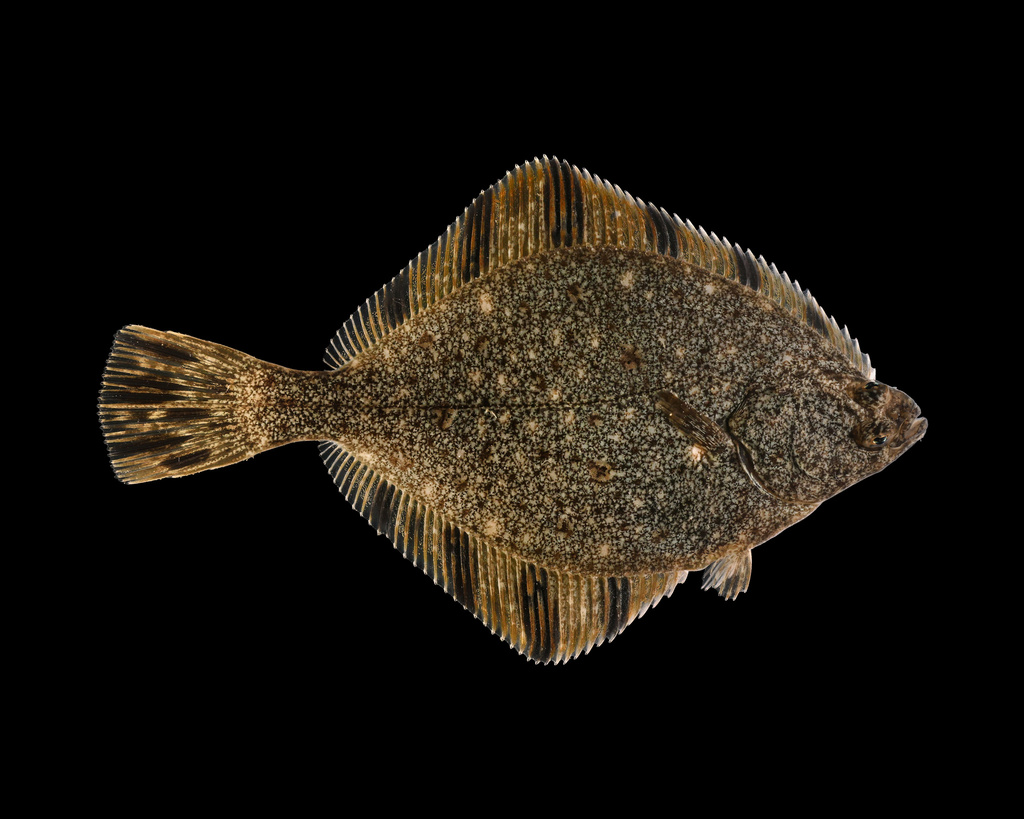
Starry Flounder
Platichthys stellatus
The starry flounder (Platichthys stellatus), also known as the grindstone, emery wheel and long-nosed flounder, is a common flatfish found around the margins of the North Pacific.
The distinctive features of the starry flounder include the combination of black and white-to-orange bar on the dorsal and anal fins, as well as the skin covered with scales modified into tiny star-shaped plates or tubercles (thus both the common name and species epithet), resulting in a rough feel. The eyed side is black to dark brown, while the lower side is white or cream-colored. Although classed as "righteye flounders," individuals may have their eyes on either the right or left side. They have been recorded at up to 91 cm and 9 kg.
From the article Starry flounder on Wikipedia (CC BY-SA), quoted section by section
Description
The starry flounder has an oval shaped body with a slender, pointed head. Its eyed side is an olive to dark brown or almost black in some cases and the blind side is a white or creamy white color. This species has unpaired fins ranging from a white to yellow-orange complexion, with black bands running perpendicular to the fish. The posterior fin or caudal fin is slightly rounded. Lateral lines with a slight curve run over the pectoral fin and a complete lack of an accessory dorsal branch is found within this species. This species relies heavily on its strong anal spine for swimming. This anal spine is used as the primary driver of locomotion while the fish is swimming through the open ocean. Through an up and down motion the fish achieves a propelling effect.
Wikipedia: “Morphology”
Range & habitat
The starry flounder has a relatively large home range, going from the North Pacific Ocean all the way to Southern California. Within the Pacific Ocean they are located in Korea and Southern Japan through Bering Strait and Arctic Alaska to the Coronation Gulf. They have also been prominently found in Canada, Santa Barbara and Southern California.
Wikipedia: “Distribution”
What it does
The starry flounder has a multitude of well studied behaviors that are exhibited on a daily basis. At a normal resting position the dorsal and anal fins are angled so to prevent the body from resting upon the substrate, support being given by the fins, so as to create a cushion of water between the fish and the substrate. This is also for water to escape through an opening on the blind side, gill slit, of the fish and lessens the amount of effort needed to move. Movement of this fish has been described to look much like crawling, with the first few rays of the dorsal and anal fins moving in a rowing motion that progresses caudally along the fish creating a waving movement of the fins, propelling the fish forward. Flounders are also capable of backwards locomotion, which is achieved with the same waving movement of the fins but the rowing motion progresses anteriorly. This movement is used as a method of escape or if it encounters an obstacle. When quick movements are needed from this fish, such as when feeding or frightened, the pectoral fin is extended at a right angle from the body, and used as an additional paddle. Another key behavioral ability displayed by the P. stellatus is its ability to change its body coloration depending upon the substrate or environment that it is in. …
Wikipedia: “Behavior”
Where it lives
Recorded sightings
—
geo-referenced records in GBIF, from museums, herbaria and field observers.
Drag the globe to turn it. Dots are where records exist, not a range map; darker means more records.
In the stacks
Searching the stacks…
Every page naming Platichthys stellatus in the Biodiversity Heritage Library →
This page is assembled live from iNaturalist, GBIF, Wikipedia, the Source Library and the Internet Archive. It is not yet part of the hand-edited codex. iNaturalist taxon 83170.