- Animals
- ›Chordates
- ›Vertebrates
- ›Ray-finned Fishes
- ›Spiny-rayed fishes
- ›Jacks, Flounders, Barracudas, and Allies
- ›Flatfishes
- ›Righteye Flounders
- ›Hippoglossinae
- ›Reinhardtius
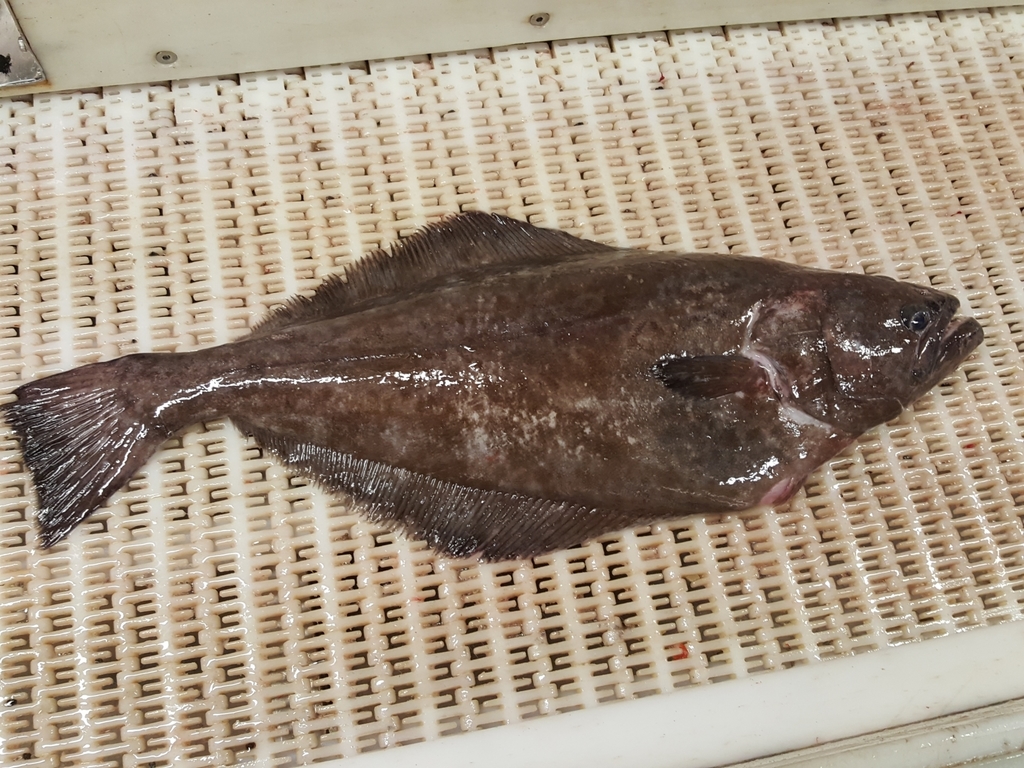
Greenland Halibut
Reinhardtius hippoglossoides
The Greenland halibut or Greenland turbot (Reinhardtius hippoglossoides) belongs to the family Pleuronectidae (the right-eye flounders), and is the only species of the genus Reinhardtius. It is a predatory fish that mostly ranges at depths between 500 and 1,000 m (1,600–3,300 ft), and is found in the cold northern Atlantic, northern Pacific, and Arctic Oceans.
It has a variety of other English vernacular names, including black halibut, blue halibut, lesser halibut, and Newfoundland turbot; while both Newfoundland turbot and Greenland turbot are in common use in North America (sometimes even without the location, just "turbot"), these names are typically not used in Europe, where they can cause easy confusion with the true turbot (Scophthalmus maximus).
From the article Greenland halibut on Wikipedia (CC BY-SA), quoted section by section
Description
Its morphology with the left eye positioned on the dorsal ridge of the forehead gives it an appearance of a cyclops when looking straight at it. The central position of the left eye in the Greenland halibut probably gives it a much wider range of peripheral vision in comparison to other flatfish, where the eye has migrated completely. Its body shape is elongated and compressed dorsoventrally and muscles on both sides are equally developed. Both sides are pigmented, but the left blind side is slightly lighter in color than the right side. The maximum length is about 120 cm (3.9 ft) and the maximum weight is about 45 kg (99 lb), the normal length is 80–100 cm (2.6–3.3 ft) and they usually weigh 11–25 kg (24–55 lb).
Range & habitat
The Greenland halibut is a cold-water species found at depths from near the surface to 2,200 m (7,200 ft), but mainly between 500 and 1,000 m (1,600 and 3,300 ft). It is mainly found in waters with temperatures from 1 to 4 °C (34–39 °F), but has also been observed at subzero temperatures down to −2.1 °C (28.2 °F). It has a circumpolar distribution in the Northern Hemisphere and is found in both the North Atlantic and the North Pacific Oceans. In the North Pacific, it ranges from the Sea of Japan near Honshu northwards to the Chukchi Sea, east through the Aleutian Islands, and south as far as northern Baja California in Mexico. In the North Atlantic, it occurs from the British Isles to northern Norway, Faroe Islands, Iceland, and eastern Greenland in the east and from Newfoundland to northwestern Greenland in the west.
Wikipedia: “Distribution and habitat”
Where it lives
Recorded sightings
—
geo-referenced records in GBIF, from museums, herbaria and field observers.
Drag the globe to turn it. Dots are where records exist, not a range map; darker means more records.
In the stacks
This page is assembled live from iNaturalist, GBIF, Wikipedia, the Source Library and the Internet Archive. It is not yet part of the hand-edited codex. iNaturalist taxon 229837.