- Animals
- ›Chordates
- ›Vertebrates
- ›Ray-finned Fishes
- ›Spiny-rayed fishes
- ›Silversides
- ›Atherinoidei
- ›Blue-eyes
- ›Pseudomugil
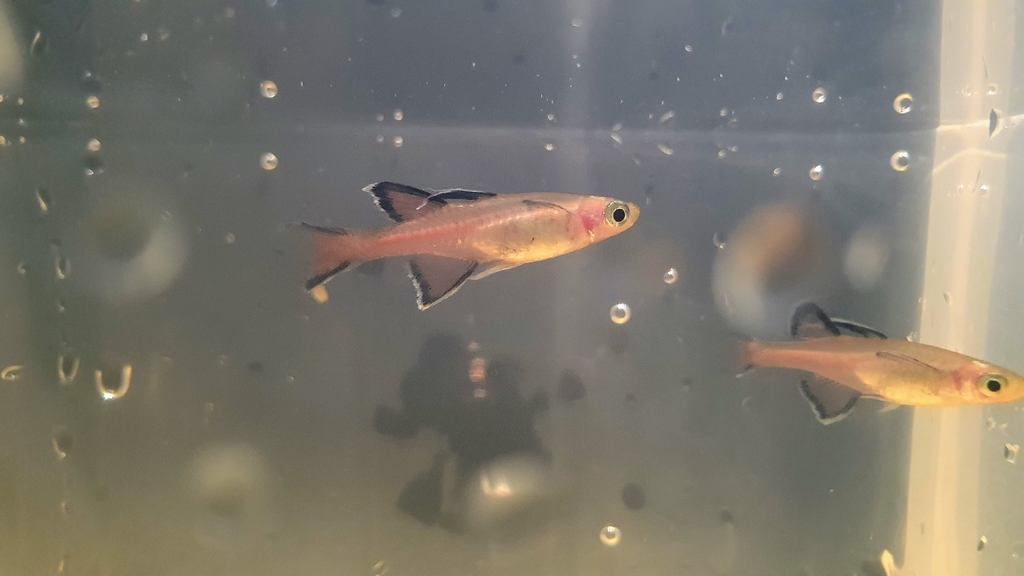
Honey Blue Eye
Pseudomugil mellis
The honey blue-eye (Pseudomugil mellis) is an endangered species of fish in the subfamily Pseudomugilinae. It is endemic to southeastern Queensland, Australia, where it is found in mildly acidic, often tannin-stained, ponds and streams in wallum habitat.
From the article Honey blue-eye on Wikipedia (CC BY-SA), quoted section by section
Description
The honey blue-eye is a small, pale honey coloured fish that can attain up to 2.5–3 cm (1–1+1⁄8 in) in length as an adult, with the largest recorded being a male of 3.8 cm (1+1⁄2 in). As the common name suggests, the honey blue-eye has blue eyes. It has blue cheeks and a single fine midlateral line running along its body from the tip of the pectoral fin backwards. The female has clear fins. Male honey blue-eyes have distinct black submarginal bands and white margins on their dorsal, anal and caudal fins. Honey blue-eyes form schools from about 25 to 70 individuals.
Range & habitat
The honey blue-eye is found in two disjunct areas of in wallum heathland in central and southeastern Queensland: in Dismal Swamp 70 km northeast of Rockhampton, and then from lakes and streams around Tin Can Bay south to Tibrogargan Creek 45 km north of Brisbane. It is found on Fraser Island but not other islands off the Queensland coast. Within its range its occurrence is patchy—it is found in 18 scattered localities. The water it is found in is generally slow-moving, mildly acidic (pH 4.4–6.8), and either clear or stained with tannin. Fish species it is commonly found with include ornate rainbowfish (Rhadinocentrus ornatus), crimson-spotted rainbowfish (Melanotaenia duboulayi), empire gudgeon (Hypseleotris compressa), firetailed gudgeon (Hypseleotris galii), and western carp gudgeon (Hypseleotris klunzingeri), and occasionally with the Oxleyan pygmy perch (Nannoperca oxleyana) or Pacific blue-eye.
Wikipedia: “Distribution and habitat”
What it does
Algae form the bulk of the diet of the honey blue-eye, with the remainder made up of insects and other aquatic invertebrates. The honey blue-eye generally forages at the surface of the water.
Wikipedia: “Feeding”
Where it lives
Recorded sightings
—
geo-referenced records in GBIF, from museums, herbaria and field observers.
Drag the globe to turn it. Dots are where records exist, not a range map; darker means more records.
In the stacks
Searching the stacks…
Every page naming Pseudomugil mellis in the Biodiversity Heritage Library →
This page is assembled live from iNaturalist, GBIF, Wikipedia, the Source Library and the Internet Archive. It is not yet part of the hand-edited codex. iNaturalist taxon 111060.