- Animals
- ›Chordates
- ›Vertebrates
- ›Cartilaginous Fishes
- ›Sharks and Rays
- ›Sharks
- ›Galean Sharks
- ›Carpet Sharks
- ›Nurse Sharks
- ›Nebrius
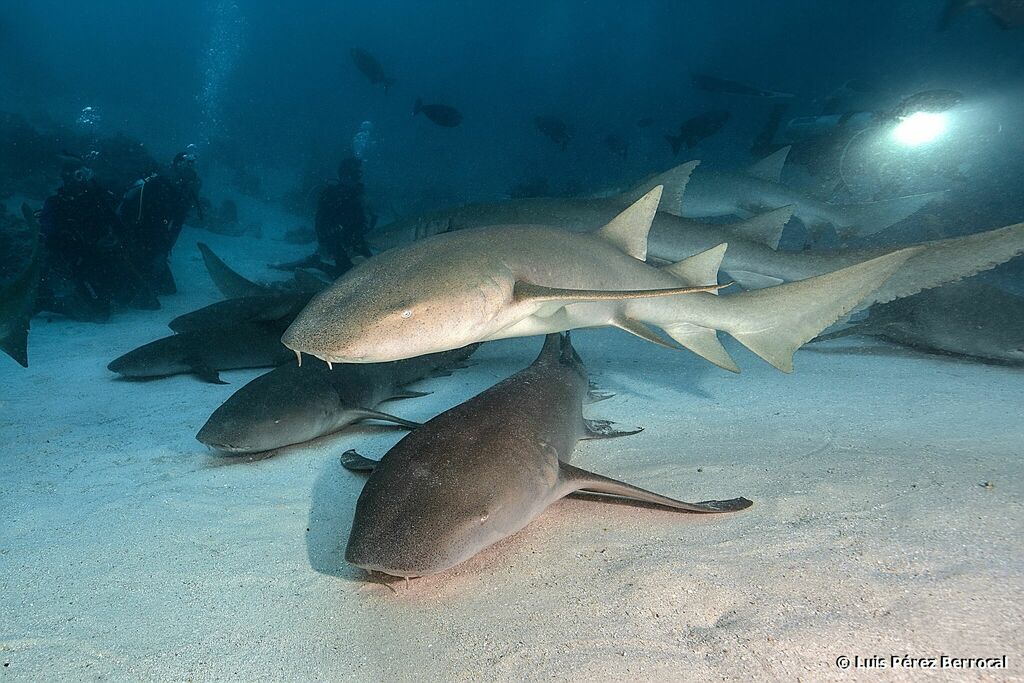
Tawny Nurse Shark
Nebrius ferrugineus
The tawny nurse shark (Nebrius ferrugineus) is a species of carpet shark in the family Ginglymostomatidae, and the only extant member of the genus Nebrius.
It is found widely along coastlines in the Indo-Pacific, preferring reefs, sandy flats, and seagrass beds from very shallow water to a depth of 70 m (230 ft). With a cylindrical body and a broad, flattened head, the tawny nurse shark is quite similar in appearance to the nurse shark (Ginglymostoma cirratum) of the Atlantic and East Pacific, from which it can be distinguished by its pointed-tipped dorsal fins and narrow, sickle-shaped pectoral fins. The maximum recorded length of the tawny nurse shark is 3.2 m (10 ft).
From the article Tawny nurse shark on Wikipedia (CC BY-SA), quoted section by section
Description
The tawny nurse shark grows to a maximum length of 3.2 m (10 ft). It has a robust, cylindrical body with a broadly rounded and flattened head. The eyes are small and face laterally, with prominent ridges over them and smaller spiracles behind. There are a pair of long, slender barbels in front of the nostrils. The mouth is small, with the lower lip divided into three lobes. There are 29–33 tooth rows in the upper jaw and 26–28 tooth rows in the lower jaw, arranged in an imbricate (overlapping) pattern with the outermost 2–4 functional rows separated from the rest by a narrow space. Each tooth resembles a fan, with a broad base rising to a small, sharp central point flanked by 3 or more smaller cusps on both sides. As the shark ages, the teeth become relatively taller and thicker. The fourth and fifth pairs of gill slits are placed much closer together than the others. The dorsal and pelvic fins are angular, with the first dorsal fin larger than the second. The pectoral fins are narrow, pointed, and falcate (sickle-shaped); their shape separates this species from the similar-looking nurse shark. The origin of the first dorsal fin is about even with the origin of the pelvic fins, while the origin of the anal fin is even with or somewhat behind the origin of the second dorsal fin. …
Range & habitat
The tawny nurse shark is widely distributed in the Indo-Pacific region. In the Indian Ocean, it is found from KwaZulu-Natal, South Africa northward to the Red Sea, Persian Gulf and India, including Madagascar, Mauritius, the Chagos Archipelago, the Seychelles, and the Maldives. In the western Pacific, it occurs from southern Japan and the coast of China to the Philippines, Southeast Asia, and Indonesia, to as far south as the northern coast of Australia. In the central Pacific, it has been reported from off New Caledonia, Samoa, Palau, the Marshall Islands, and Tahiti. Fossil teeth belonging to this species have been found in the Pirabas Formation of northern Brazil, dating back to the Lower Miocene (23–16 Ma). The presence of these fossils indicates that the range of the tawny nurse shark once extended to the tropical Atlantic Ocean, prior to the formation of the Isthmus of Panama. An inshore species, the tawny nurse shark inhabits continental and insular shelves over sandy flats or beds of seagrass, as well as along the outer edges of coral or rocky reefs. This shark may be found from the surf zone, often in water barely deep enough to cover its body, to a maximum depth of 70 m (230 ft) on coral reefs; it is most common at a depth of 5–30 m (16–98 ft). …
Wikipedia: “Distribution and habitat”
What it does
With a more streamlined form than other nurse sharks, the tawny nurse shark is believed to be a less benthic, more active swimmer. The characteristics of its body, head, fins, and teeth are comparable to other active reef sharks sharing its range, such as the sicklefin lemon shark (Negaprion acutidens). Tawny nurse sharks are primarily nocturnal, though they are said to be active at all hours off Madagascar, and in captivity they will become diurnally active if presented with food. During the day, groups of two dozen or more sharks can be found resting inside caves and under ledges, often stacked atop one another. Individual sharks have small home ranges that they consistently return to each day. The tawny nurse shark has few natural predators; attacks on this species have been reported from bull sharks (Carcharhinus leucas) and great hammerheads (Sphyrna mokarran), while the related nurse shark has been known to fall prey to tiger sharks (Galeocerdo cuvier) and lemon sharks (Negaprion brevirostris). Known parasites of this species include five species of tapeworms in the genus Pedibothrium, which infest the shark's spiral intestine.
Feeding. The tawny nurse shark may be one of the few fishes specializing in preying on octopus. Other known food items include corals, sea urchins, crustaceans (e.g. crabs and lobsters), squid, small fishes (e.g. …
Wikipedia: “Biology and ecology”
Where it lives
Recorded sightings
—
geo-referenced records in GBIF, from museums, herbaria and field observers.
Drag the globe to turn it. Dots are where records exist, not a range map; darker means more records.
In the stacks
Searching the stacks…
Every page naming Nebrius ferrugineus in the Biodiversity Heritage Library →
This page is assembled live from iNaturalist, GBIF, Wikipedia, the Source Library and the Internet Archive. It is not yet part of the hand-edited codex. iNaturalist taxon 49962.