- Animals
- ›Chordates
- ›Vertebrates
- ›Cartilaginous Fishes
- ›Sharks and Rays
- ›Sharks
- ›Galean Sharks
- ›Carpet Sharks
- ›Wobbegongs
- ›Sutorectus
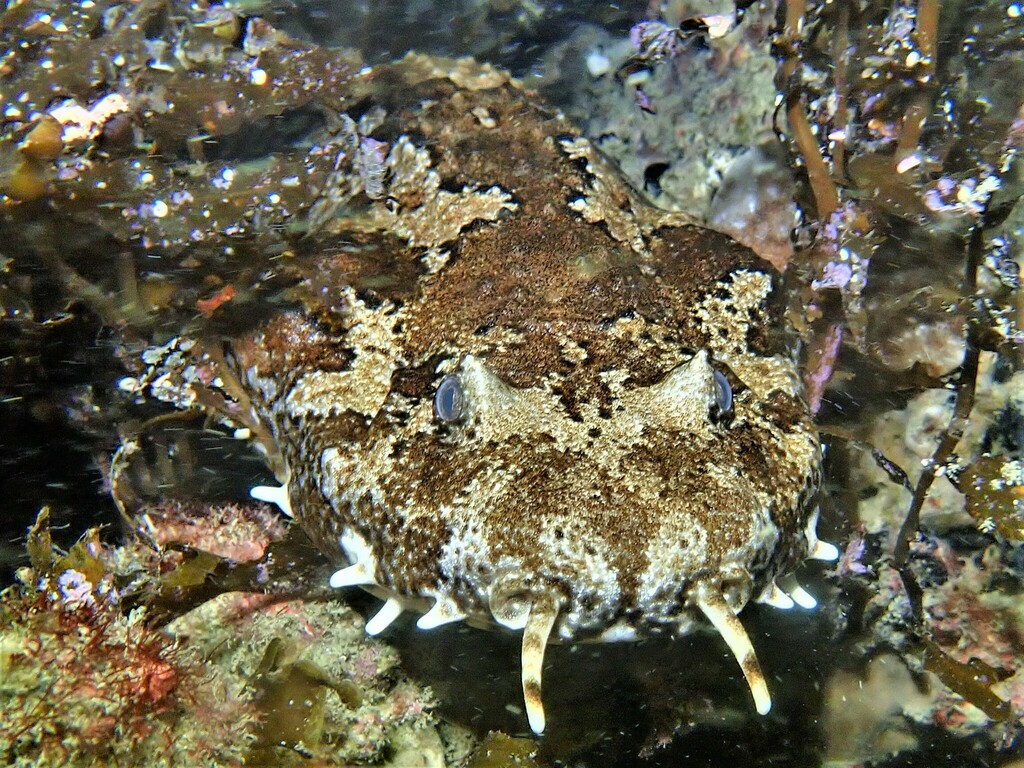
Cobbler Wobbegong
Sutorectus tentaculatus
The cobbler wobbegong (Sutorectus tentaculatus) is a carpet shark in the family Orectolobidae, the only member of the genus Sutorectus. It is found in the subtropical eastern Indian Ocean around Western Australia between latitudes 26° S and 35° S. It is frequently found in rocky and coral reef areas. Cobbler wobbegongs reach a length of 92 cm (36 in). It has unbranched dermal lobes on the head, rows of warty tubercles along the back and black spots on the body and fins.
From the article Cobbler wobbegong on Wikipedia (CC BY-SA), quoted section by section
Description
Cobbler wobbegongs are a small species of carpet shark (given the name because of the carpet-like patterns on the skin), Orectolobiformes, that are capable of growing to a size of 92 cm (36 in) in total length. The size at birth of these sharks is approximately 22 cm (9 in) total length, with males maturing at a length of about 65 cm (26 in) total. Based upon morphology, Sutorectus is placed ancestral to Eucrossorhinus, also known as the tasseled wobbegong. Sutorectus and/or Eucrossorhinus are clustered together with Orectolobus in all of the six equally parsimonious trees. Orectolobus is also paraphyletic with respect to Eucrossorhinus and Sutorectus according to molecular data, meaning that they share a common ancestor. The type of genus of the family, Orectolobus, could only be considered monophyletic with the inclusion of S. tentaculatus and E. dasypogon. In most orectolobiforms, the pectoral radials are primarily composed of three components—the cleithrum, coracoid, and scapula. Typically, the pectoral radials are short, with long ceratotrichia distally, aplesodic style. Wobbegongs are dorso-ventrally flattened, demersal sharks that can be distinguished from other elasmobranch families by the presence of warty dermal lobes or tubercles on the lateral sides of the head, as well as the dorsal surface of the shark. …
Wikipedia: “Morphology and ancestral relations”
Range & habitat
The Cobbler wobbegong is typically found in rocky reefs and weedy areas at a depth of about 35 metres (110 ft). They are endemic to the temperate and tropical continental waters of the western Pacific and eastern Indian oceans but are most diverse in Australian waters. Similar to other wobbegongs, the Cobbler wobbegong does not venture far from its typical parameters. However, some have shown to have short-term fidelity to a site, but are not permanent residents, as they move out of an area over time and are replaced by other temporary residents.
Wikipedia: “Habitat”
What it does
The mouth morphology contribute to how the species eats and the food that they consume. Cobbler wobbegongs have two rows of enlarged fang-like teeth in the upper jaw and three rows in the lower jaw. The mouth is positioned in front of the eyes, giving them an advantage when attacking prey. Wobbegongs are ambush predators, meaning that they hide under the sand or in rocks and wait for their prey to pass by before they attack. The camouflage of their skin significantly impacts their success in this hunting style. The positioning and shape of their teeth, in addition to their heavy jaws, are fit to consume small benthic fish and invertebrates (crabs, lobsters and abalone). The sharp, jagged edges of the teeth allow these sharks to pierce through the thick scales of fishes and hard exteriors of invertebrates.
Wikipedia: “Diet and mouth structure”
Where it lives
Recorded sightings
—
geo-referenced records in GBIF, from museums, herbaria and field observers.
Drag the globe to turn it. Dots are where records exist, not a range map; darker means more records.
In the stacks
Searching the stacks…
Every page naming Sutorectus tentaculatus in the Biodiversity Heritage Library →
This page is assembled live from iNaturalist, GBIF, Wikipedia, the Source Library and the Internet Archive. It is not yet part of the hand-edited codex. iNaturalist taxon 113487.