- Animals
- ›Chordates
- ›Vertebrates
- ›Cartilaginous Fishes
- ›Sharks and Rays
- ›Sharks
- ›Squalean Sharks
- ›Angel Sharks
- ›Angel Sharks
- ›Squatina
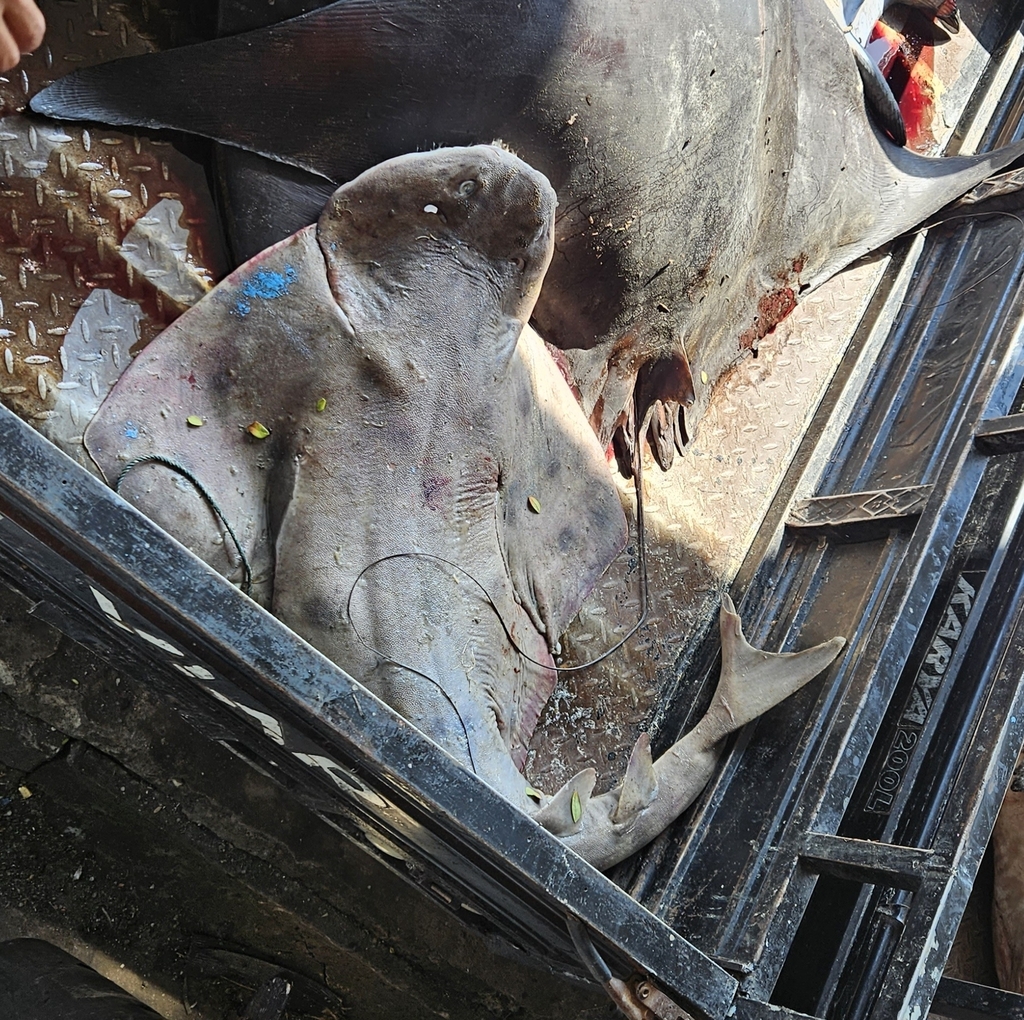
Indonesian Angelshark
Squatina legnota
The Indonesian angelshark (Squatina legnota) is a rare species of angelshark, family Squatinidae, known only from a few specimens collected from fish landing sites in southern Indonesia. It is thought to inhabit the deep waters of the continental slope. Reaching at least 1.34 m (4.4 ft) long, this species has a flattened, ray-like shape and a well-developed tail and caudal fin. It is characterized by the absences of fringes on its nasal barbels and thorns down the midline of its back, as well as by its relatively plain grayish-brown dorsal coloration with dark saddles beneath the dorsal fin bases and a black leading margin on the underside of the pectoral fins. The International Union for Conservation of Nature (IUCN) has classified it as Critically Endangered due to significant fishing pressure.
From the article Indonesian angelshark on Wikipedia (CC BY-SA), quoted section by section
Description
The largest known Indonesian angelshark specimen measured 1.34 m (4.4 ft) long. As in all angel sharks, it has a flattened body with greatly enlarged pectoral and pelvic fins. The broad, flattened head has a very short, blunt snout and small, widely spaced eyes placed somewhat on top. The eyes are followed by much larger, crescent-shaped spiracles. The nostrils are large and preceded by well-developed flaps of skin that reach the mouth; each flap bears two prominent barbels, which are smooth rather than fringed. The capacious, gently curved mouth is placed at the front of the head. There are long, deep furrows extending from the mouth corners onto and away from the lower jaw. The teeth number around 18 rows in both jaws; each is small and dagger-like, with a single sharp cusp. The five pairs of gill slits are long and placed on the sides of the head. The pectoral fins are angular, with the anterior lobes of their bases free from the head, and their outer tips forming an angle of slightly under 120°. The tips of the pelvic fins are rounded; males have thick claspers. The two dorsal fins are close in shape and size, with rounded to angular apexes and slightly convex trailing margins. The first dorsal originates over the pelvic fins rear tips, and the second dorsal is placed close to the first. There is no anal fin. …
Range & habitat
The known specimens of the Indonesian angelshark have come from fish landing sites at Palabuhanratu in West Java, Cilacap in Central Java, Kedonganan in Bali, and Tanjung Luar in Lombok. Therefore, specific information on its preferred natural habitat is unavailable, though it is probably bottom-dwelling in the deeper waters of the continental slope.
Wikipedia: “Distribution and habitat”
What it does
Little is known of the Indonesian angelshark's natural history. It is presumably aplacental viviparous like other members of its family. The smallest male specimen, an adult, measured 1.25 m (4.1 ft) long.
Wikipedia: “Biology and ecology”
Where it lives
Recorded sightings
—
geo-referenced records in GBIF, from museums, herbaria and field observers.
Drag the globe to turn it. Dots are where records exist, not a range map; darker means more records.
In the stacks
Searching the stacks…
Every page naming Squatina legnota in the Biodiversity Heritage Library →
This page is assembled live from iNaturalist, GBIF, Wikipedia, the Source Library and the Internet Archive. It is not yet part of the hand-edited codex. iNaturalist taxon 113057.