- Animals
- ›Chordates
- ›Vertebrates
- ›Cartilaginous Fishes
- ›Sharks and Rays
- ›Sharks
- ›Galean Sharks
- ›Ground Sharks
- ›Requiem Sharks
- ›Carcharhinus
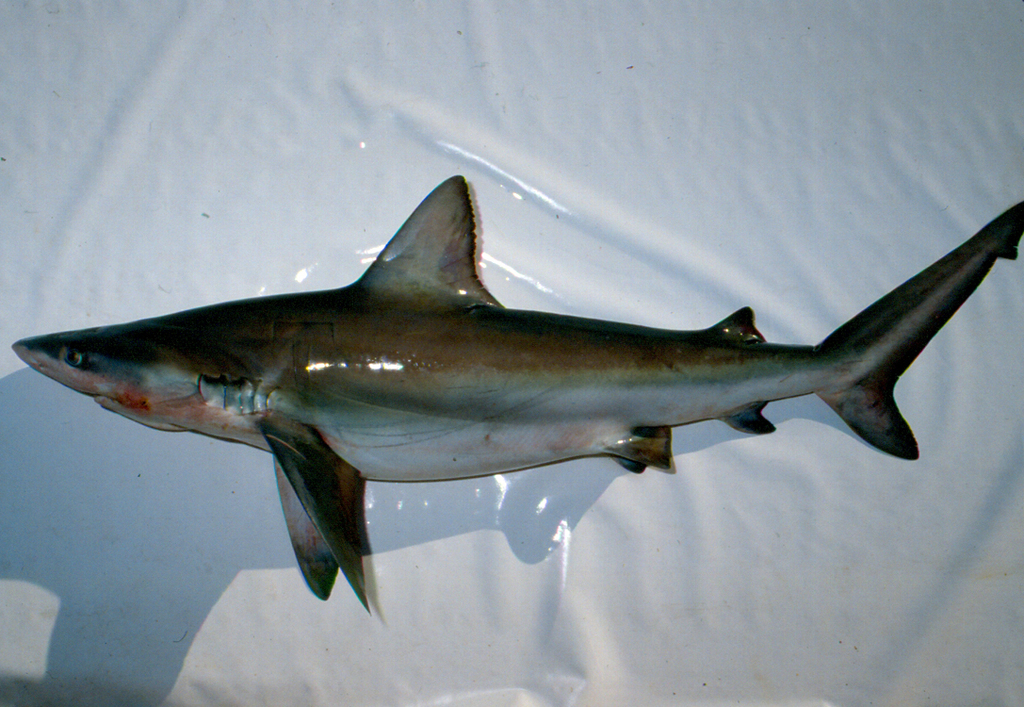
Bignose Shark
Carcharhinus altimus
The bignose shark (Carcharhinus altimus) is a species of requiem shark, in the family Carcharhinidae. Distributed worldwide in tropical and subtropical waters, this migratory shark frequents deep waters around the edges of the continental shelf. It is typically found at depths of 90–430 m (300–1,410 ft), though at night it may move towards the surface or into shallower water. The bignose shark is plain-colored and grows to at least 2.7–2.8 m (8.9–9.2 ft) in length. It has a long, broad snout with prominent nasal skin flaps, and tall, triangular upper teeth. Its pectoral fins are long and almost straight, and there is a ridge on its back between the two dorsal fins.
Hunting close to the sea floor, the bignose shark feeds on bony and cartilaginous fishes, and cephalopods. It is viviparous, meaning the embryos are sustained to term via a placental connection. Females bear litters of three to 15 pups after a 10-month gestation period. Despite its size, this shark lives too deep to pose much danger to humans. It is caught incidentally by commercial fisheries in many parts of its range; the meat, fins, skin, liver oil, and offal may be used. The various fishing pressures within its range are cause for concern given its slow reproductive rate, and it may have already declined in the northwestern Atlantic and elsewhere.
From the article Bignose shark on Wikipedia (CC BY-SA), quoted section by section
Description
Rather heavily built, the bignose shark has a long, broad, and blunt snout with the nostrils preceded by well-developed, triangular flaps of skin. The moderately large, circular eyes are equipped with nictitating membranes (protective third eyelids). The mouth is broadly curved and lacks obvious furrows at the corners. The upper teeth number 14–16 rows on either side and have tall, broad, triangular cusps with serrated edges; they are erect at the jaw center and become increasingly oblique towards the sides. The lower teeth number 14–15 rows on either side and have narrow, erect cusps with extremely fine serrations. The five pairs of gill slits are moderately long. The long and wide pectoral fins have pointed tips and nearly straight margins. The first dorsal fin originates roughly over the rear of the pectoral fin bases; it is fairly tall and falcate (sickle-shaped), with a blunt apex and a long free rear tip. The second dorsal fin is relatively large with a short free rear tip, and is positioned slightly ahead of the anal fin. A high midline ridge is present between the dorsal fins. The caudal peduncle has a crescent-shaped notch at the origin of the upper caudal fin margin. The caudal fin has a large lower lobe and a strong ventral notch near the tip of the upper lobe. …
Range & habitat
According to patchy records from around the world, the bignose shark appears to have a circumglobal distribution in tropical and subtropical waters. In the Atlantic Ocean, it occurs from Delaware Bay to Brazil, in the Mediterranean Sea, and off West Africa. In the Indian Ocean, it is known in South Africa and Madagascar, the Red Sea, India, and the Maldives. In the Pacific Ocean, it has been recorded from China to Australia, around Hawaii, and from the Gulf of California to Ecuador. It is reportedly common off Florida, the Bahamas, and the West Indies, and rare off Brazil. It is now common in the south-western Mediterranean Sea. The bignose shark is found near the edge of the continental shelf and over the upper continental slope, generally swimming close to the sea floor at depths of 90–430 m (300–1,410 ft). Young sharks may venture into water as shallow as 25 m (82 ft). Night-time captures of this species from close to the surface suggest it may perform a diel vertical migration, moving from deep water upwards or toward the coast at night. In the northwestern Atlantic, the bignose shark conducts a poorly documented seasonal migration, spending summer off the US East Coast and winter in the Gulf of Mexico and the Caribbean Sea. Individual sharks have been recorded traveling distances between 1,600 and 3,200 km (1,000 and 2,000 mi).
Wikipedia: “Distribution and habitat”
What it does
The bignose shark feeds mainly on bottom-dwelling bony fishes (including lizardfishes, croakers, flatfishes, and batfishes), cartilaginous fishes (including Squalus dogfishes, Holohalaelurus catsharks, Dasyatis stingrays, and chimaeras), and cephalopods. In turn, juveniles may potentially fall prey to larger sharks. Like other requiem sharks, this species is viviparous: when the developing embryos exhaust their supply of yolk, the depleted yolk sac is converted into a placental connection through which the mother delivers nourishment. Females bear litters of three to 15 pups, with seven being typical, following a gestation period of approximately 10 months. A single litter may be sired by two or more males. Birthing has been reported to occur in August and September in the Mediterranean, and in September and October off Madagascar. The newborns measure 70–90 cm (28–35 in) long. Males and females mature sexually at around 2.2 and 2.3 m (7.2 and 7.5 ft) long, respectively. The average age of reproductively active individuals is 21 years.
Wikipedia: “Biology and ecology”
Where it lives
Recorded sightings
—
geo-referenced records in GBIF, from museums, herbaria and field observers.
Drag the globe to turn it. Dots are where records exist, not a range map; darker means more records.
In the stacks
Searching the stacks…
Every page naming Carcharhinus altimus in the Biodiversity Heritage Library →
This page is assembled live from iNaturalist, GBIF, Wikipedia, the Source Library and the Internet Archive. It is not yet part of the hand-edited codex. iNaturalist taxon 96746.