- Animals
- ›Chordates
- ›Vertebrates
- ›Cartilaginous Fishes
- ›Sharks and Rays
- ›Sharks
- ›Galean Sharks
- ›Ground Sharks
- ›Requiem Sharks
- ›Carcharhinus
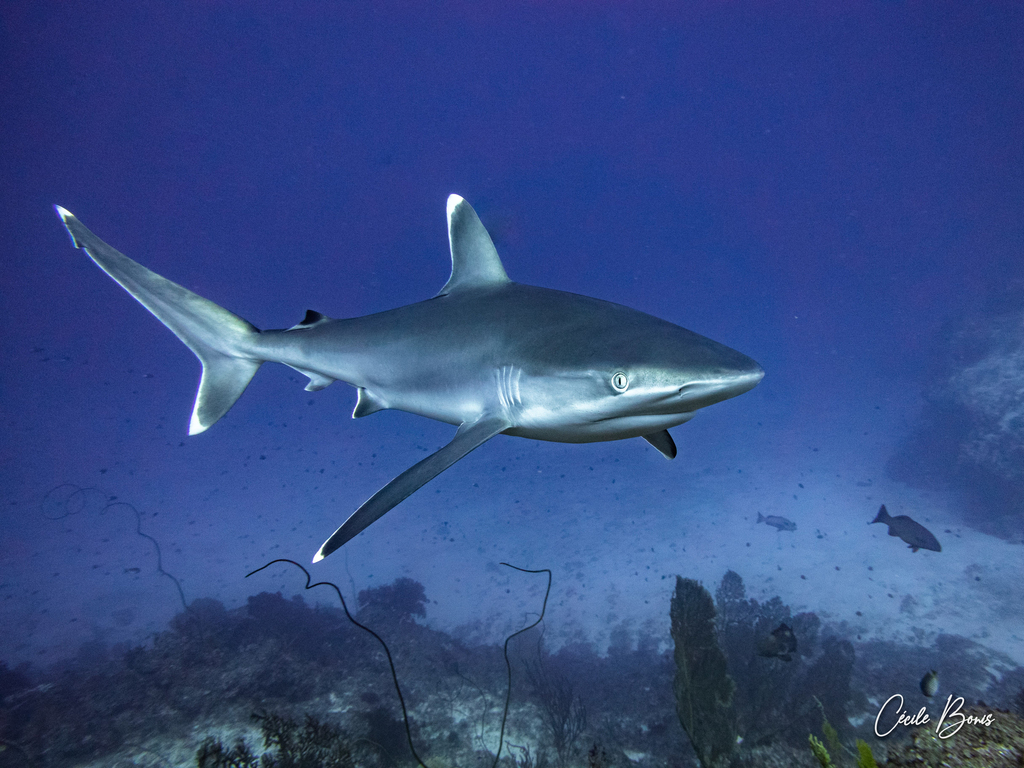
Silvertip Shark
Carcharhinus albimarginatus
The silvertip shark (Carcharhinus albimarginatus) is a large species of requiem shark in the family carcharhinidae, with a fragmented distribution throughout the tropical Indian and Pacific Oceans. It is often encountered around offshore islands and coral reefs, and has been known to dive to a depth of 800 m (2,600 ft). The silvertip shark resembles a larger and bulkier grey reef shark (C. amblyrhynchos), but can be easily identified by the prominent white margins on its fins. It attains a maximum length of 3 m (10 ft).
It feeds on a wide variety of bony fishes, as well as eagle rays, smaller sharks, and cephalopods. This species dominates other requiem sharks of equal size when competing for food, and larger individuals are often heavily scarred from conflicts with others of its species. As with other members of its family, the silvertip shark is viviparous, with females giving birth to one to 11 pups in the summer. Silvertip sharks are regarded as potentially dangerous to humans, as they often approach divers quite closely. This slow-reproducing species is taken by commercial fisheries for its meat, fins, skin, cartilage, and jaws and teeth, which has apparently led to local population declines or extirpations.
From the article Silvertip shark on Wikipedia (CC BY-SA), quoted section by section
Description
The silvertip shark is a robust and streamlined species with a moderately long, broad snout and large, round eyes. The five pairs of gill slits are short. It has 12–14 tooth rows on each side of both jaws, with one or two small teeth at the symphysis (middle of the jaws). The upper teeth are broad with oblique triangular cusps and coarse serrations near the base; the lower teeth have erect cusps with fine serrations. The first dorsal fin is large and triangular, originating above or slightly forward of the free pectoral fin tips. A ridge occurs between the first and second dorsal fins. The pectoral fins are proportionately longer than in most requiem sharks and falcate (sickle-like) in shape, with pointed tips. The coloration is blue-gray above with a bronze sheen, and white below. A subtle white band runs along the sides, with distinctive white tips and borders on all fins. Silvertip sharks can grow up to 3 m (9.8 ft) long, but typically measure 2.0–2.5 m (6.6–8.2 ft) in length. The maximum reported weight is 162.2 kg (358 lb). Females are larger than males.
Range & habitat
The silvertip shark is widely but not continuously distributed in the tropical Indian and Pacific Oceans. In the western Indian Ocean, this species occurs from the Red Sea to South Africa, including Madagascar, the Seychelles, the Aldabra Group, Mauritius and the Chagos Archipelago. In the western Pacific, it is known from off southern Japan to northern Australia, including Taiwan, the Philippines, Indonesia, Papua New Guinea, New Caledonia, Guam, Palau, the Solomon Islands, the Marshall Islands, the Phoenix Islands and Tahiti. In the eastern Pacific, it occurs from southern Baja California to Colombia, including the Cocos, Galapagos, and Revillagigedo Islands. Its presence in the Gulf of Mexico and the Caribbean Sea is unconfirmed. Silvertip sharks are found over continental and insular shelves at a depth of 30–800 m (98–2,625 ft), occupying all levels of the water column. They are most common around isolated islands, coral banks, and reef drop-offs. Juveniles frequent coastal shallows or lagoons, while adults occur in deeper water, with little overlap between the two age groups.
Wikipedia: “Distribution and habitat”
What it does
Though silvertip sharks are quite mobile, they exhibit fidelity to certain areas, with reports of territorial behavior. They are usually encountered alone or in pairs. Small groups of adult females have been seen in deep water. Individual silvertip sharks behave very aggressively towards one another, and many are heavily scarred. They are also reported to dominate Galapagos sharks (C. galapagensis) and blacktip sharks (C. limbatus) of equal size when competing for food. This shark sometimes forms mixed-species aggregations with grey reef sharks. Rainbow runners (Elagatis bipinnulata) have been observed rubbing against silvertip sharks, using the sharks' rough skin to scrape off parasites. They sometimes follow marine mammals such as bottlenose dolphins (Tursiops sp.) in open water, and are themselves followed by pilot fish (Naucrates ductor). Like the grey reef shark, the silvertip shark sometimes perform a stereotypical threat display if pursued by divers, warning that it is prepared to attack. The display begins with the shark accelerating away to a distance of 15 m (49 ft), before turning and charging towards the perceived threat. At a distance of two body lengths, the shark brakes, turns broadside, drops its pectoral fins, gapes its jaws, lowers the posterior two-thirds of its body, and "shivers". …
Wikipedia: “Biology and ecology”
Where it lives
Recorded sightings
—
geo-referenced records in GBIF, from museums, herbaria and field observers.
Drag the globe to turn it. Dots are where records exist, not a range map; darker means more records.
In the stacks
Searching the stacks…
Every page naming Carcharhinus albimarginatus in the Biodiversity Heritage Library →
This page is assembled live from iNaturalist, GBIF, Wikipedia, the Source Library and the Internet Archive. It is not yet part of the hand-edited codex. iNaturalist taxon 52315.