- Animals
- ›Chordates
- ›Vertebrates
- ›Cartilaginous Fishes
- ›Sharks and Rays
- ›Sharks
- ›Galean Sharks
- ›Ground Sharks
- ›Requiem Sharks
- ›Carcharhinus
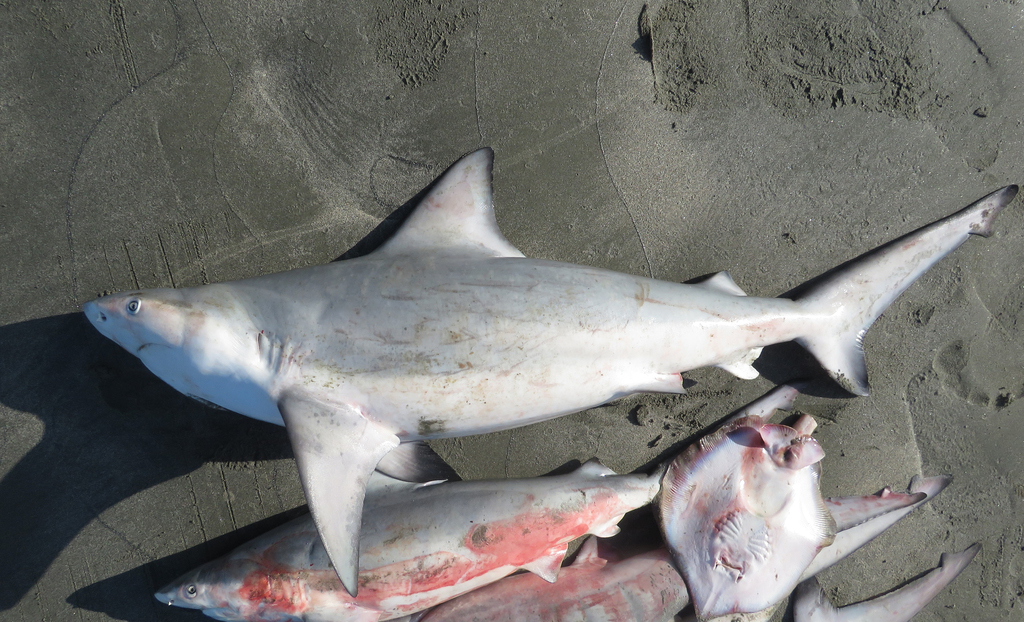
Pigeye Shark
Carcharhinus amboinensis
The pigeye shark or Java shark (Carcharhinus amboinensis) is an uncommon species of requiem shark, in the family Carcharhinidae, found in the warm coastal waters of the eastern Atlantic and western Indo-Pacific. It prefers shallow, murky environments with soft bottoms, and tends to roam within a fairly localized area. With its bulky grey body, small eyes, and short, blunt snout, the pigeye shark looks almost identical to (and is often confused with) the better-known bull shark (C. leucas). The two species differ in vertebral count, the relative sizes of the dorsal fins, and other subtle traits. This shark typically reaches lengths of 1.9–2.5 m (6.2–8.2 ft).
The pigeye shark is an apex predator that mostly hunts low in the water column. It has a varied diet, consisting mainly of bony and cartilaginous fishes and also including crustaceans, molluscs, sea snakes, and cetaceans. This species gives birth to live young, with the developing embryos sustained to term via a placental connection to their mother. Litters of three to thirteen pups are born after a gestation period of nine or twelve months. Young sharks spend their first few years of life in sheltered inshore habitats such as bays, where their movements follow tidal and seasonal patterns. The pigeye shark's size and dentition make it potentially dangerous, though it has not been known to attack humans. The shark is infrequently caught in shark nets protecting beaches and by fisheries, which use it for meat and fins. The IUCN presently assesses this species as vulnerable.
From the article Pigeye shark on Wikipedia (CC BY-SA), quoted section by section
Description
The pigeye shark is a very robust-bodied species with a short, broad, and rounded snout. The small and circular eyes are equipped with nictitating membranes. The anterior rims of the nostrils bear medium-sized flaps of skin. The mouth forms a wide arch and has barely noticeable furrows at the corners. There are 11–13 (usually 12) upper and 10–12 (usually 11) lower tooth rows on each side; in addition, there are single rows of tiny teeth at the upper and lower symphyses (jaw midpoints). The teeth are broad and triangular with serrated edges; those in the lower jaw are slightly narrower, more upright, and more finely serrated than those in the upper. The five pairs of gill slits are of moderate length. The first dorsal fin is large and triangular, with a pointed apex and a concave trailing margin; it originates roughly over the posterior insertions of the pectoral fins. The second dorsal fin is less than a third as high as the first, and originates ahead of the anal fin. There is no midline ridge between the dorsal fins. The long pectoral fins are broad and slightly falcate (sickle-shaped), becoming narrow and pointed at the tips. The anal fin has a sharply notched trailing margin. The caudal peduncle has a deep notch on its upper surface at the caudal fin origin. …
Range & habitat
Though widely distributed in the tropical and subtropical marine waters of Eurasia, Africa, and Oceania, the pigeye shark does not appear to be common anywhere. Existing records are patchy, and the full extent of its range may be obscured by confusion with the bull shark. In the eastern Atlantic, it is found off Cape Verde and Senegal, and from Nigeria to Namibia; there is a single Mediterranean record from off Crotone, Italy. It occurs all along the continental periphery of the Indian Ocean, from eastern South Africa to the Arabian Peninsula (including Madagascar, the Seychelles, and Mauritius), to Southeast Asia and northern Australia. Its range extends into the Pacific, northward to the Philippines and southern China, and eastward to New Guinea and some Micronesian islands. Tagging and genetic data indicate that pigeye sharks, particularly juveniles, are not strongly migratory and tend to remain in a local area. The longest recorded distance covered by an adult is 1,080 km (670 mi). The pigeye shark inhabits coastal waters down to a depth of 150 m (490 ft), favouring environments with fine sediment and murky water. It sometimes enters estuaries, but unlike the bull shark, it does not ascend rivers and avoids brackish water. The movements and habitat usage of juvenile pigeye sharks have been extensively studied in Cleveland Bay in northeastern Queensland. …
Wikipedia: “Distribution and habitat”
What it does
The pigeye shark is a largely solitary animal, though occasionally several individuals may be found at the same location. In the Mozambique Channel, it outnumbers the bull shark on the east side while the opposite is true on the west side, suggesting there may be competitive exclusion between these similar species. Parasites documented from the pigeye shark include the myxosporean Kudoa carcharhini, the copepods Pandarus smithii and P. cranchii, and the tapeworms Callitetrarhynchus gracilis, Cathetocephalus sp., Floriceps minacanthus, Heteronybelinia australis, Otobothrium australe, O. crenacolle, and Protogrillotia sp. Young pigeye sharks are potentially vulnerable to predation by larger sharks. The natural mortality for juveniles in Cleveland Bay has been measured at no more than 5% per year; this rate is comparable to that in juvenile bull sharks, and is much lower than in juvenile blacktip sharks (C. limbatus) or lemon sharks (Negaprion brevirostris).
Feeding. Though the pigeye shark will take prey from anywhere in the water column, it tends to hunt close to the sea floor. An apex predator, it feeds mainly on teleost fishes such as croakers, flatfishes, and cutlassfishes, and to a lesser extent on cartilaginous fishes, cephalopods, and decapod crustaceans. It has also been recorded eating gastropods, sea snakes, dolphins, and whale carrion. …
Wikipedia: “Biology and ecology”
Where it lives
Recorded sightings
—
geo-referenced records in GBIF, from museums, herbaria and field observers.
Drag the globe to turn it. Dots are where records exist, not a range map; darker means more records.
In the stacks
Searching the stacks…
Every page naming Carcharhinus amboinensis in the Biodiversity Heritage Library →
This page is assembled live from iNaturalist, GBIF, Wikipedia, the Source Library and the Internet Archive. It is not yet part of the hand-edited codex. iNaturalist taxon 96748.