- Animals
- ›Chordates
- ›Vertebrates
- ›Cartilaginous Fishes
- ›Sharks and Rays
- ›Sharks
- ›Galean Sharks
- ›Ground Sharks
- ›Requiem Sharks
- ›Carcharhinus
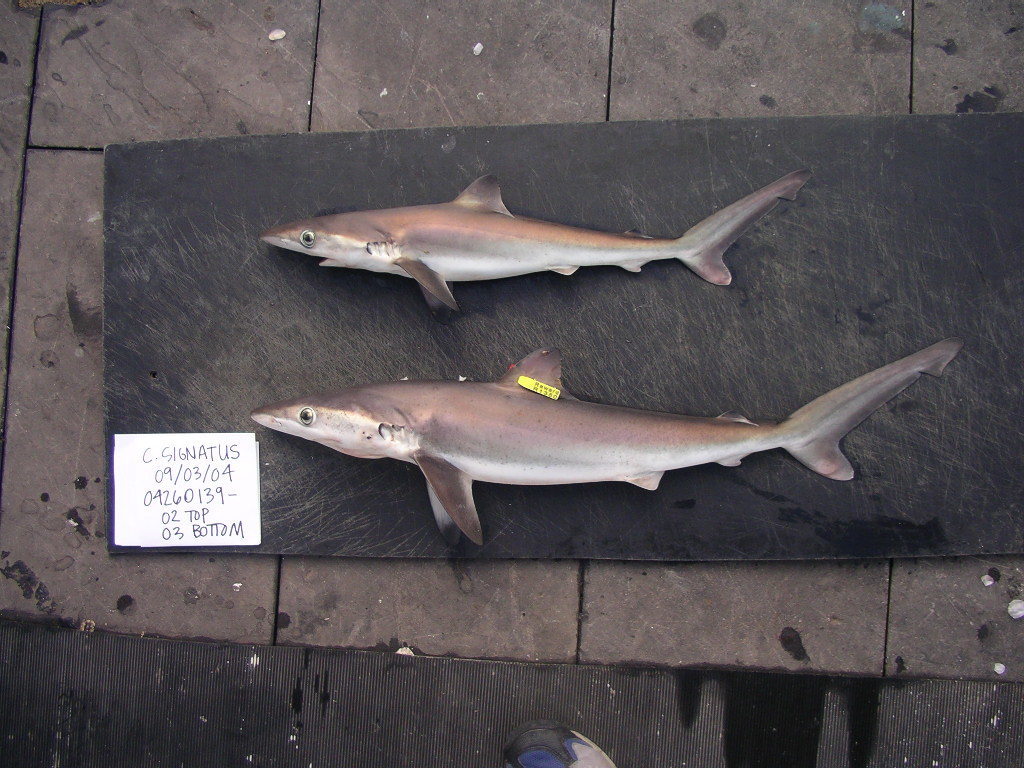
Night Shark
Carcharhinus signatus
The night shark (Carcharhinus signatus) is a species of requiem shark, in the family Carcharhinidae, found in the temperate and tropical waters of the Atlantic Ocean. An inhabitant of the outer continental shelf and upper continental slope, this shark most commonly occurs at depths of 50–600 m (160–1,970 ft) and conducts a diel vertical migration, spending the day in deeper water and moving into shallower waters at night. Off northeastern Brazil, large numbers congregate around seamounts of varying depths. A slender, streamlined species, the night shark typically reaches a length of 2 m (6.6 ft). It can be identified by its long, pointed snout and large, green eyes (when alive), and is dark grayish blue or brown above and white below.
Night sharks are quick, nocturnally active, schooling predators that feed mainly on small bony fishes and squid. Reproduction is viviparous as with the other members of its family; females mate during the summer and give birth to litters of usually 12–18 pups after a gestation period of a year. This deepwater species is not known to pose a danger to humans. It is caught incidentally by commercial tuna and swordfish longline fisheries in the western Atlantic, and also by a targeted longline fishery operating off northeastern Brazil. The night shark is highly valued for its fins, and additionally as a source of meat, liver oil, and fishmeal. However, most sharks caught off northeastern Brazil have been found to contain unsafe concentrations of mercury.
From the article Night shark on Wikipedia (CC BY-SA), quoted section by section
Description
The night shark has a slender build with an elongated, pointed snout. The nares are flanked by moderately developed flaps of skin. The eyes are large, circular, and green in life, with irregularly shaped pupils and a nictitating membrane (protective third eyelid). The mouth lacks conspicuous furrows at the corners and usually bears 15 tooth rows on either side of both jaws, plusone to two upper and one lower symphysial (jaw midline) tooth rows. Each upper tooth has a smooth to serrated edge, a narrow cusp becoming more oblique towards the corner of the mouth, and two to five coarse serrations at the base of the trailing margin. The number and size of serrations on the leading margin of the tooth cusp increase relative to those on the trailing margin as the animal grows older. The lower teeth are upright and smooth-edged. The five pairs of gill slits are rather short. The pectoral fins are less than a fifth as long as the total body length and taper towards a somewhat rounded tip. The first dorsal fin is relatively small, triangular, and pointed, originating over the free rear tips of the pectoral fins. The second dorsal fin is much smaller than the first and originates over or slightly ahead of the anal fin. A ridge runs between the dorsal fins. The dermal denticles are not tightly packed and overlap each other minimally. …
Range & habitat
The distribution of the night shark extends along the outer continental shelves and upper continental slopes of the Atlantic Ocean, from the U.S. state of Massachusetts to Argentina in the west, including the Gulf of Mexico and the Caribbean Sea, and from Senegal to northern Namibia in the east. In United States waters, it is relatively common off North Carolina and Florida (particularly the Florida Straits) and rarer elsewhere. There are questionable reports of this species off the Pacific coast of Panama. The night shark is a deepwater species that has been reported from as far down as 2 km (1.2 mi), though it occasionally ventures to within 26 m (85 ft) of the surface. Off the southeastern United States, it is usually caught at a depth range of 50–600 m (160–1,970 ft). Off northeastern Brazil, the night shark is most commonly found near the summits of seamounts ranging from 38 to 370 m (125 to 1,214 ft) deep. Off West Africa, it occurs at depths of 90–285 m (295–935 ft), where the temperature is 11–16 °C (52–61 °F), the salinity is 36 ppt, and the dissolved oxygen level is 1.81 mL/L. Annual variation in Cuban catch rates may indicate a seasonal migration.
Wikipedia: “Distribution and habitat”
What it does
Fast and energetic, the night shark feeds primarily on small, active bony fishes such as mullet, mackerel, butterfish, sea basses, and flyingfish. Squid and shrimp are also sometimes taken. Most feeding activity occurs at night, hence its common name, with peaks at dawn and dusk. Catch records indicate that this species is usually found in schools and conducts a diel vertical migration, spending the day at a depth of 275–366 m (902–1,201 ft) and moving up to shallower than 183 m (600 ft) at night. Ovulating and gravid females are rarely ever caught, suggesting that during this period, they may stop feeding or segregate themselves from others of their species. Potential predators of the night shark include larger sharks. Known parasites include the copepods Kroyeria caseyi, which attach to the gills, Pandarus bicolor and P. smithii, which infest the skin, and the tapeworms Heteronybelinia yamagutii, H. nipponica and Progrillotia dollfusi, which are found in the spiral valve intestine. Another parasite is an undescribed isopod similar to Aega webbii. The common remora (Remora remora) may be found attached to this species.
Like other members of its family, the night shark is viviparous; once the developing embryos exhaust their supply of yolk, the depleted yolk sac is converted into a placental connection through which the mother delivers nourishment. …
Wikipedia: “Biology and ecology”
Where it lives
Recorded sightings
—
geo-referenced records in GBIF, from museums, herbaria and field observers.
Drag the globe to turn it. Dots are where records exist, not a range map; darker means more records.
In the stacks
Searching the stacks…
Every page naming Carcharhinus signatus in the Biodiversity Heritage Library →
This page is assembled live from iNaturalist, GBIF, Wikipedia, the Source Library and the Internet Archive. It is not yet part of the hand-edited codex. iNaturalist taxon 96766.