- Animals
- ›Chordates
- ›Vertebrates
- ›Cartilaginous Fishes
- ›Sharks and Rays
- ›Sharks
- ›Galean Sharks
- ›Ground Sharks
- ›Deepwater Catsharks
- ›Apristurus
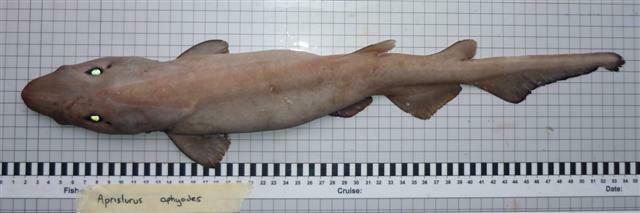
White Ghost Catshark
Apristurus aphyodes
The white ghost catshark (Apristurus aphyodes) is a shark of the catshark family Pentanchidae, the deepwater catsharks. This shark is found in deep water in the northeast Atlantic between latitudes 57°N and 58°N.
A deep-water catshark known from the eastern North Atlantic from depths of 1,014 to 1,800 m, it is known from only a limited number of specimens. It reaches a maximum of 54 cm or 1.7 ft total length which is a medium size for the Apristurus genus.
From the article White ghost catshark on Wikipedia (CC BY-SA), quoted section by section
Description
The white ghost catshark has a slender and cylindrical body with a relatively long and flattened snout. It is distinguished from the other 10 North Atlantic Apristurus species by the following. It has a uniform whitish coloration and large oval eyes with a weak subocular fold. Its snout is bell shaped and contains numerous visible pores making up ampullae of Lorenzini on the dorsal and ventral side of the snout. Its preorbital snout length (where the snout intersects its eyes) equals half of its head length. Aphyodes has elliptical ampullae patterns on the ventral midline of the snout and a slender elliptical patch on the dorsal side. Aphyodes has a strongly arched mouth with well developed labial furrows (grooves around the lips) with its upper labial furrows shorter than its lower labial furrows. Aphyodes's spiracle is small and located slightly below the horizontal axis of its eyes. It has five small gill openings the smallest of which is located above its pectoral fin. Aphyodes has widely spaced pectoral and pelvic fins with their interspace about equal to the length of its head. Its pectoral fins are small, narrow and sub quadrangular(almost quadrilateral). In contrast their pelvic fins are more normal in proportion to their body size. The catshark's dorsal fins are unequal in size and unlike most sharks its first dorsal fin is smaller than its second dorsal fin. …
Wikipedia: “Description and morphology”
Range & habitat
North Eastern Atlantic deep water off the coast of the UK is dominated by deep ocean basins. The average ocean depth is 5,800 m (19,000 ft). Sediments are composed of clay particles and calcareous from phytoplankton. Near the continental shelf the sediment is primarily made of sand and mud scales. Deep water temperatures are 5.5–7.5 °C. Habitat characteristics are shaped by North Atlantic Deep Water and its resulting thermohaline circulation. Primary productivity in this part of the ocean is low and the area is considered oligotrophic or less than 100 g carbon per m2 per year, though it experiences short phytoplankton blooms of diatoms in the spring and fall due to the thermocline being weak in those times and strong upwelling and picoplankton blooms in the summer as the thermocline strengthens. Deep water corals consisting of Lophelia pertusa are the main reef building species present. They contain the area's highest biodiversity including species such as bryozoans, hydroids, sponges, redfish, saithe, cod, squat lobsters, squid, mollusks, starfish and sea urchins. Biodiversity in the area is also concentrate around hydrothermal vents. Three vent systems have been found in North Eastern Atlantic deep water named Lucy Strike, Menez Gwen and Rainbow.
Wikipedia: “Habitat”
What it does
Similar to its hunting behavior, very little is known about aphyodes's reproduction (other than that it is oviparous and lays paired eggs) and aging, partially because their biology is resistant to traditional aging techniques due to having low calcium in their vertebra in addition to those vertebra being resistant to staining and cleaning agents. Aphyodes reaches sexual maturity between 47 and 50 cm and shows sexual dimorphism with females being larger than males.
Wikipedia: “Reproduction and maturity”
Where it lives
Recorded sightings
—
geo-referenced records in GBIF, from museums, herbaria and field observers.
Drag the globe to turn it. Dots are where records exist, not a range map; darker means more records.
In the stacks
Searching the stacks…
Every page naming Apristurus aphyodes in the Biodiversity Heritage Library →
This page is assembled live from iNaturalist, GBIF, Wikipedia, the Source Library and the Internet Archive. It is not yet part of the hand-edited codex. iNaturalist taxon 94437.