- Animals
- ›Chordates
- ›Vertebrates
- ›Cartilaginous Fishes
- ›Sharks and Rays
- ›Sharks
- ›Galean Sharks
- ›Ground Sharks
- ›Deepwater Catsharks
- ›Figaro
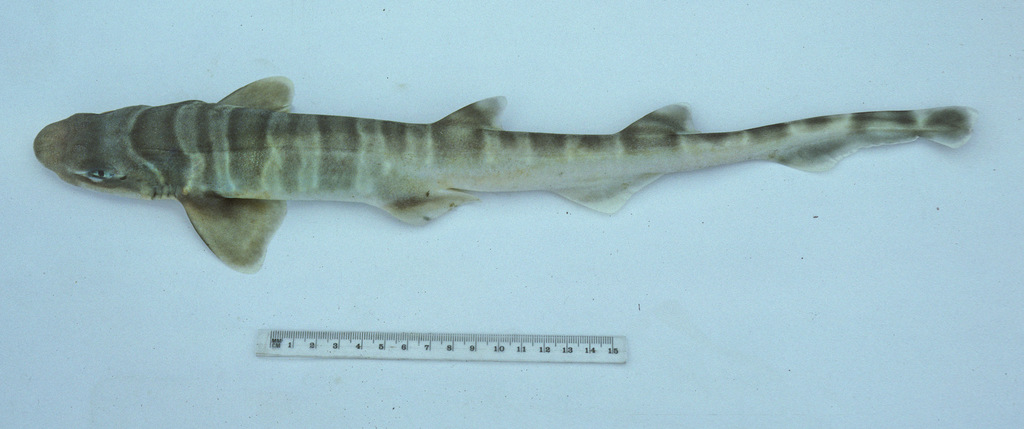
Australian Sawtail Catshark
Figaro boardmani
The Australian sawtail catshark (Figaro boardmani) is a common species of deepwater catshark, belonging to the family Pentanchidae, endemic to southern Australian waters. It is found on or near the bottom of the outer continental shelf and upper continental slope, at depths of 85 to 823 m (279 to 2,700 ft). This slim-bodied species is characterized by crests of enlarged dermal denticles along both the dorsal and ventral edges of its caudal fin and caudal peduncle, along with a color pattern of broad, dark saddles outlined in white. It can grow to 61 cm (24 in) in length. The Australian sawtail catshark feeds mainly on fishes, crustaceans, and cephalopods. Females are oviparous and lay eggs enclosed by capsules. This species is often caught incidentally by commercial bottom trawl fisheries, but is not significantly threatened by fishing activity. Thus, it has been assessed as of Least Concern by the International Union for Conservation of Nature (IUCN).
From the article Australian sawtail catshark on Wikipedia (CC BY-SA), quoted section by section
Description
The maximum known length of the Australian sawtail catshark is 61 cm (24 in). Its slender body is firm and nearly cylindrical in cross-section. The snout is rather short and narrow, with a somewhat angular profile from above. The eyes are horizontally oval and equipped with rudimentary nictitating membranes (protective third eyelids). Beneath the eye is a thin ridge, and behind is a tiny spiracle. The nostrils have triangular flaps of skin in front. The mouth is wide and arched, with furrows of medium length at each corner. The teeth are small, each with a long central cusp and multiple smaller cusplets on each side. There are five pairs of gill slits. The two dorsal fins have rounded apexes, with the first slightly larger than the second. The first and second dorsal fins originate over the rear of the pelvic fin and anal fins respectively. The pectoral fins are broad and moderate in size. The pelvic fins are small and low with an angular shape; in adult males their inner margins are fused to form a subtle "apron" over the claspers. The anal fin is roughly triangular; its base measures 11% of the total length, exceeding the distance between the pelvic and anal fins but not the distance between the dorsal fins. The caudal fin is short and low, with a small but obvious lower lobe and a ventral notch near the tip of the upper lobe. …
Range & habitat
Widely distributed off southern Australia, the Australian sawtail catshark has been found from Carnarvon in Western Australia to Noosa in Queensland, including all of Tasmania. This abundant, demersal species inhabits the outer continental shelf and upper continental slope at a depth of 85–823 m (279–2,700 ft).
Wikipedia: “Distribution and habitat”
What it does
The Australian sawtail catshark has been known to assemble in groups of a single sex. It feeds primarily on fishes, crustaceans, and cephalopods. Reproduction is oviparous, possibly without a well-defined breeding season as is the case in other catsharks. Adult females have a single functional ovary and two functional oviducts; apparently a single egg matures in each oviduct at a time. The eggs are enclosed in capsules measuring 6.8–7.4 cm (2.7–2.9 in) long, 1.9–2.0 cm (0.75–0.79 in) across, and 8–9 cm (3.1–3.5 in) thick. Males and females attain sexual maturity at roughly 40 cm (16 in) and 40–43 cm (16–17 in) long respectively.
Wikipedia: “Biology and ecology”
Where it lives
Recorded sightings
—
geo-referenced records in GBIF, from museums, herbaria and field observers.
Drag the globe to turn it. Dots are where records exist, not a range map; darker means more records.
In the stacks
Searching the stacks…
Every page naming Figaro boardmani in the Biodiversity Heritage Library →
This page is assembled live from iNaturalist, GBIF, Wikipedia, the Source Library and the Internet Archive. It is not yet part of the hand-edited codex. iNaturalist taxon 100950.