- Animals
- ›Chordates
- ›Vertebrates
- ›Cartilaginous Fishes
- ›Sharks and Rays
- ›Sharks
- ›Galean Sharks
- ›Ground Sharks
- ›Finback Catsharks
- ›Eridacnis
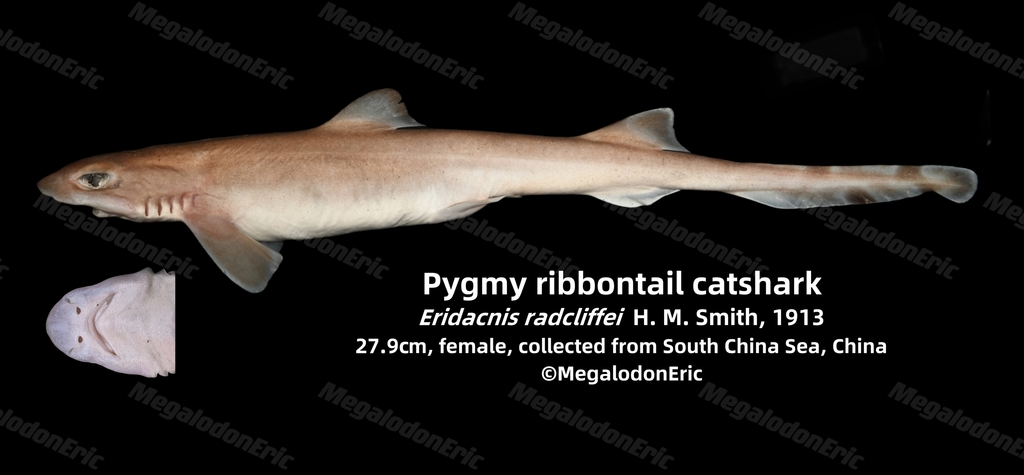
Pygmy Ribbontail Catshark
Eridacnis radcliffei
The pygmy ribbontail catshark (Eridacnis radcliffei) is a species of finback catshark, family Proscylliidae, distributed patchily in the western Indo-Pacific from Tanzania to the Philippines. It occurs around the edges of continental and insular shelves at a depth of 71–766 m (233–2,513 ft), typically on or near mud bottoms. One of the smallest living shark species, the pygmy ribbontail catshark grows to a maximum known length of 24 cm (9.4 in). It has a slender body with a low, ribbon-like tail fin, and is dark brown in color with blackish dorsal fin markings and tail bands. This shark feeds mainly on bony fishes, followed by crustaceans and then squid. It is aplacental viviparous with females bearing litters of 1–2 relatively large pups. It is of minimal significance to fisheries, being caught as bycatch in some areas.
From the article Pygmy ribbontail catshark on Wikipedia (CC BY-SA), quoted section by section
Description
The pygmy ribbontail catshark has a thin body with a short, rounded snout and elongated, oval eyes bearing rudimentary nictitating membranes. Each nostril is preceded by a short, triangular flap of skin. The mouth is wide and V-shaped, without furrows at the corners and containing numerous rows of small, multi-pointed teeth that become more comb-like towards the sides. There are papillae on the roof of the mouth and the edges of the gill arches. The two dorsal fins are of comparable size, the first positioned slightly closer to the pectoral than the pelvic fins and the second over the anal fin. The caudal fin is low and long, comprising a quarter of the total length or more, and lacks a lower lobe. The coloration is a plain dark brown, with black markings on the dorsal fins and darker bands on the caudal fin. The maximum recorded lengths are 23 cm (9.1 in) for a male and 24 cm (9.4 in) for a female. One male shark 18.6 cm (7.3 in) long weighed 14 g (0.49 oz), and a pregnant female 24.2 cm (9.5 in) long weighed 37 g (1.3 oz).
Range & habitat
By far the most widely (if sporadically) distributed member of its genus, the pygmy ribbontail catshark has been reported from Tanzania, the Gulf of Aden, the Gulf of Mannar, the Bay of Bengal, the Andaman Islands, Vietnam, and the Philippines. This bottom-dwelling shark occurs at depths of 71–766 m (233–2,513 ft) on outer continental and insular shelves or upper slopes, commonly over mud.
Wikipedia: “Distribution and habitat”
What it does
The pygmy ribbontail catshark is reportedly very abundant in some places, such as off southern India and the Philippines. One study in Indian waters found that 55% of this shark's diet was composed of bony fishes (mainly lanternfishes but also bristlemouths and small eels), 28% of crustaceans (mainly shrimp but also stomatopods and crab larvae), 14% of squid, and the remainder of other items including a bivalve. Reproduction is aplacental viviparous, with the developing young being sustained by a yolk sac until they are ready to be born. Female pygmy ribbontail catsharks are capable of becoming pregnant at 16.6 cm (6.5 in) long, though only females over 18 cm (7.1 in) long have been found with fully developed fetuses, suggesting that they grow substantially during the gestation period. One or two pups are born at a time; the newborns are extremely large relative to their mothers, measuring around 11 cm (4.3 in) in length. Males reach sexual maturity at a length of 18–19 cm (7.1–7.5 in) and females at perhaps 15–16 cm (5.9–6.3 in). This is comparable to the sizes at maturity of the spined pygmy shark (Squaliolus laticaudus) and the dwarf lanternshark (Etmopterus perryi), ranking the pygmy ribbontail catshark among the world's smallest sharks. …
Wikipedia: “Biology and ecology”
Where it lives
Recorded sightings
—
geo-referenced records in GBIF, from museums, herbaria and field observers.
Drag the globe to turn it. Dots are where records exist, not a range map; darker means more records.
In the stacks
Searching the stacks…
Every page naming Eridacnis radcliffei in the Biodiversity Heritage Library →
This page is assembled live from iNaturalist, GBIF, Wikipedia, the Source Library and the Internet Archive. It is not yet part of the hand-edited codex. iNaturalist taxon 100349.