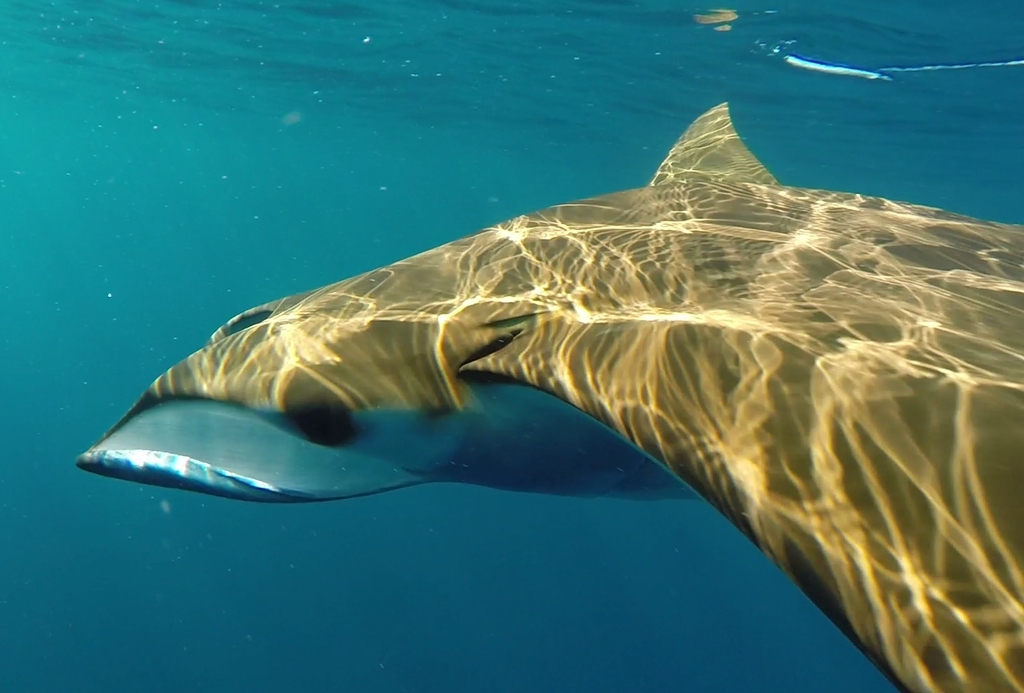
Sicklefin Devil Ray
Mobula tarapacana
The Chilean devil ray, box ray, greater Guinean mobula, sicklefin devil ray, or spiny mobula (Mobula tarapacana) is a species of fish in the family Myliobatidae. It is found worldwide in tropical, subtropical and warm temperate oceans, and mainly occurs offshore, only occasionally appearing near the coast. These fish have been discovered to feed at depths up to 1,848 metres (6,063 ft) during deep dives, and are among the deepest-diving ocean animals. There are two distinct deep...
From the article Chilean devil ray on Wikipedia (CC BY-SA), quoted section by section
Description
Chilean Devil Rays are recognized by their unique boxy and rectangular head shape, which is different from other rays who have more rounded heads. They also have a pale patch behind their heads, which is used as a good identifier for the species. Their bodies are disc-shaped and are flat. Furthermore, these rays have a specialized gill rack filter pad which is used to help strain microscopic zooplankton from the water they take in. Also, they have special cephalic fins, which are long, finger- like structures on their heads which are used to help zooplankton channel into their mouths.
Wikipedia: “Anatomy:”
Range & habitat
The Chilean devil Ray lives in warm temperate to tropic oceanic waters across the Atlantic, Pacific, and Indian Oceans. They mostly are pelagic, swimming in the open ocean, but also inhabiting areas near continental shelves, and oceanic islands. Their range typically extends from the northeastern United States and the Caribbean to Japan and Australia, and as far as South Africa and the Maldives. They have been known to make long distance migrations across the Atlantic often.
Wikipedia: “Habitat:”
What it does
The Chilean Devil Ray is a planktivorous filter feeder, which means they eat small organisms, including zooplankton, copepods, krill, and other small crustaceans . They swim with their mouths open to suck in water, which passes over their gills which traps the small organisms in and then lets the water out. They typically feed near surface waters where the plankton concentrations are the highest. Due to their prey being so small, they need to eat frequently and often.
Wikipedia: “Diet/ Feeding:”
Where it lives
Recorded sightings
—
geo-referenced records in GBIF, from museums, herbaria and field observers.
Drag the globe to turn it. Dots are where records exist, not a range map; darker means more records.
In the stacks
Searching the stacks…
Every page naming Mobula tarapacana in the Biodiversity Heritage Library →
This page is assembled live from iNaturalist, GBIF, Wikipedia, the Source Library and the Internet Archive. It is not yet part of the hand-edited codex. iNaturalist taxon 105926.