- Animals
- ›Chordates
- ›Vertebrates
- ›Cartilaginous Fishes
- ›Sharks and Rays
- ›Rays
- ›Stingrays
- ›Whiptail Stingrays
- ›Common Whiptail Stingrays
- ›Pteroplatytrygon
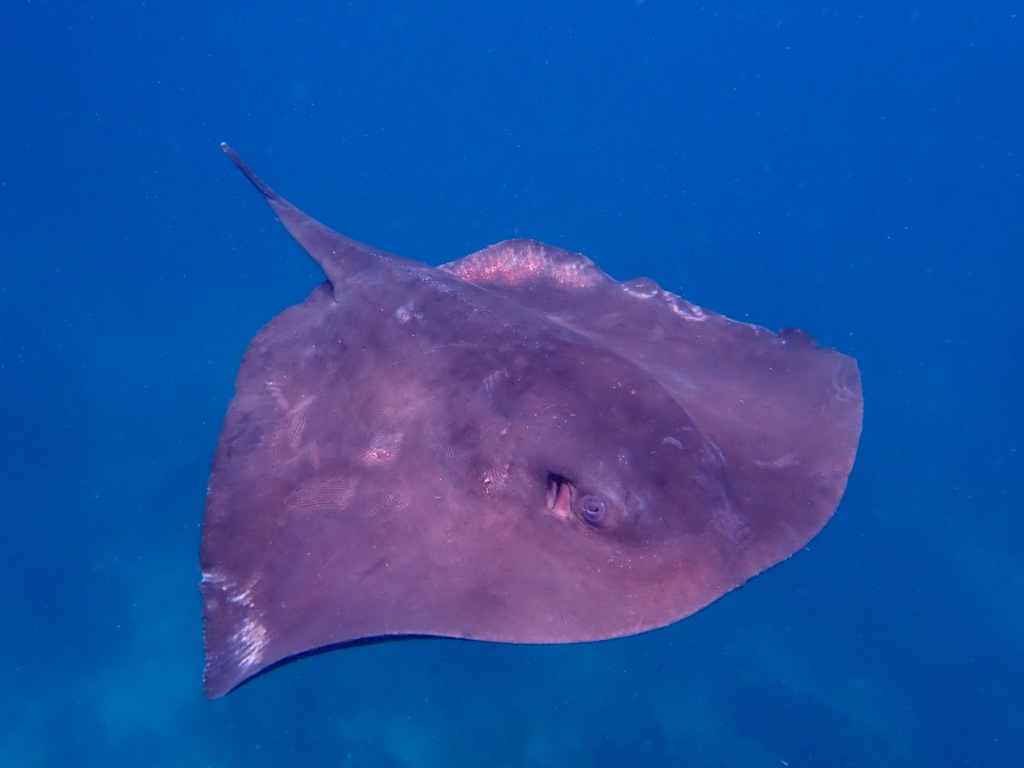
Pelagic Stingray
Pteroplatytrygon violacea
The pelagic stingray (Pteroplatytrygon violacea) is a species of stingray in the family Dasyatidae, and the sole member of its genus. It is characterized by the wedge-like shape of its pectoral fin disc, which is much wider than long, as well as by the pointed teeth in both sexes, whip-like tail with extremely long tail spine, and uniform violet to blue-green coloration. It generally reaches 59 cm (23 in) in width. The pelagic stingray has a worldwide distribution in waters warmer than 19 °C (66 °F), and migrates seasonally to spend the summer closer to the continental shelf and at higher latitudes. The only stingray that almost exclusively inhabits the open ocean, this species is typically found in surface waters down to a depth of 100 m (330 ft). As a consequence of its midwater habits, its swimming style has evolved to feature more of a flapping motion of the pectoral fins, as opposed to the disc margin undulations used by other, bottom-dwelling stingrays.
The diet of the pelagic stingray consists of free-swimming invertebrates and bony fishes. It is an active hunter, using its pectoral fins to trap and move food to its mouth, and has been known to take advantage of seasonal feeding opportunities such as spawning squid. Like other stingrays, it is aplacental viviparous, meaning that the embryos are sustained initially by yolk and later by histotroph ("uterine milk"). With a short gestation period of 2–4 months, females may bear two litters of 4–13 pups per year.
From the article Pelagic stingray on Wikipedia (CC BY-SA), quoted section by section
Description
The pelagic stingray has a very thick, distinctively wedge-shaped pectoral fin disc one-third wider than long, with broadly curved leading margins, rather angular outer corners, and nearly straight trailing margins. The snout is short with a rounded tip. The eyes are minute and, unlike in other stingrays, do not protrude above the body; the spiracles (paired respiratory openings) follow immediate behind. There is a short but broad curtain of skin between the nostrils, with a weakly fringed rear margin. The mouth is small and gently arched, with deep furrows at the corners and a tiny projection at the center of the upper jaw that fits into an indentation on the lower jaw. There are anywhere from 0 to 15 forked papillae (nipple-like structures) in a row across the floor of the mouth. There are 25–34 upper tooth rows and 25–31 lower tooth rows; the teeth of both sexes have single, pointed cusps, but those of adult males are longer and sharper than those of adult females. The margins of the pelvic fins are nearly straight in front and become rounded at the tips and in back. The whip-like tail measures up to twice as long as the disc; it is thick at the base and tapers significantly to the extremely long, serrated spine placed approximately one-third to halfway along its length. Two spines may be present if a replacement grows in before the original drops off. …
Range & habitat
The distribution of the pelagic stingray extends nearly worldwide in tropical to warm-temperate pelagic waters, between the latitudes of 52°N and 50°S. In the western Atlantic, it has been reported from the Grand Banks of Newfoundland to North Carolina, the northern Gulf of Mexico, and the Lesser Antilles, Brazil and Uruguay. In the eastern Atlantic, this species has been recorded from the North Sea to Madeira, including the Mediterranean, as well as around Cape Verde, in the Gulf of Guinea and off South Africa. In the Pacific, it is known from Japan to Australia and New Zealand in the west, British Columbia to Chile in the east, and around many oceanic islands including Hawaii, the Galápagos, and Easter Island. There have been no reports of this species from much of the Indian Ocean, but it is known to be common in the southwestern portion and around Indonesia.
Unique amongst stingrays in inhabiting the open ocean rather than the sea floor, the pelagic stingray is generally found from the surface to a depth of 100 m (330 ft) over deep water. It has also been caught at a depth of 330–381 m (1,083–1,250 ft) over the Kyushu–Palau Ridge, indicating that it at least occasionally approaches the bottom. …
Wikipedia: “Distribution and habitat”
What it does
In adopting a midwater lifestyle, the pelagic stingray exhibits several characteristics different from those of its bottom-dwelling relatives. While most stingrays propel themselves by undulating their disc margins, this species swims by oscillating (flapping) its pectoral fins in a manner approaching the "underwater flying" employed by eagle rays. Oscillatory fin motions generate lift, thus improving cruising efficiency in open water at a cost to maneuverability. The pelagic stingray is adept at swimming backwards, which may compensate for the lower fine control offered by its swimming mode. Vision seems to be more important to the pelagic ray in finding food than in other stingrays. Compared to other members of its family, this species has less than one-third the density of electroreceptive ampullae of Lorenzini on its underside. The ampullae also cover a smaller area, though not as small as in eagle rays, and are more evenly distributed between the ventral and dorsal surfaces. This ray can detect an electric field of well under 1 nV/cm at a distance of up to 30 cm (12 in), and may be able to pick up the minute electric fields produced by moving sea water. …
Wikipedia: “Biology and ecology”
Where it lives
Recorded sightings
—
geo-referenced records in GBIF, from museums, herbaria and field observers.
Drag the globe to turn it. Dots are where records exist, not a range map; darker means more records.
In the stacks
Searching the stacks…
Every page naming Pteroplatytrygon violacea in the Biodiversity Heritage Library →
This page is assembled live from iNaturalist, GBIF, Wikipedia, the Source Library and the Internet Archive. It is not yet part of the hand-edited codex. iNaturalist taxon 111212.