- Animals
- ›Chordates
- ›Vertebrates
- ›Cartilaginous Fishes
- ›Sharks and Rays
- ›Rays
- ›Stingrays
- ›Whiptail Stingrays
- ›Maskrays
- ›Neotrygon
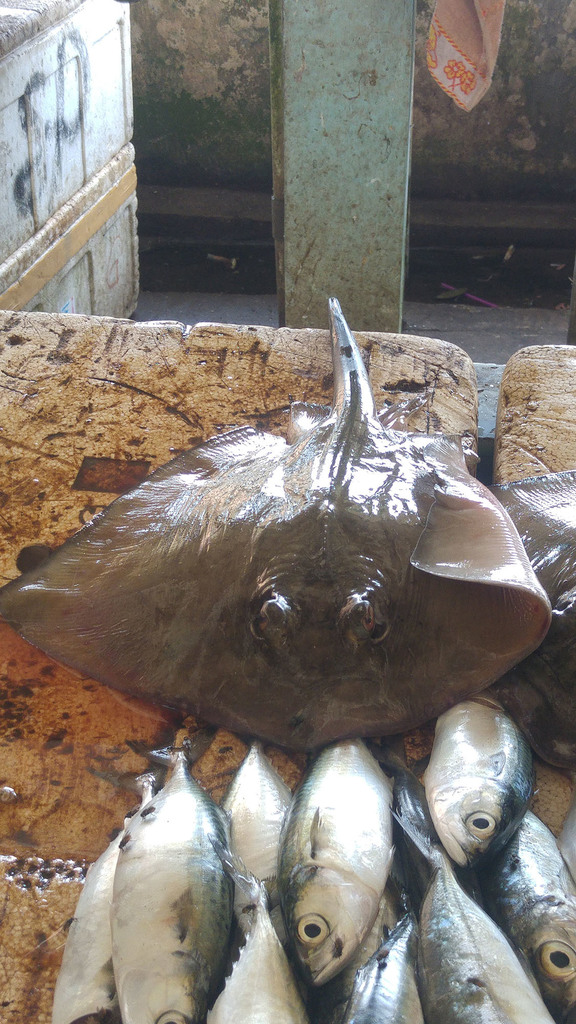
Plain Maskray
Neotrygon annotata
The plain maskray (Neotrygon annotata) or brown stingray, is a species of stingray in the family Dasyatidae. It is found in shallow, soft-bottomed habitats off northern Australia. Reaching 24 cm (9.4 in) in width, this species has a diamond-shaped, grayish green pectoral fin disc. Its short, whip-like tail has alternating black and white bands with fin folds above and below. There are short rows of thorns on the back and the base of the tail, but otherwise the skin is smooth. While this species possesses the dark mask-like pattern across its eyes common to its genus, it is not ornately patterned like other maskrays.
Benthic in nature, the plain maskray feeds mainly on caridean shrimp and polychaete worms, and to a lesser extent on small bony fishes. It is viviparous, with females producing litters of one or two young that are nourished during gestation via histotroph ("uterine milk"). This species lacks economic value but is caught incidentally in bottom trawls, which it is thought to be less able to withstand than other maskrays due to its gracile build. As it also has a limited distribution and low fecundity, the International Union for Conservation of Nature (IUCN) has listed it as Near Threatened.
From the article Plain maskray on Wikipedia (CC BY-SA), quoted section by section
Description
The pectoral fin disc of the plain maskray is thin and diamond-shaped with narrowly rounded outer corners, measuring 1.1–1.3 times longer than wide. The leading margins of the disc are gently concave and converge at a broad angle to the pointed tip of the snout. The small eyes are placed close together, and behind them are the spiracles. The nostrils are elongated and have a skirt-shaped flap of skin between them. The small mouth bears prominent furrows at the corners and contains two slender papillae on the floor. Small papillae are also found around the outside of the mouth. There are five pairs of gill slits. The pelvic fins are fairly large and pointed. The tail is short, barely exceeding the length of the disc when intact, and has a broad and flattened base leading to usually two stinging spines. After the stings, the tail becomes slender and bears a long ventral fin fold and a much shorter, lower dorsal fin fold. Most of the body lacks dermal denticles; a midline row of 4–13 small, closely spaced thorns is present behind the spiracles, and another row of 0–4 thorns before the stings. The dorsal coloration is grayish green, becoming pinkish towards the disc margins; there is a dark mask-like shape around the eyes and a pair of small dark blotches behind the spiracles. …
Range & habitat
The plain maskray inhabits the continental shelf of northern Australia from the Wellesley Islands in Queensland to the Bonaparte Archipelago in Western Australia, including the Gulf of Carpentaria and the Timor and Arafura Seas. There are unsubstantiated reports that its range extends to southern Papua New Guinea. It is the least common of the several maskray species native to the region. This species is a bottom-dweller that prefers habitats with fine sediment. It has been recorded from between 12 and 62 m (39 and 203 ft) deep, and tends to be found farther away from shore than other maskrays in its range.
Wikipedia: “Distribution and habitat”
What it does
The plain maskray generally hunts at the surface of the bottom substrate, rather than digging for prey. Its diet consists predominantly of caridean shrimp and polychaete worms. Small bony fishes are also eaten, along with the occasional penaeid prawn or amphipod. Larger rays consume a greater variety of prey and relatively more polychaete worms when compared to smaller rays. This species is parasitized by the tapeworm Acanthobothrium jonesi. Like other stingrays, the plain maskray is viviparous with the developing embryos sustained to term by histotroph ("uterine milk") produced by the mother. Mature females have a single functional ovary and uterus, on the left. Litter size is one or two; the newborns measure 12–14 cm (4.7–5.5 in) across. Males and females reach sexual maturity at disc widths of 20–21 cm (7.9–8.3 in) and 18–19 cm (7.1–7.5 in) respectively. The maximum lifespan is estimated to be 9 years for males and 13 years for females.
Wikipedia: “Biology and ecology”
Where it lives
Recorded sightings
—
geo-referenced records in GBIF, from museums, herbaria and field observers.
Drag the globe to turn it. Dots are where records exist, not a range map; darker means more records.
In the stacks
Searching the stacks…
Every page naming Neotrygon annotata in the Biodiversity Heritage Library →
This page is assembled live from iNaturalist, GBIF, Wikipedia, the Source Library and the Internet Archive. It is not yet part of the hand-edited codex. iNaturalist taxon 106876.