- Animals
- ›Chordates
- ›Vertebrates
- ›Cartilaginous Fishes
- ›Sharks and Rays
- ›Sharks
- ›Squalean Sharks
- ›Cow and Frilled Sharks
- ›Cow Sharks
- ›Notorynchus
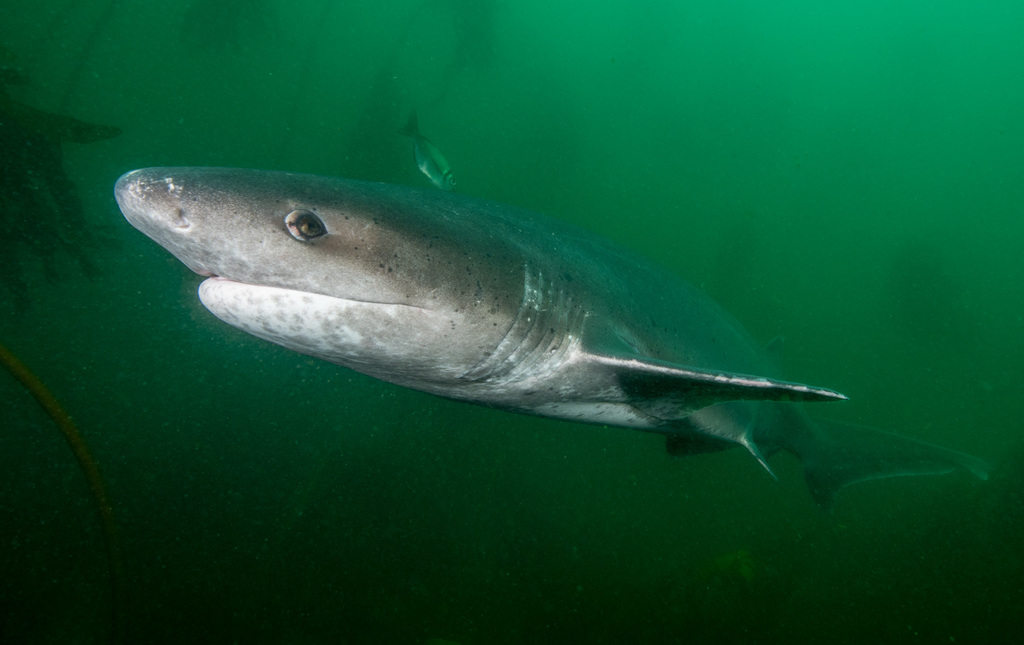
Broadnose Sevengill Shark
Notorynchus cepedianus
The broadnose sevengill shark (Notorynchus cepedianus) is the only extant member of the genus Notorynchus, in the family Hexanchidae. It is recognizable because of its seven gill slits, while most shark species have five gill slits, with the exception of the members of the order Hexanchiformes and the sixgill sawshark. This shark has a large, thick body, with a broad head and blunt snout. The top jaw has jagged, cusped teeth and the bottom jaw has comb-shaped teeth. Its single dorsal fin is set far back along the spine towards the caudal fin, and is behind the pelvic fins. In this shark the upper caudal fin is much longer than the lower, and is slightly notched near the tip. Like many sharks, this sevengill is counter-shaded. Its dorsal surface is silver-gray to brown in order to blend with the dark water and substrate when viewed from above. In counter to this, its ventral surface is very pale, blending with the sunlit water when viewed from below. The body and fins are covered in a scattering of small black & white spots. In juveniles, their fins often have white margins.
It is also known as sevengill shark or simply sevengill and was formerly known as cow shark and mud shark; it is called sevengill due to its seven gill slits. Because of this, it was listed along with the sharpnose sevengill shark (Heptranchias perlo) by Guinness World Records as having the most gill slits. It is similar to the sharpnose sevengill shark but the latter has a pointed snout and lacks spots on its dorsal surface.
From the article Broadnose sevengill shark on Wikipedia (CC BY-SA), quoted section by section
Description
The length at birth is 40–45 cm (15.5–17.5 in) while the mature male length is 1.5 m (4.9 ft) and mature female length is around 2.2 m (7.2 ft). The maximum length found is 3.0 metres (9.8 ft). The maximum recorded weight is 182 kg (401 lb) for a 2.91-metre (9.5 ft) individual. The shark is large and active and has a large head but small eyes and snout. The mouth is broad and prominent. The shark has one dorsal fin at the back of the body that spans from the insertion to the tops of the pelvic fins. The mottled grey and white body is covered in a variable number of small black spots.
Range & habitat
The broadnose sevengill has so far been found in the western Pacific Ocean off China, Japan, Australia, New Zealand, the eastern Pacific Ocean off Canada, United States and Chile, and the southern Atlantic Ocean off Argentina and South Africa. It is significantly found in the San Francisco Bay particularly near the Golden Gate Bridge and Alcatraz Island. Large, old individuals tend to live in deep offshore environments as far down as 446 feet (136 m). However, most individuals live in either the deep channels of bays, or in the shallower waters of continental shelves and estuaries. These sharks are mainly benthic in nature, cruising along the sea floor and making an occasional foray to the surface. Individuals that live closer to the coast in South Africa tend to prefer more open areas with a sandy sea floor and sparse clumps of kelp.
Wikipedia: “Range and habitat”
What it does
An opportunistic predator, the broadnose sevengill preys on a great variety of animals, and has been found at depths of 1,870 feet (570 m), in offshore waters. It has been found to feed on other sharks (including the gummy shark, one of its main prey choices, and cowsharks), rays, chimaeras, cetaceans, pinnipeds, bony fishes and animal falls (seafloor carrion). It will also feed on anything that fits in its mouth, such as shark egg cases, sea snails, crustaceans and any remains of rats, seabirds, and even deceased drowned humans. Research in 2003 found that its diet consisted of 30% mammals, with a frequency of occurrence of 35%. It is a frequent top predator in shallow waters, and has comb-like teeth, with the upper teeth having slender, smooth edged cusps to swallow small enough prey whole and lower teeth that are broad enough to bite flesh into pieces. These sharks occasionally hunt in packs to take larger prey, using tactics such as stealth to succeed. After feeding, it slowly digests for several days, and can go weeks until eating again. Larger, predatory sharks (such as the great white shark) can be a threat, and cannibalism among this species has also been recorded. The species has also been observed being preyed upon by orcas in False Bay, South Africa. …
Wikipedia: “Behavior”
Where it lives
Recorded sightings
—
geo-referenced records in GBIF, from museums, herbaria and field observers.
Drag the globe to turn it. Dots are where records exist, not a range map; darker means more records.
In the stacks
Searching the stacks…
Every page naming Notorynchus cepedianus in the Biodiversity Heritage Library →
This page is assembled live from iNaturalist, GBIF, Wikipedia, the Source Library and the Internet Archive. It is not yet part of the hand-edited codex. iNaturalist taxon 107194.