- Animals
- ›Chordates
- ›Vertebrates
- ›Amphibians
- ›Frogs and Toads
- ›Terraranas
- ›Rain Frogs
- ›Eleutherodactylinae
- ›Eleutherodactylus
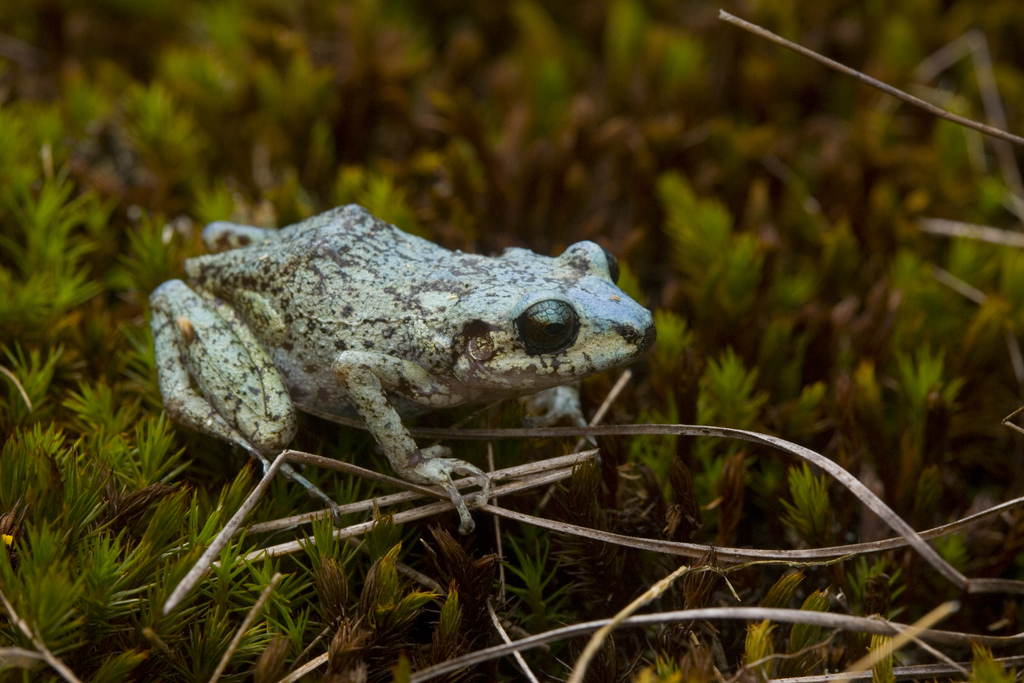
Southern Pastel Frog
Eleutherodactylus leoncei
The southern pastel frog or Hispaniola robber frog (Eleutherodactylus leoncei) is a species of frog in the family Eleutherodactylidae. It is endemic to Hispaniola and known from the Massif de la Selle, both in the Dominican Republic and in Haiti. Its natural habitats are upland pine forests. Males call from the ground. It is threatened by habitat loss caused by logging and agriculture. It is known from the Sierra de Bahoruco National Park (Dominican Republic), but habitat degradation is occurring in this area too.
From the article Southern pastel frog on Wikipedia (CC BY-SA), quoted section by section
Range & habitat
The type series and the majority of subsequent specimens were collected during the day under rocks and logs in pine (Pinus occidentalis) and hardwood forests, while one was discovered crossing a road in a pine forest at night.
This species is restricted to the Massif de la Selle in Haiti, and Sierra de Bahoruco in the Dominican Republic, Hispaniola. It has been recorded from 1,182 to 2,303 m asl. It is considered a terrestrial species that lives in upland pine forests, preferring shady spots and calling from the ground. It will not tolerate disturbances to its natural environment. It breeds by direct development and lays its eggs on the ground.
Wikipedia: “Distribution and habitat”
In human culture
E. leoncei was described by Shreve & Williams in 1963. The type-locality for the species is Foret des Pins, near Pic La Selle in Haiti. The holotype (YPM 1167) is an adult female collected the 26 February 1959 by P. S. Humphrey.
Wikipedia: “Taxonomic history”
Listen
Looking for field recordings…
Where it lives
Recorded sightings
—
geo-referenced records in GBIF, from museums, herbaria and field observers.
Drag the globe to turn it. Dots are where records exist, not a range map; darker means more records.
In the stacks
Searching the stacks…
Every page naming Eleutherodactylus leoncei in the Biodiversity Heritage Library →
This page is assembled live from iNaturalist, GBIF, Wikipedia, the Source Library and the Internet Archive. It is not yet part of the hand-edited codex. iNaturalist taxon 22418.