 NL·0663
Herbarium of the Nature Library
- Name
- Rana temporaria
- Family
- Ranidae
- Native to
- Most of Europe from northern Spain and Britain to the Urals and western Siberia, north beyond the Arctic Circle; absent from much of the Mediterranean lowland
- Habitat
- Ponds, Wet meadows, Woodland, Gardens, Mountain tarns
Common frog
Rana temporaria
Also calledEuropean common frog · Grasfrosch (German) · Grenouille rousse (French) · Vanlig groda (Swedish) · Lyagushka travyanaya (Russian)
Northern Europe's familiar brown frog, found from Mediterranean mountains to beyond the Arctic Circle. Each spring it is one of the first amphibians to breed, filling ponds with clumps of spawn.
The common frog or grass frog, also known as the European common frog, European common brown frog, European grass frog, European Holarctic true frog, European pond frog, European brown frog, or simply the frog, is a semi-aquatic amphibian of the family Ranidae, found throughout much of Europe as far north as Scandinavia and as far east as the Urals, except for most of the Iberian Peninsula, southern Italy, and the southern Balkans. The farthest west it can be found is Ireland. It is also found in Asia, and eastward to Japan. The nominative, and most common, subspecies Rana temporaria temporaria is a largely terrestrial frog native to Europe. It is distributed throughout northern Europe and can be found from Ireland to as far east as Japan. Wikipedia
What it can do
- iBreeds in water as cold as just above freezing
- iiLives at altitudes up to ~2,500 m in the Alps
- iiiCan change skin tone to match its surroundings over hours or days
In the field
Field marks
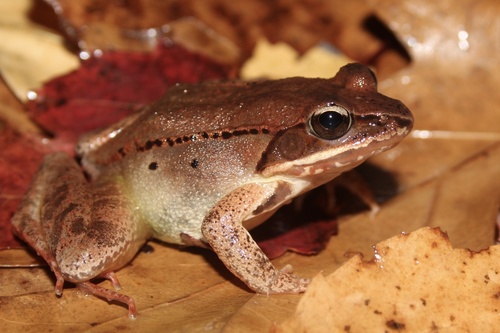
- aBrown, olive or yellow-brown with variable dark spots
- bDark 'mask' patch behind the eye over the eardrum
- cDark bars on the hind legs
- dSmooth, moist skin; hops rather than crawls
- Voice
- A low, soft, purring croak, like a distant motorbike, often from many frogs together
- Not to be confused with
- The common toad (Bufo bufo) has warty skin, crawls and lays spawn in strings, not clumps. The moor frog (R. arvalis) has a more pointed snout and males can turn blue when breeding. The agile frog (R. dalmatina) has very long hind legs and a paler body.
- Where to see it
- Garden ponds and wetlands across Britain, Ireland, Scandinavia and the Alps
- When
- Spawns February–April (later in the north and mountains); hibernates in winter, males often in pond mud
Listen
Looking for field recordings…
Life & habits
- Diet
- Insects, slugs, snails, worms, spiders; tadpoles graze algae
- Habitat
- Ponds, ditches, marshes, damp grassland, woodland and gardens
- Size
- ~6–10 cm
- Lifespan
- ~5–10 years
Large numbers gather in ponds in early spring for a few days of 'explosive' breeding, often in the same pond each year.
Where it lives
Recorded sightings
—
geo-referenced records in GBIF, from museums, herbaria and field observers.
Native range
Most of Europe from northern Spain and Britain to the Urals and western Siberia, north beyond the Arctic Circle; absent from much of the Mediterranean lowland
Drag the globe to turn it. Dots are where records exist, not a range map; darker means more records.
In the stacks
Searching the stacks…
Every page naming Rana temporaria in the Biodiversity Heritage Library →
Marginalia
Curiosity
In Ireland it is the only native frog; whether it arrived naturally or with medieval monks has long been debated.
Kinship

Photographs: iNaturalist contributors under the licences shown. Records: GBIF.org. Historical plates: Source Library (CC BY-SA 4.0; originals public domain). Summary text: Nature Library editors and Wikipedia (CC BY-SA). Medicinal and edibility notes are historical and educational, not advice. iNaturalist taxon 25591.