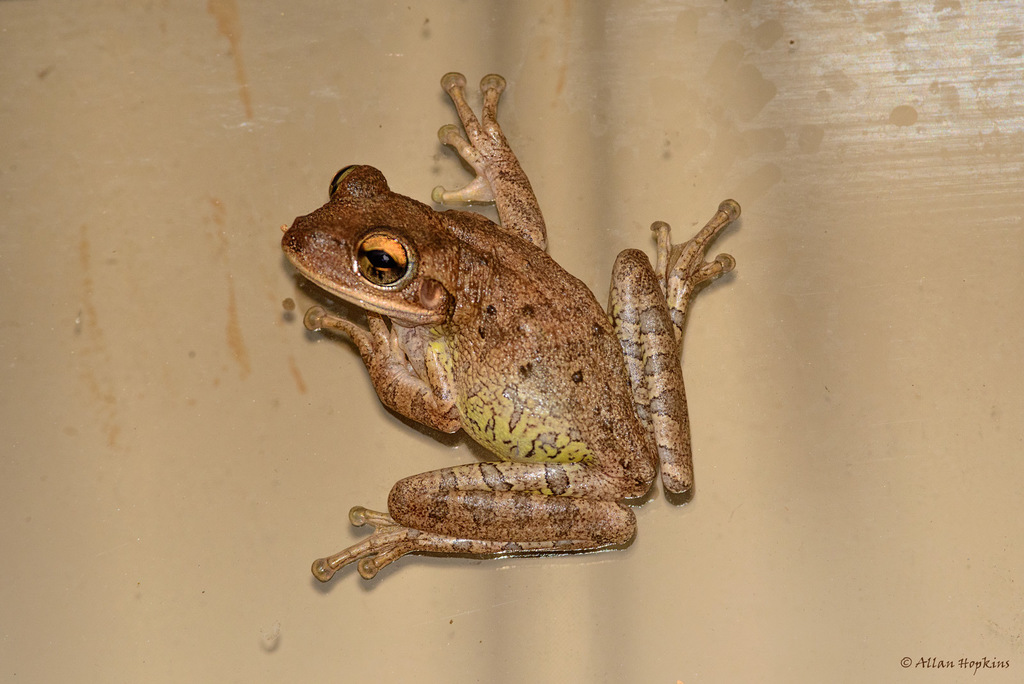
Cuban Tree Frog
Osteopilus septentrionalis
The Cuban tree frog (Osteopilus septentrionalis) is a large species of tree frog that is native to Cuba, the Bahamas, and the Cayman Islands; but has become invasive in several other places around the Americas. Its wide diet and ability to thrive in urban areas has made it a highly invasive species with established colonies in places such as Florida, the Hawaiian island of Oahu, and the Caribbean Islands. These tree frogs can vary in size from 2 to 5.5 inches (5 to 12.7 cm) in length. Due to their large size, Cuban tree frogs can eat a wide variety of things, particularly native tree frogs, and their removal has shown to result in an increase in the amount of native tree frogs in an area. The tadpoles of Cuban tree frogs also heavily compete with native frog tadpoles, which can cause negative effects in body mass, size at metamorphosis, and growth rates for the native tadpoles.
From the article Cuban tree frog on Wikipedia (CC BY-SA), quoted section by section
Description
Cuban tree frogs are the largest tree frogs in North America, ranging from 2 to 5.5 inches or (5 to 12.7 cm) in length. Cuban tree frogs are mostly gray, brown, or green, with young frogs having more green coloration than adults. These frogs have rough, warty skin with blotchy or mottled patterning. Cuban tree frogs have the ability to change their color and pattern to camouflage themselves. The inner thighs of these frogs are bright yellow, which helps to confuse a predator when the frog jumps and reveals the color. The toes have sticky pads that are useful in their arboreal life. The skin on their heads is fused to the skull; if the head of an adult frog is rubbed (between the eyes), the skin does not move. This special adaptation prevents water loss, since fewer blood vessels occur in the "co-ossified" (fused) area. Cuban tree frogs are able to secrete a toxic mucus from their skin which can cause a fiery sensation if it makes contact with a person's eyes.
Range & habitat
The Cuban tree frog is native to Cuba, the Bahamas, and the Cayman Islands. This large frog has been introduced in Puerto Rico, the US Virgin Islands, and the British Virgin Islands. Whether the species was native to the Key West region of Florida is debated, or if it was introduced to the area. First discovered in the 1930s, these frogs arrived via cargo ships in the 1800s. They can survive in brackish water, which may have helped the species to spread to various islands. The Cuban tree frogs' progressive colonization into the mainland of Florida is believed to be abetted by use of State Road A1A construction during the 1940s. The species is now established in southern Florida and parts of the panhandle region, and can be found as far north as South Carolina. The Cuban tree frog is known to hitchhike on shipments of potted plants, vegetation, packaging, boats, and other motorized vehicles. Once in a new location, the frogs become an invasive species. In Puerto Rico, they have become a predator of the common coquí (Eleutherodactylus coqui). They have several good colonizing traits, such as high fecundity, short generation time, a diverse diet, good competitive ability, and the ability to coexist with humans. …
Wikipedia: “Distribution”
What it does
Cuban tree frogs are mainly nocturnal and sleep during the day, preferring to hunt and breed when the sun goes down. Being very voracious, this tree frog will eat almost anything large enough to fit in its mouth, including smaller frogs. Their foraging will occasionally take them up utility poles, where they can cause short-circuits of utility switches, causing costly power outages. Cuban tree frogs will sometimes sleep on palm trees or in potted plants, which can aid in their spread.
Wikipedia: “Behavior”
Listen
Looking for field recordings…
Where it lives
Recorded sightings
—
geo-referenced records in GBIF, from museums, herbaria and field observers.
Drag the globe to turn it. Dots are where records exist, not a range map; darker means more records.
In the stacks
Searching the stacks…
Every page naming Osteopilus septentrionalis in the Biodiversity Heritage Library →
This page is assembled live from iNaturalist, GBIF, Wikipedia, the Source Library and the Internet Archive. It is not yet part of the hand-edited codex. iNaturalist taxon 24382.