- Animals
- ›Chordates
- ›Vertebrates
- ›Mammals
- ›Therians
- ›Placental Mammals
- ›Ungulates, Carnivorans, and Allies
- ›Carnivorans
- ›Mustelids
- ›Otters
- ›Lutra
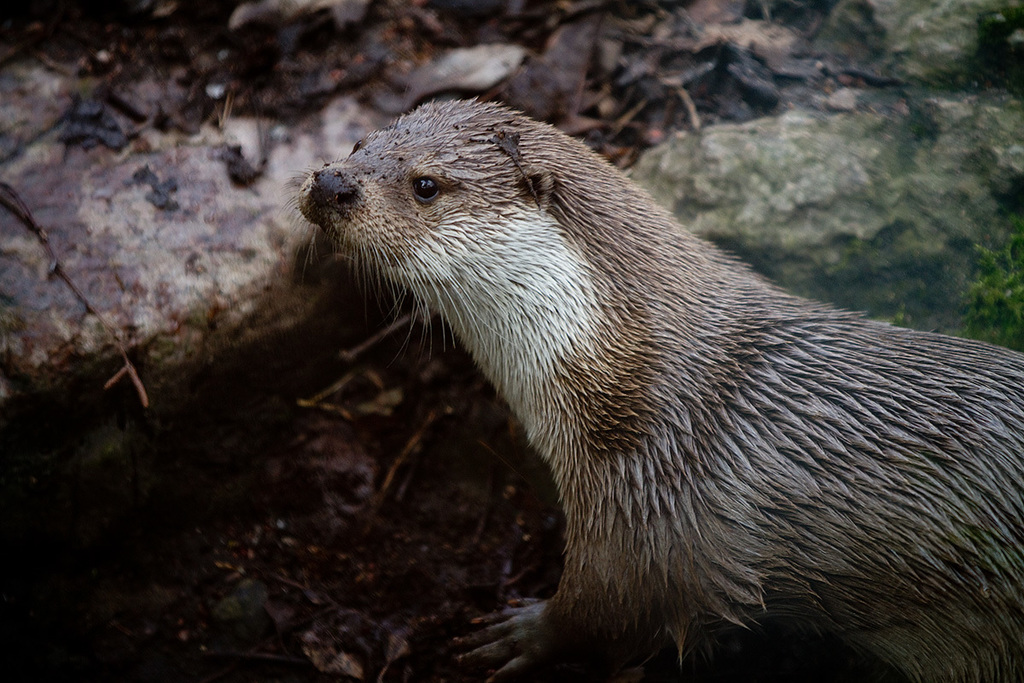
Eurasian Otter
Lutra lutra
The Eurasian otter (Lutra lutra), also known as the European otter, Eurasian river otter, European river otter, common otter, and Old World otter, is a semiaquatic mammal native to Eurasia and the Maghreb. It is the most widely distributed member of the otter subfamily (Lutrinae) of the weasel family (Mustelidae) and is found in the waterways and on the coasts of Europe, much of Asia, and parts of North Africa. The Eurasian otter eats mainly fish, and is strongly territorial. It is endangered in some parts of its range, but is recovering in others.
From the article Eurasian otter on Wikipedia (CC BY-SA), quoted section by section
Description
The Eurasian otter is a typical member of the otter subfamily. With brown fur on their backs and cream-coloured fur on their bellies, these long, slender creatures are well-equipped for their aquatic lifestyle. Their bones show osteosclerosis, which increases their density and reduces buoyancy. This otter differs from the North American river otter by its shorter neck, broader visage, the greater space between the ears and its longer tail. However, the Eurasian otter is the only otter in much of its range, so it is rarely confused for any other animal. Normally, this species is 57 to 95 cm (22.5 to 37.5 in) long, not counting a tail of 35–45 cm (14–17.5 in). The female is shorter than the male. The otter's average body weight is 7 to 12 kg (15 to 26 lb), although occasionally a large old male may reach up to 17 kg (37 lb). The record-sized specimen, reported by a reliable source but not verified, weighed over 24 kg (53 lb).
Range & habitat
The Eurasian otter is the most widely distributed otter species. Its range includes Europe, North Africa and parts of Asia as far as the Palestine region. Though currently thought to be extinct in Liechtenstein and Switzerland, it is now common in Latvia, along the coast of Norway, in the western regions of Spain and Portugal and across Great Britain and Ireland. In Italy, it lives in the southern part of the peninsula. It inhabits unpolluted bodies of fresh water such as lakes, streams, rivers, canals and ponds, as long as the food supply is adequate. In Andalusia, it uses artificial lakes on golf courses. It prefers the open areas of streams and also lives along the coast in salt water, but requires regular access to fresh water to clean its fur. In Syria, the Eurasian otter was recorded in montane creeks in Latakia and Raqqa Governorates and in the lower Euphrates valley in Deir ez-Zor Governorate. In western Nepal, its presence was documented at elevations of around 1,600 m (5,200 ft) in Barekot river in Jajarkot District and at 1,337 m (4,386 ft) in Tubang river in Eastern Rukum District. In India, it is distributed in the Himalayan foothills, southern Western Ghats and the central Indian landscape. In Kyrgyzstan, the Eurasian otter was considered to have disappeared after surveys did not yield any record of a stable breeding population; one Eurasian otter was sighted on t …
Wikipedia: “Distribution and habitat”
What it does
The Eurasian otter's diet consists primarily of fish, particularly in Mediterranean and temperate freshwater habitats where fish is most abundant. During winter and in cooler climates, the Eurasian otter's diet includes worms, caterpillars, clams, crustaceans, insects, eggs, birds, and small mammals, including young European beavers, and amphibians. The Eurasian otter is capable of overpowering prey that is significantly larger than itself, and it occasionally hunts large waterbirds such as adult greylag geese.
Wikipedia: “Diet”
Listen
Looking for field recordings…
Where it lives
Recorded sightings
—
geo-referenced records in GBIF, from museums, herbaria and field observers.
Drag the globe to turn it. Dots are where records exist, not a range map; darker means more records.
In the stacks
Searching the stacks…
Every page naming Lutra lutra in the Biodiversity Heritage Library →
This page is assembled live from iNaturalist, GBIF, Wikipedia, the Source Library and the Internet Archive. It is not yet part of the hand-edited codex. iNaturalist taxon 41850.