- Animals
- ›Chordates
- ›Vertebrates
- ›Mammals
- ›Therians
- ›Placental Mammals
- ›Ungulates, Carnivorans, and Allies
- ›Shrews, Moles, Hedgehogs, and Allies
- ›Shrews, Moles, and Hedgehogs
- ›Shrews
- ›White-toothed Shrews
- ›Crocidura
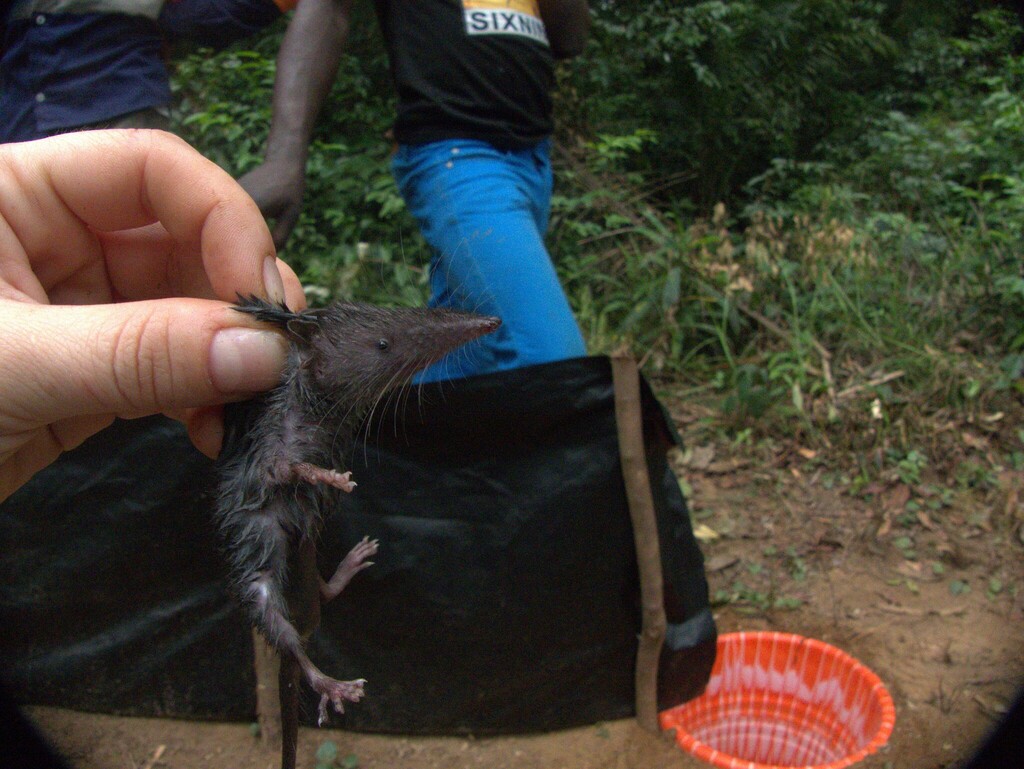
African Giant Shrew
Crocidura olivieri
The African giant shrew (Crocidura olivieri) is a species of white-toothed shrew. It also is known as, Mann's musk shrew, Euchareena's musk shrew, or Olivier's shrew. It is native to Africa, where it has a widespread distribution and occurs in many types of habitat. Its natural habitats are subtropical or tropical dry forest, subtropical or tropical moist lowland forest, subtropical or tropical moist montane forest, dry savanna, moist savanna, arable land, rural gardens, urban areas, and heavily degraded former forest. In the Nile Valley it is found near human habitation, where it is considered to be a pest. It is a common species and is listed by the International Union for Conservation of Nature as being of "least concern".
From the article African giant shrew on Wikipedia (CC BY-SA), quoted section by section
Description
This is a large shrew growing to a head-and-body length of 110 to 140 mm (4.3 to 5.5 in) with a tail about 80% of the body-length. The hind foot measures 21 to 23 mm (0.8 to 0.9 in). In Nigeria, this shrew weighs between 37 and 65 g (1.3 and 2.3 oz) while in Zimbabwe, it is smaller at 31 to 37 g (1.1 to 1.3 oz). The fur is variable in colour, the dorsal surface being reddish-brown, dark brown, or blackish, while the ventral surface is buffy-brown to dark grey. The tail is thickly clad with short bristles. The skull is robust and somewhat flattened, with a long rostrum and smallish braincase. The teeth are large and strong, particularly the incisors. There are three pairs of nipples and on the flanks are glands that exude a musky odour.
Range & habitat
This shrew is present in the Nile Valley in Egypt and has a wide distribution in sub-Saharan Africa, where its range extends from Senegal to Sudan and Ethiopia, and southwards to Angola, northern Namibia and Zimbabwe. It occurs in a wide range of habitats, both wet and dry, and both forest and savanna. In Egypt, it occurs in gardens, agricultural areas, and canal embankments. When it lives in close proximity to human settlements, it may be regarded as a pest species.
Wikipedia: “Distribution and habitat”
What it does
The African giant shrew is a terrestrial species that is active at night, particularly just before dawn. It feeds on small invertebrates such as ants, beetles, millipedes, termites, and spiders, and possibly also on carrion. Breeding activity varies across its range but appears to take place most of the year with litter sizes averaging about four. Owls such as the barn owl, the African grass owl, and the spotted eagle-owl are among the main predators, as well as small mammals such as genets, mongooses, and wild cats.
== References ==
Wikipedia: “Ecology”
Listen
Looking for field recordings…
Where it lives
Recorded sightings
—
geo-referenced records in GBIF, from museums, herbaria and field observers.
Drag the globe to turn it. Dots are where records exist, not a range map; darker means more records.
In the stacks
Searching the stacks…
Every page naming Crocidura olivieri in the Biodiversity Heritage Library →
This page is assembled live from iNaturalist, GBIF, Wikipedia, the Source Library and the Internet Archive. It is not yet part of the hand-edited codex. iNaturalist taxon 46705.