- Animals
- ›Chordates
- ›Vertebrates
- ›Mammals
- ›Therians
- ›Placental Mammals
- ›Primates, Rodents, and Allies
- ›Primates
- ›Monkeys, Apes, and Tarsiers
- ›Monkeys and Apes
- ›Apes and Old World Monkeys
- ›Old World Monkeys
- ›Colobines
- ›Langurs, Surilis, and Lutungs
- ›Trachypithecus
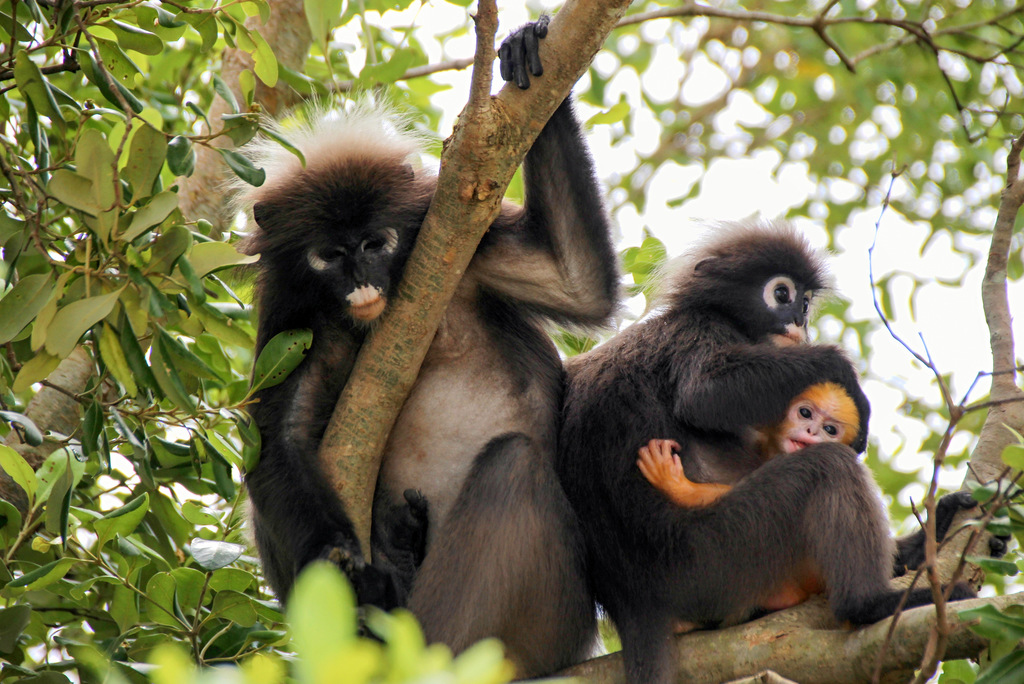
Dusky Leaf Monkey
Trachypithecus obscurus
The dusky leaf monkey (Trachypithecus obscurus), also known as the spectacled langur or the spectacled leaf monkey, is a species of primate in the family Cercopithecidae. It is found in Peninsular Malaysia, Myanmar and Thailand, and can occasionally be found in Singapore. During the day, these small, folivorous primates divide in sub-groups and forage for vegetation and fruit throughout the tropical forests. According to the IUCN, the dusky leaf monkey's population is declining due to habitat loss, poaching, and anthropogenic land use, which prompted the IUCN to classify the species as endangered in 2015.
From the article Dusky leaf monkey on Wikipedia (CC BY-SA), quoted section by section
Description
The dusky leaf monkey can appear in different colour variations, depending on the sub-species. While dusky leaf monkeys are born with an orange coat, the colour of their fur changes as they mature into adulthood. Along the abdominal area, their fur is often several shades lighter than that of their dorsal area, which can develop in shades of brown, black, or grey. Surrounding their eyes are circular patterns of bright white fur. The dusky leaf monkey is a rather small primate. In a study conducted by G. J Burton, the average weight of the 25 male dusky leaf monkeys that were sampled was 7.39 kilograms, while that of the 44 female dusky leaf monkeys that were sampled was 6.47 kilograms. These results suggest that dusky leaf monkeys are sexually dimorphic species, as the females were found to be, on average, 12% smaller than the males sampled. Burton's study also revealed that, among the 25 male primates, there was a direct correlation with the weight of one testicle with the weight of the other, suggesting that one testicle may be used to estimate the weight of the other. However, the female ovaries were found to not be statistically significant enough to predict the weight of one ovary with the other.
Range & habitat
The dusky leaf monkey can be found across Malaysia, Myanmar, and Thailand, where they inhabit tropical forests.
Singapore population. However, these primates have occasionally been spotted in Singapore. Research conducted within the country between 2019 and 2020 revealed that three dusky leaf monkey individuals were located in August 2019 within the northern region of the island, near the body of water that borders Singapore and Malaysia. While dusky leaf monkeys are not considered native to the region, researchers speculate that they are able to swim to the country. Researchers are concerned about these migratory patterns because these primates can increase competition for resources, such as vegetation, and transfer diseases and pathogens to other native species that are not equipped to recover from them. In January 2020, a group of two dusky leaf monkeys, who possibly swum across Johor, was observed in Singapore, and they were able to chase away a group of eleven Raffles' banded langurs. Despite this, the species is not considered an invasive species, as their colonisation of Singapore is natural and not assisted by humans.
Wikipedia: “Distribution”
What it does
Numerous activity budgets have been conducted across Malaysia to study the behavioural patterns of the dusky leaf monkey. For instance, one activity budget conducted in 2016 with 12,480 primates in Teluk Bahang, Malaysia, found that, within the eight-month period, dusky leaf monkeys spent 40% of their time positioning, 33% of their time feeding, and 20% of their day moving. The sampled primates also allocated their time allo-grooming (4%), playing (2%), and foraging (1%). Ten years prior, another activity budget with 18 dusky leaf monkeys was conducted at the Penang Botanical Garden, which is also located in Malaysia. Researchers at the National University of Malaysia concluded that, within 18 days, the dusky leaf monkeys that were sampled spent 40% of their day eating, almost 24% of their day resting, and approximately 22.5% of their time moving. The dusky leaf monkeys also allocated time for autogrooming (6.52%) and allo-grooming (1.33%), among other behaviours. …
Wikipedia: “Behaviour and diet”
Listen
Looking for field recordings…
Where it lives
Recorded sightings
—
geo-referenced records in GBIF, from museums, herbaria and field observers.
Drag the globe to turn it. Dots are where records exist, not a range map; darker means more records.
In the stacks
Searching the stacks…
Every page naming Trachypithecus obscurus in the Biodiversity Heritage Library →
This page is assembled live from iNaturalist, GBIF, Wikipedia, the Source Library and the Internet Archive. It is not yet part of the hand-edited codex. iNaturalist taxon 43494.