- Animals
- ›Chordates
- ›Vertebrates
- ›Mammals
- ›Therians
- ›Placental Mammals
- ›Primates, Rodents, and Allies
- ›Primates
- ›Monkeys, Apes, and Tarsiers
- ›Monkeys and Apes
- ›Apes and Old World Monkeys
- ›Old World Monkeys
- ›Colobines
- ›Langurs, Surilis, and Lutungs
- ›Trachypithecus
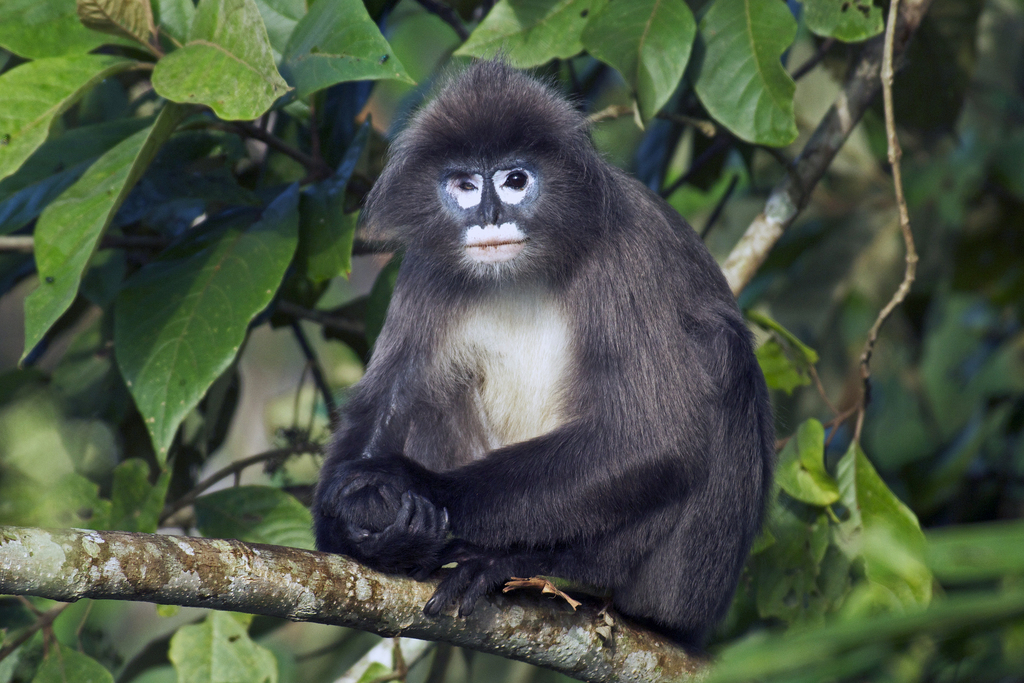
Phayre's Leaf Monkey
Trachypithecus phayrei
Phayre's leaf monkey (Trachypithecus phayrei), also known as Phayre's langur, is a species of Old World monkey native to South Asia and Southeast Asia, namely India, Bangladesh, and Myanmar. Populations from further east are now thought to belong to other species. It is listed as Endangered on the IUCN Red List and is threatened by hunting and loss of habitat.
The species epithet commemorates Arthur Purves Phayre.
From the article Phayre's leaf monkey on Wikipedia (CC BY-SA), quoted section by section
Description
Phayre's langur is characterized by white coloration around the ventral, mouth, and eye area. The broad ring-shaped patches around the eyes resemble spectacles, contributing to the local name of "Chasma bandor" in Bengali, or spectacled monkey. The white fur is especially contrasting with the overall deep bluish-brown fur all over its body with darker shades at the head, below the elbows, and at the end of the tail. There is a presence of a sagittal crest on the heads of both adult males and females, giving it a triangular shape. The infants have a straw-colored natal coat, making it easily distinguishable in a group. The average head-body length ranges from 530–580 mm (21–23 in) in males and 495–580 mm (19.5–22.8 in) in females. The tail is usually longer than its body, with an average of 700 mm (28 in) for males and 750 mm (30 in), for females. In comparison to T. melamera and T. popa, it has a shorter tail length. The average mass of Phayre's langur is observed to be around 7.9 kg (17 lb) for males and 6.9 kg (15 lb) for females. In field studies males and females are differentiated through the shape of the patches around the eyes. Female have cone-shaped white patches bending in towards the nose while males have a rounder shape. …
Wikipedia: “Characteristics”
Range & habitat
Pharye's langur is found in tropical, deciduous, and evergreen forests of North-East India, Eastern Bangladesh, and Western Myanmar. It can also be seen residing in secondary forests such as bamboo clusters and rubber plantations. Tree species with large canopies like Artocarpus chama, Artocarpus lacucha, Ficus racemosa, Trophis aspera, Mangifera indica, and Grewia nervosa, in Bangladesh, are used for resting in their shade. In India, the most common roosting trees range from heights of 6–15 m (20–49 ft) and have an extensive canopy, e.g., Ficus hispida and Triadica sebifera in Mizoram. Currently, a total of 1200 individual langurs have been recorded in India and 376 individuals in Bangladesh, 288 of which resided in the northeastern forests of Bangladesh.
Wikipedia: “Distribution and habitat”
What it does
Female Phayre's langurs are pregnant by an average age of 5.3 years with an average gestation period of 205 days. The females show promiscuous behavior, studies do show a preference for more experienced males, usually of higher dominance. Polygynous relationships are common, where males offer protection to copulated females. Females usually nurse their infants on average 22 months with weaning at around 19–21 months. The natal coat starts to become darker 26 weeks after birth.
Wikipedia: “Reproduction”
Listen
Looking for field recordings…
Where it lives
Recorded sightings
—
geo-referenced records in GBIF, from museums, herbaria and field observers.
Drag the globe to turn it. Dots are where records exist, not a range map; darker means more records.
In the stacks
Searching the stacks…
Every page naming Trachypithecus phayrei in the Biodiversity Heritage Library →
This page is assembled live from iNaturalist, GBIF, Wikipedia, the Source Library and the Internet Archive. It is not yet part of the hand-edited codex. iNaturalist taxon 43490.