- Animals
- ›Chordates
- ›Vertebrates
- ›Mammals
- ›Therians
- ›Placental Mammals
- ›Primates, Rodents, and Allies
- ›Primates
- ›Monkeys, Apes, and Tarsiers
- ›Monkeys and Apes
- ›Apes and Old World Monkeys
- ›Old World Monkeys
- ›Colobines
- ›Langurs, Surilis, and Lutungs
- ›Trachypithecus
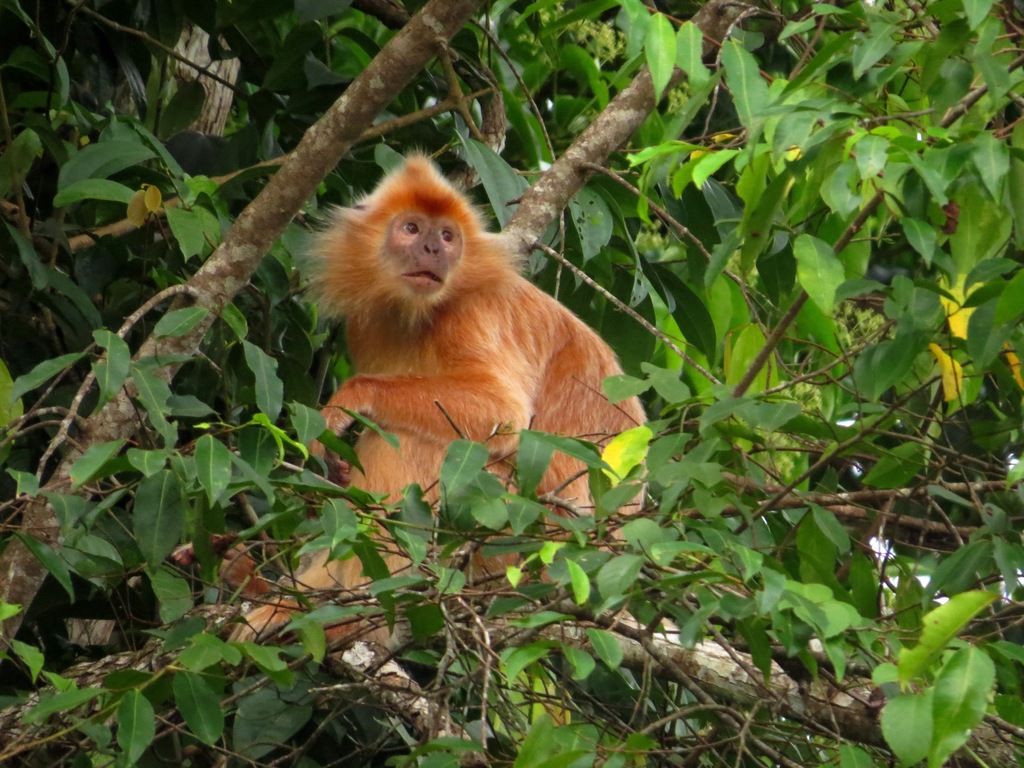
Silvered Leaf Monkey
Trachypithecus cristatus
The silvery lutung (Trachypithecus cristatus), also known as the silvered leaf monkey or the silvery langur, is an Old World monkey. It is arboreal, living in coastal, mangrove, and riverine forests in Sumatra, Borneo, Java, as well as in parts of the southwestern Malay Peninsula, the Natuna Islands, and other nearby islands. It is the type species of its species group.
From the article Silvery lutung on Wikipedia (CC BY-SA), quoted section by section
Description
The silvery lutung is a medium-sized monkey with a long, non-prehensile tail. It has grey-tipped, dark brown or black fur, giving it a uniform silvery appearance. Unlike some related species, there are no paler markings on the face or body, except for a patch of whitish hair on the groin of females. A crest of fur runs along the top of the head, and the hair on the cheeks is long, often obscuring the ears. The hands and feet are hairless, with dark-coloured skin, and have opposable thumbs and toes. Females range from 46 to 51 centimetres (18 to 20 in) in head-body length, with an average weight of 5.7 kilograms (13 lb) and a tail length of 67 to 75 centimetres (26 to 30 in). Males are slightly larger, from 50 to 58 centimetres (20 to 23 in) in length, with an average weight of 6.6 kilograms (15 lb) and a tail length of 67 to 75 centimetres (26 to 30 in). Like other langurs, the silvery lutung has a large three-chambered stomach to digest the cellulose found in its herbivorous diet. This allows for fermentation of food, and has some similarities with the stomach of ruminants. The intestine is unusually long, even compared to those of other langurs, and has several pouches along its length, which carry out further fermentation of plant matter. The teeth have grinding ridges and other modifications to allow the more efficient processing of tough leaves.
Range & habitat
The silvery lutung is found across Borneo, Sumatra, and Java, as well as in parts of the southwestern Malay Peninsula, the Natuna Islands, and other nearby islands. It inhabits mangrove swamps and nearby forest regions and generally avoids travelling far from coasts or rivers.
Wikipedia: “Distribution and habitat”
What it does
Silvery lutungs are diurnal, and travel in groups of around 9-40 individuals with one adult male and many adult females communally caring for infants. They rarely leave the trees, which provide them protection from ground-dwelling predators, and rapidly flee if threatened. Each group occupies a home range of 20 to 43 ha (49 to 106 acres), although these may overlap with those of neighbouring groups. During the day, individuals may travel up to 500 m (1,600 ft) through the forest, with some forming all-female subgroups that separate from the group containing the male. The entire group shelters in a single tree at night. The social structure of silvery lutungs is matrilineal and harem based. Females remain in the group for life, while males leave shortly after reaching adulthood, living in small groups of their own until they can take over an established harem. Within the group, males dominate the females, and females with young dominate those without. However, there is relatively little aggression within the group compared with some related species. Because group ranges often overlap, different groups frequently come into contact with one another. The adult male protects his group and territory from competing males, communicating his dominance to other males via vocalizations and fighting. …
Wikipedia: “Behaviour and ecology”
Listen
Looking for field recordings…
Where it lives
Recorded sightings
—
geo-referenced records in GBIF, from museums, herbaria and field observers.
Drag the globe to turn it. Dots are where records exist, not a range map; darker means more records.
In the stacks
Searching the stacks…
Every page naming Trachypithecus cristatus in the Biodiversity Heritage Library →
This page is assembled live from iNaturalist, GBIF, Wikipedia, the Source Library and the Internet Archive. It is not yet part of the hand-edited codex. iNaturalist taxon 43497.