- Animals
- ›Chordates
- ›Vertebrates
- ›Mammals
- ›Therians
- ›Placental Mammals
- ›Primates, Rodents, and Allies
- ›Primates
- ›Monkeys, Apes, and Tarsiers
- ›Monkeys and Apes
- ›Apes and Old World Monkeys
- ›Old World Monkeys
- ›Cercopithecines
- ›Baboons, Macaques, and Mangabeys
- ›Theropithecus
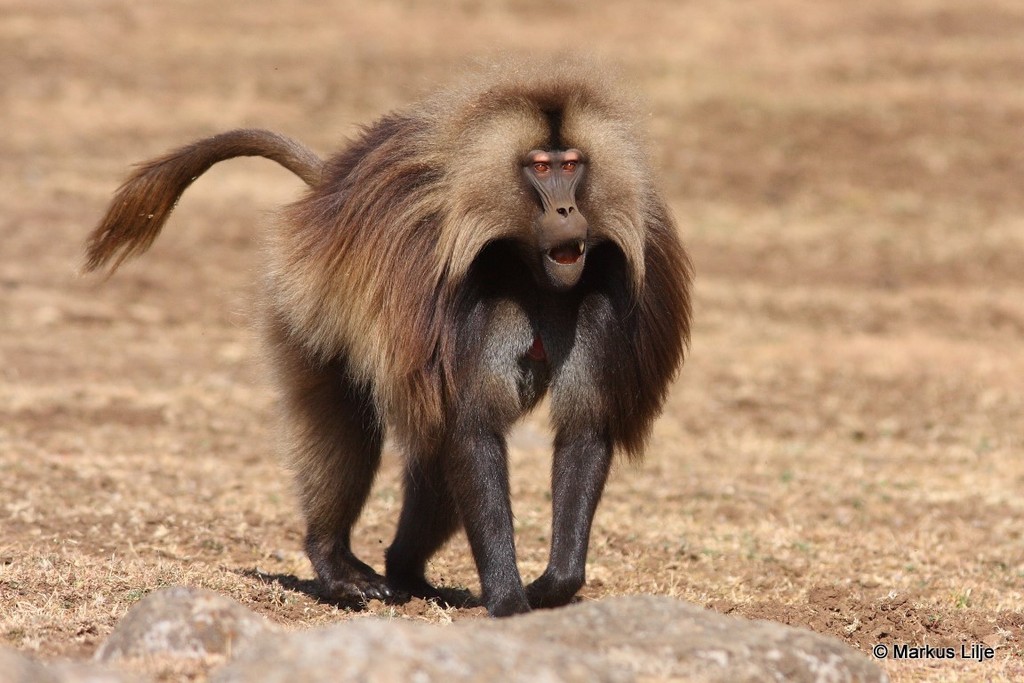
Gelada
Theropithecus gelada
The gelada (Theropithecus gelada, Amharic: ጭላዳ, romanized: č̣əlada, Oromo: Jaldeessa daabee), sometimes called the bleeding-heart monkey or the gelada baboon, is a species of Old World monkey found only in the Ethiopian Highlands, living at elevations of 1,800–4,400 m (5,900–14,400 ft) above sea level. It is the only living member of the genus Theropithecus, a name derived from the Greek root words for "beast-ape" (θηρο-πίθηκος : thēro-píthēkos). Like its close relatives in genus Papio, the baboons, it is largely terrestrial, spending much of its time foraging in grasslands, with grasses comprising up to 90% of its diet.
It has buff to dark brown hair with a dark face and pale eyelids. Adult males have longer hair on their backs and a conspicuous bright red patch of skin shaped like an hourglass on their chests. Females also have a bare patch of skin but it is less pronounced, except during estrus, when it brightens and exhibits a "necklace" of fluid-filled blisters. Males average 18.5 kg (41 lb) and females average 11 kg (24 lb) in weight. The head-body length is 50–75 cm (20–30 in) with a tail of 30–50 cm (12–20 in).
From the article Gelada on Wikipedia (CC BY-SA), quoted section by section
Description
The gelada is large and robust, and it is covered with buff to dark-brown, coarse hair and has a dark face with pale eyelids. Its arms and feet are nearly black. Its short tail ends in a tuft of hair. Adult males have a long, heavy cape of hair on their backs. The gelada has a hairless face with a short muzzle that looks more similar to a chimpanzee's than a baboon's. It can also be physically distinguished from a baboon by the bright patch of skin on its chest. This patch is hourglass-shaped. On males, it is bright red and surrounded by white hair; on females, it is far less pronounced, but when in estrus, the female's patch brightens, and a "necklace" of fluid-filled blisters forms on the patch. This is thought to be analogous to the swollen buttocks common to most baboons experiencing estrus. In addition, females have knobs of skin around their patches. Geladas also have well-developed ischial callosities. Sexual dimorphism is seen in this species; males average 18.5 kg (40.8 lb), while females are smaller, averaging 11 kg (24.3 lb). The head and body length of this species is 50–75 cm (19.7–29.5 in) for both sexes. Tail length is 30–50 cm (11.8–19.7 in). The gelada has several adaptations for its terrestrial and graminivorous (grass-eating) lifestyle. It has small, sturdy fingers adapted for pulling grass and narrow, small incisors adapted for chewing it. …
Range & habitat
Geladas are found only in the high grasslands of the deep gorges of the central Ethiopian plateau. They live in elevations 1,800–4,400 m (5,900–14,400 ft) above sea level, using the cliffs for sleeping and montane grasslands for foraging. These grasslands have widely spaced trees and also contain bushes and dense thickets. The highland areas where they live tend to be cooler and less arid than lowland areas. Thus, the geladas usually do not experience the negative effects that the dry season has on food availability. Nevertheless, in some areas, they do experience frost in the dry season, as well as hailstorms in the wet season. Geladas are the only primates that are primarily graminivores and grazers – grass blades make up to 90% of their diet. They eat both the blades and the seeds of grasses. When both blades and seeds are available, geladas prefer the seeds. They eat flowers, rhizomes, and roots when available, using their hands to dig for the latter two. They consume herbs, small plants, fruits, creepers, bushes, and thistles. Insects can be eaten, but only rarely and only if they can easily be obtained. During the dry season, herbs are preferred over grasses. Geladas consume their food more like ungulates than primates, and they can chew their food as effectively as zebra. Geladas are primarily diurnal. At night, they sleep on the ledges of cliffs. …
Wikipedia: “Range and ecology”
What it does
When in estrus, the female points her posterior towards a male and raises it, moving her tail to one side. The male then approaches the female and inspects her chest and genital areas. A female will copulate up to five times per day, usually around midday. Breeding and reproduction can occur at any time of the year, although some areas have birth peaks.
Most births occur at night. Newborn infants have red faces and closed eyes, and they are covered in black hair. On average, newborn infants weigh 464 g (16.4 oz). If a new male assumes mastery of a harem, females impregnated by the previous leader have an 80% likelihood of aborting, in a phenomenon known as the Bruce effect. Females come into estrus quickly after giving birth, so males have little incentive for practising infanticide, although it does occur in some communities in the Arsi region of Ethiopia, which may be an incentive for females to abort and avoid investing caring for an infant that will most likely be killed. Females also practice deceptive fertility signalling when conception is unlikely, a strategy to avoid infanticide. Infanticide in geladas remains fairly uncommon, though, compared to many primates that live in one-male units such as gorillas or gray langurs. The females that cancel their pregnancy are thought to bond with the new leader faster. …
Wikipedia: “Reproduction and parenting”
Listen
Looking for field recordings…
Where it lives
Recorded sightings
—
geo-referenced records in GBIF, from museums, herbaria and field observers.
Drag the globe to turn it. Dots are where records exist, not a range map; darker means more records.
In the stacks
Searching the stacks…
Every page naming Theropithecus gelada in the Biodiversity Heritage Library →
This page is assembled live from iNaturalist, GBIF, Wikipedia, the Source Library and the Internet Archive. It is not yet part of the hand-edited codex. iNaturalist taxon 43530.