- Animals
- ›Chordates
- ›Vertebrates
- ›Mammals
- ›Therians
- ›Placental Mammals
- ›Primates, Rodents, and Allies
- ›Primates
- ›Monkeys, Apes, and Tarsiers
- ›Monkeys and Apes
- ›Apes and Old World Monkeys
- ›Old World Monkeys
- ›Cercopithecines
- ›Baboons, Macaques, and Mangabeys
- ›Macaca
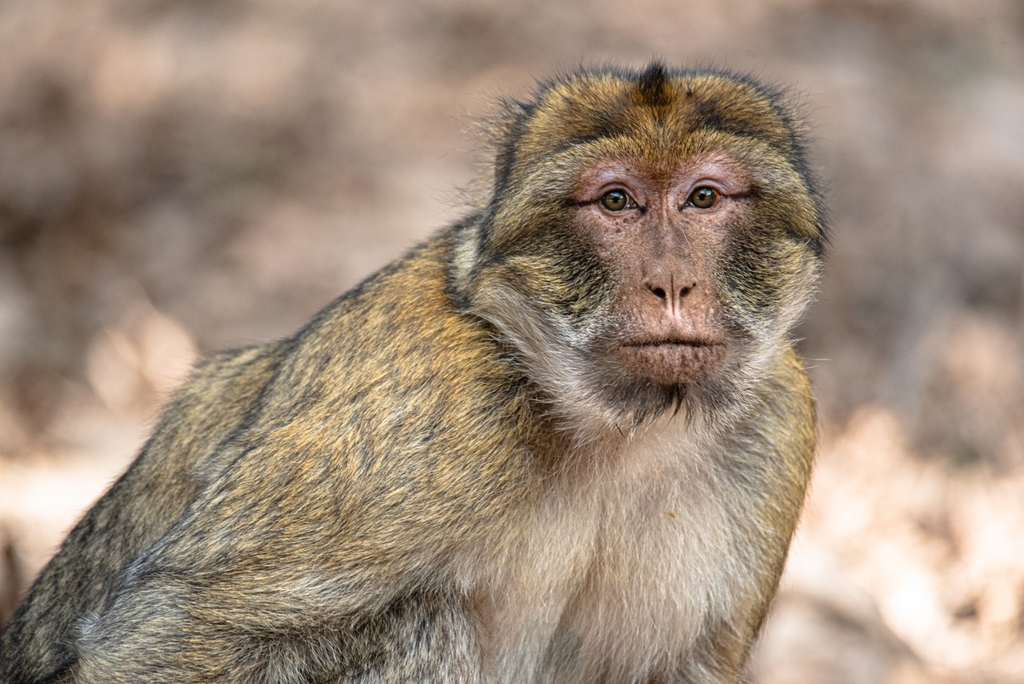
Barbary Macaque
Macaca sylvanus
The Barbary macaque (Macaca sylvanus) is a macaque species native to the Atlas Mountains of Morocco, Algeria and Tunisia, along with a small introduced population in Gibraltar. It is the type species of the genus Macaca. From the Early Pliocene to the Late Pleistocene, until around 85–40,000 years ago, it was widely distributed in Europe. Today, the Barbary macaques in Gibraltar are the only Old World monkeys in Europe. About 300 individuals live on the Rock of Gibraltar. This population appears to be stable or increasing, while the North African population is declining.
The diet of the Barbary macaque consists primarily of plants and insects. Males play an atypical role in rearing young. Because of uncertain paternity, males are integral to raising all infants. Generally, both sexes and all ages contribute in alloparental care of the young. Males live to around 25 years old while females may live up to 30 years.
From the article Barbary macaque on Wikipedia (CC BY-SA), quoted section by section
Description
The Barbary macaque has a dark pink face with a pale buff to golden brown to grey pelage and a lighter underside. The colour of mature adults changes with ages. In adults and subadults the fur on the back is variegated pale and dark which is due to banding on individual hairs. In spring to early summer, as the temperatures rise, the adult macaques moult their thick winter fur. The species shows sexual dimorphism with males larger than females. The mean head-body length is 55.7 cm (21.9 in) in females and 63.4 cm (25.0 in) in males. The boneless vestigial tail is greatly reduced compared with other macaque species and, if not absent, measures 4–22 mm (0.16–0.87 in). Males may have a more prominent tail, though data is scarce. The average body weight is 9.9–11 kg (22–24 lb) in females and 14.5–16 kg (32–35 lb) in males. Like all Old World monkeys, the Barbary macaque has well-developed sitting pads (ischial callosities) on its rear. Females exhibit an exaggerated anogenital swelling, which increases in size during oestrus. It has cheek pouches and high-crowned bilophodont molars (molars with two ridges); the third molar is elongated. The diploid chromosome number of the Barbary macaque is 42, like other members of the Old World monkey tribe Papionini.
Range & habitat
Historically, the Barbary macaque occurred across North Africa from Libya to Morocco. It is the only monkey in Africa that survives north of the Sahara. It lives mainly in fragmented areas of the Rif and the Middle and High Atlas mountain ranges in Morocco and the Grande and Petite Kabylie mountain region in Algeria. It has been recorded at elevations of 400–2,300 m (1,300–7,500 ft), though it seems to prefer higher elevations. The Moroccan and Algerian populations are around 700 km (430 mi) apart, although the gap was smaller during the Holocene. The Barbary macaque also occurs in the British Overseas Territory of Gibraltar at the southern tip of Europe's Iberian Peninsula. Gibraltar historian Alonso Hernández del Portillo noted in the early 17th century that the macaques had been present "from time immemorial". Most likely, the Moors introduced macaques from North Africa to Gibraltar during the Middle Ages. During World War II, Winston Churchill ordered for more Barbary macaques to be introduced to Gibraltar to reverse population declines. Today, there are around 300 Barbary macaques in Gibraltar. It can live in a variety of habitats, such as cedar, fir, and oak forests, grasslands, thermophilous scrub, and rocky ridges full of vegetation in Mediterranean climate with seasonal extremes of temperature. …
Wikipedia: “Distribution and habitat”
What it does
The Barbary macaque is gregarious, forming mixed groups of several females and males. Troops can have 10 to 100 individuals and are matriarchal, with their hierarchy determined by lineage to the lead female. Unlike other macaques, the males participate in rearing the young. Males may spend a considerable amount of time playing with and grooming infants. In this way, a strong social bond is formed between males and juveniles, both the male's own offspring and those of others in the troop. This may be a result of selectivity on the part of the females, who may prefer highly parental males. The mating season runs from November through March. The gestation period is 147 to 192 days, and females usually have only one offspring per pregnancy. Females rear twins in rare instances. Offspring reach maturity at three to four years of age, and may live for 20 years or more. Grooming other Barbary macaques leads to lower stress levels for the individuals that do the grooming. While stress levels do not appear to be reduced in animals that are groomed, grooming more individuals leads to even lower stress levels; this is a benefit that might outweigh the costs to the groomer, which include less time to participate in other activities such as foraging. …
Wikipedia: “Behaviour and ecology”
Listen
Looking for field recordings…
Where it lives
Recorded sightings
—
geo-referenced records in GBIF, from museums, herbaria and field observers.
Drag the globe to turn it. Dots are where records exist, not a range map; darker means more records.
In the old herbals & bestiaries

In the stacks
Searching the stacks…
Every page naming Macaca sylvanus in the Biodiversity Heritage Library →
This page is assembled live from iNaturalist, GBIF, Wikipedia, the Source Library and the Internet Archive. It is not yet part of the hand-edited codex. iNaturalist taxon 43452.