- Animals
- ›Chordates
- ›Vertebrates
- ›Mammals
- ›Therians
- ›Placental Mammals
- ›Primates, Rodents, and Allies
- ›Primates
- ›Monkeys, Apes, and Tarsiers
- ›Monkeys and Apes
- ›New World Monkeys
- ›Cebid Monkeys
- ›Squirrel Monkeys
- ›Saimiri
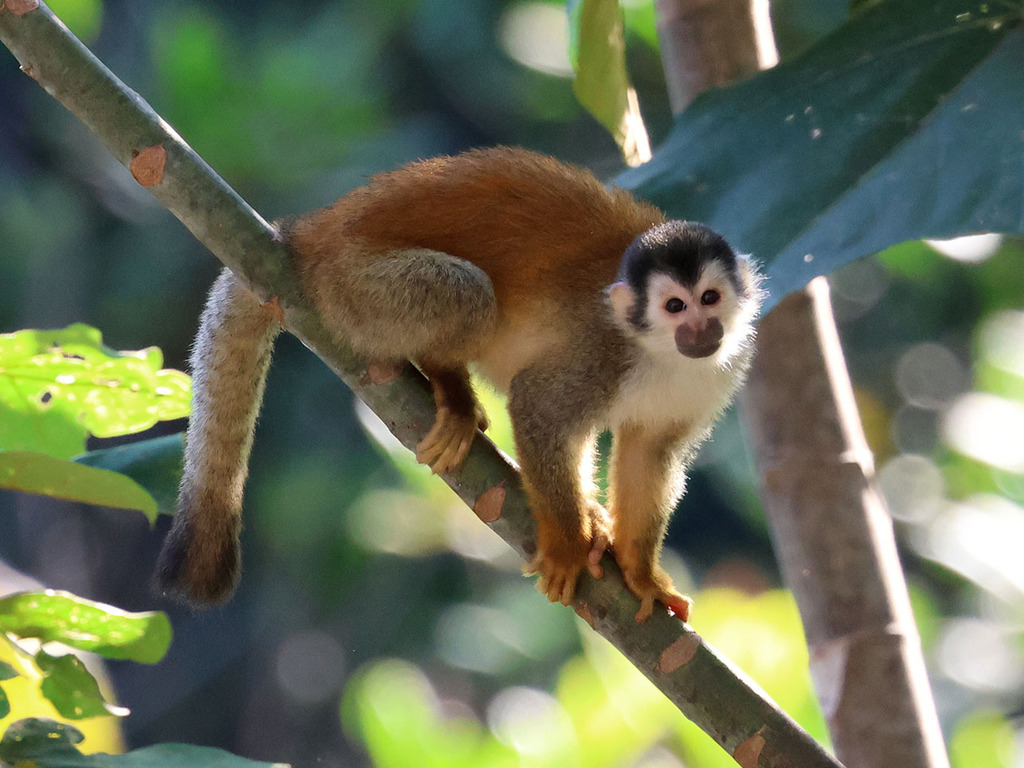
Central American Squirrel Monkey
Saimiri oerstedii
The Central American squirrel monkey (Saimiri oerstedii), also known as the red-backed squirrel monkey, is a squirrel monkey species from the Pacific coast of Costa Rica and Panama. It is restricted to the northwestern tip of Panama near the border with Costa Rica, and the central and southern Pacific coast of Costa Rica, primarily in Manuel Antonio and Corcovado National Parks.
It is a small monkey with an orange back and a distinctive white and black facial mask. It has an omnivorous diet, eating fruits, other plant materials, invertebrates and some small vertebrates. In turn, it has a number of predators, including raptors, cats and snakes. It lives in large groups that typically contain between 20 and 75 monkeys. It has one of the most egalitarian social structures of all monkeys. Females do not form dominance hierarchies, and males do so only at breeding season. Females become sexually mature at 2+1⁄2 years, and males at 4 to 5 years. Sexually mature females leave the natal group, but males can remain with their natal group their entire life. The Central American squirrel monkey can live for more than 15 years.
From the article Central American squirrel monkey on Wikipedia (CC BY-SA), quoted section by section
Range & habitat
The Central American squirrel monkey has a restricted distribution in Costa Rica and Panama. It lives only near the Pacific coast. Its range covers Central Pacific Costa Rica in the north through western Panama. It lives in two of Costa Rica's national parks—Manuel Antonio National Park and Corcovado National Park—where it can be seen by visitors, but it is not as commonly seen in these parks as the white-headed capuchin or the mantled howler monkeys. It lives in lowland forests and is restricted to secondary forests and primary forests which have been partially logged. It requires forests with abundant low and mid-level vegetation and has difficulty surviving in tall, mature, undisturbed forests that lack such vegetation. Its specialization for coastal lowland forest may explain its restricted distribution.
Wikipedia: “Distribution and habitat”
What it does
The Central American squirrel monkey is omnivorous. Its diet includes insects and insect larvae (especially grasshoppers and caterpillars), spiders, fruit, leaves, bark, flowers, and nectar. It also eats small vertebrates, including bats, birds, lizards, and tree frogs. It finds its food foraging through the lower and middle levels of the forest, typically between 4.5 and 9 metres (15 and 30 feet) high. Two-thirds to three-quarters of each day is spent foraging for food. It has difficulty finding its desired food late in the wet season, when fewer arthropods are available. It has a unique method of capturing tent-making bats. It looks for roosting bats by looking for their tents (which are made of a folded leaf). When it finds a bat it climbs to a higher level and jumps onto the tent from above, attempting to dislodge the bat. If the fallen bat does not fly away in time, the monkey pounces on it on the ground and eats it. The Central American squirrel monkey is an important seed disperser and a pollinator of certain flowers, including the passion flower. While it is not a significant agricultural pest, it does sometimes eat corn, coffee, bananas and mangos. Other fruits eaten include cecropias, legumes, figs, palms, cerillo, quiubra, yayo flaco and wild cashew fruits.
Wikipedia: “Diet”
Listen
Looking for field recordings…
Where it lives
Recorded sightings
—
geo-referenced records in GBIF, from museums, herbaria and field observers.
Drag the globe to turn it. Dots are where records exist, not a range map; darker means more records.
In the stacks
Searching the stacks…
Every page naming Saimiri oerstedii in the Biodiversity Heritage Library →
This page is assembled live from iNaturalist, GBIF, Wikipedia, the Source Library and the Internet Archive. It is not yet part of the hand-edited codex. iNaturalist taxon 43425.