- Animals
- ›Chordates
- ›Vertebrates
- ›Mammals
- ›Therians
- ›Placental Mammals
- ›Primates, Rodents, and Allies
- ›Rodents
- ›Squirrels, Dormice, and Mountain Beavers
- ›Squirrels
- ›Beautiful and Palm Squirrels
- ›Palm Squirrels
- ›Funambulus
- ›Funambulus
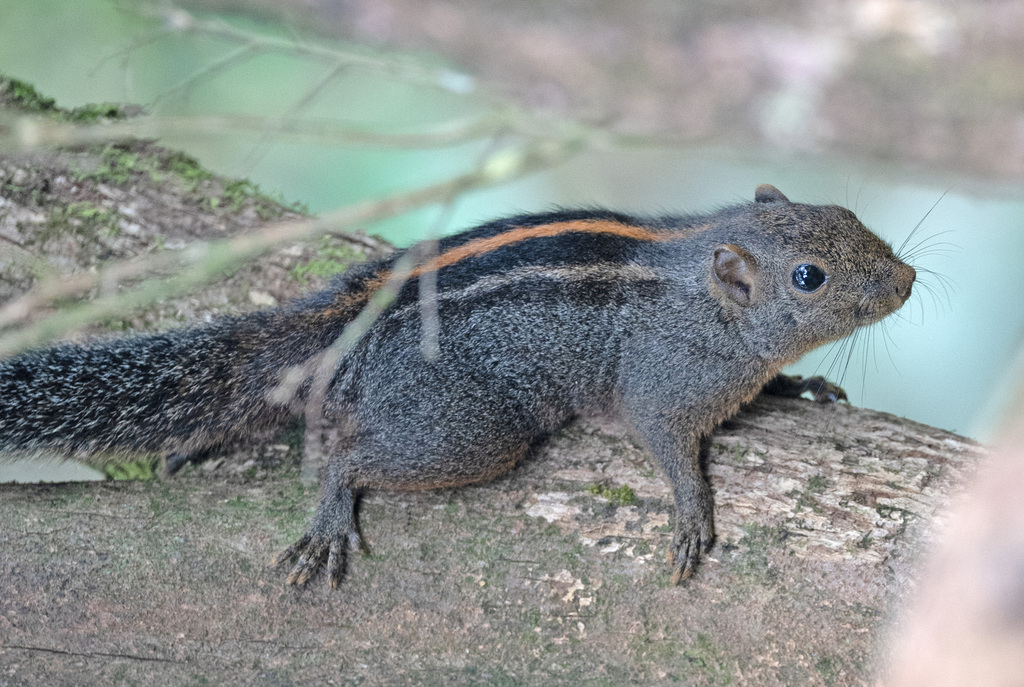
Layard's Palm Squirrel
Funambulus layardi
Layard's palm squirrel or flame-striped jungle squirrel (Funambulus layardi) is a species of rodents in the family Sciuridae endemic to Sri Lanka. The validity of the subspecies F. l. dravidianus based on a single specimen from the southern tip of India has been questioned, and is probably a juvenile F. sublineatus. Known as මූකලන් ලේනා (mukalan lena) in Sinhala.
From the article Layard's palm squirrel on Wikipedia (CC BY-SA), quoted section by section
Description
Its head and body length is 12–17 cm, with a 14-cm tail. In color, it is blackish brown with three stripes on its dorsum; the central stripe is broadest and longest with an orange hue in F. signatus, yellow in F. layardi. Its underparts are reddish orange in color, and its snout is small. Tail bushy and blackish brown with some red in it. Some individuals also possess some grizzling appearance on it. Fur is soft, short and dense.
Range & habitat
It is endemic to the central highlands of Sri Lanka. Few observations are known out of central hills, such as from Trincomalee and Matara districts, but it remains unresolved. It can be seen in Knuckles mountain range and other high altitude ranges in western basin of the central hills.
Wikipedia: “Distribution”
What it does
Its natural habitat is subtropical and tropical moist lowland forests or subtropical and tropical moist montane forests. It is threatened by habitat loss. It is a diurnal species as other squirrels of the genus and forage in full daytime. They are found on canopy level in forests, where they spend little time on ground. With night falls, they start to become noisy. The main predators of this little creature are snakes, raptor birds, civets and small cats. Mongooses can be predators when they land on the ground floor.
Wikipedia: “Habitat and ecology”
Listen
Looking for field recordings…
Where it lives
Recorded sightings
—
geo-referenced records in GBIF, from museums, herbaria and field observers.
Drag the globe to turn it. Dots are where records exist, not a range map; darker means more records.
In the stacks
Searching the stacks…
Every page naming Funambulus layardi in the Biodiversity Heritage Library →
This page is assembled live from iNaturalist, GBIF, Wikipedia, the Source Library and the Internet Archive. It is not yet part of the hand-edited codex. iNaturalist taxon 45939.