- Animals
- ›Chordates
- ›Vertebrates
- ›Mammals
- ›Therians
- ›Placental Mammals
- ›Primates, Rodents, and Allies
- ›Rodents
- ›Squirrels, Dormice, and Mountain Beavers
- ›Squirrels
- ›Ground and African Tree Squirrels
- ›Holarctic Ground Squirrels
- ›Spermophilus
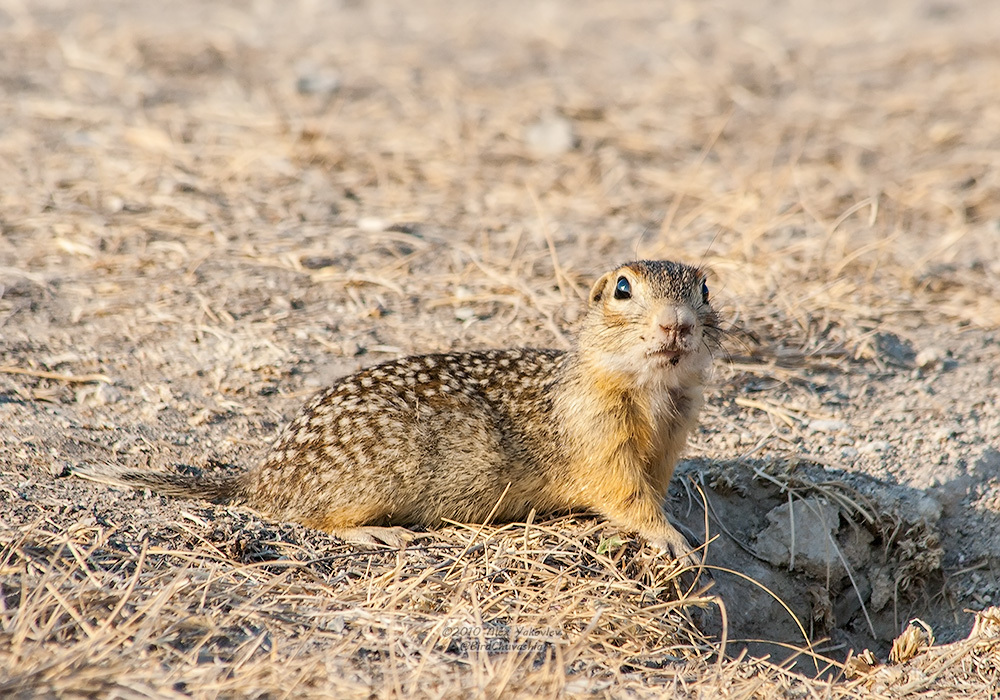
Speckled Ground Squirrel
Spermophilus suslicus
The speckled ground squirrel or spotted souslik (Spermophilus suslicus) is a species of rodent in the family Sciuridae from Eastern Europe. Spermophilus suslicus consists of three subspecies: S. s. boristhenicus, S. s. guttatus, and S. s. suslicus. It is threatened by habitat loss.
From the article Speckled ground squirrel on Wikipedia (CC BY-SA), quoted section by section
Description
The speckled ground squirrel has dark-brown fur with white spots on its back and a short, thin tail. It grows to a length of 25 cm (10 in) and a weight of 280 g (10 oz). Its dental formula is 1.0.2.31.0.1.3. It is smaller and less social than many other ground squirrels of the genus Spermophilus.
Range & habitat
It is found in Belarus, Moldova, Poland, European Russia, and Ukraine. Its natural habitat is temperate grassland and it is also found on cultivated ground. It is threatened by the loss and fragmentation of its habitat. Causes of habitat loss include the expansion of agriculture and forestry, the reduction of pasturing, the development and growth of cities, and industrial development. Also, in some areas it is hunted as an agricultural pest. The speckled ground squirrel's range in Poland and southern Russia has contracted markedly, with only 10% of its area in the mid-twentieth century currently remaining. At the current rate of contraction of its range, the speckled ground squirrel will soon be extirpated from Poland.
Wikipedia: “Distribution”
What it does
The speckled ground squirrel is a diurnal species which hibernates from October to April. It is active in the morning once the sun warms the area slightly, retreats to its underground den during the heat of the day, then reemerges late in the day for another feeding bout. It feeds mostly on grasses and cereals, although small vertebrates and arthropods are also eaten. Compared with other Spermophilus species, it lives in a relatively closed habitat with high grasses that block visibility during its active seasons. Individuals live in separate burrows within a larger colony. These colonies can be up to over 160 individuals per ha. It mates between April and May. Gestation ranges from 23 to 26 days. Four to eight cubs are born per litter. Sporadic hybridization occurs where S. suslicus occurs sympatrically with the little (S. pygmaeus) and European ground squirrels (S. citellus).
Wikipedia: “Behavior”
Listen
Looking for field recordings…
Where it lives
Recorded sightings
—
geo-referenced records in GBIF, from museums, herbaria and field observers.
Drag the globe to turn it. Dots are where records exist, not a range map; darker means more records.
In the stacks
Searching the stacks…
Every page naming Spermophilus suslicus in the Biodiversity Heritage Library →
This page is assembled live from iNaturalist, GBIF, Wikipedia, the Source Library and the Internet Archive. It is not yet part of the hand-edited codex. iNaturalist taxon 46047.