- Animals
- ›Chordates
- ›Vertebrates
- ›Mammals
- ›Therians
- ›Placental Mammals
- ›Primates, Rodents, and Allies
- ›Rodents
- ›Mice, Rats, and Hamsters
- ›Muroids
- ›Old World Mice and Rats
- ›Murines
- ›Australasian Mice and Rats
- ›Notomys
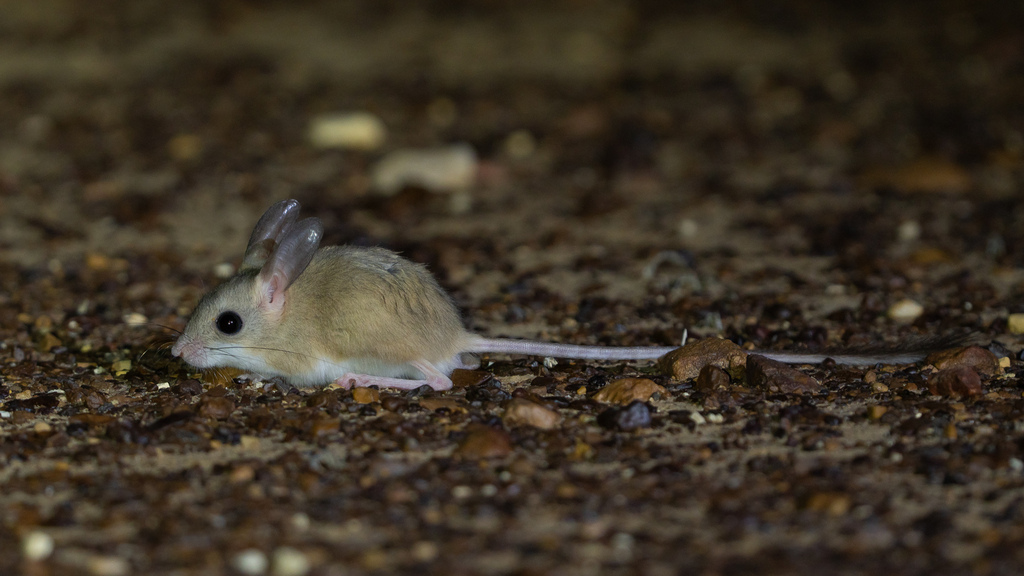
Fawn Hopping Mouse
Notomys cervinus
The fawn hopping mouse (Notomys cervinus) is a medium sized rodent endemic to the Channel Country Bioregion of northeast South Australia and southwest Queensland in Australia. They inhabit open gibber (stony) and clay plains of the Lake Eyre basin. While the population and distribution has been greatly reduced since European settlement, the current population shows little evidence of significant decline and is consequently listed as 'Near Threatened'.
From the article Fawn hopping mouse on Wikipedia (CC BY-SA), quoted section by section
Description
The fawn hopping mouse is a medium sized rodent weighing between 30 and 50 g (1.1 and 1.8 oz) with a head and body length between 10 and 12 cm (3.7 to 4.7 in). Its bi-coloured tail is longer than the length of the body reaching a length of 12–16 cm (4.7 to 6.3 in) ending with a tuft of dark hairs. The head is broad and short with large, long ears with distinctive large protuberant eyes. Whiskers on the muzzle are extremely long reaching a length of up to 6.5 cm (2.6 in). The hind legs and feet are very elongated similar to other hopping mouse species. This allows for efficient movements through the environment.
Identification. The colour range of the upper body between individuals varies from a pale pinkish-fawn to grey. The underside is white with the tail following a similar colour pattern to the rest of the body except the dark brush at the tip. The absence of throat pouches in both males and females can be used to distinguish fawn hopping mouse from the closely related species the dusky hopping mouse (Notomys fuscus) and spinifex hopping mouse (Notomys alexis). The presence of a naked area of glandular skin on the chest between the forelimbs of males (and some females) can also be used to distinguish between species.
Range & habitat
The current endemic range of the fawn hopping mouse is largely reduced to the Channel Country Bioregion north-east South Australia and south-west Queensland. Restricted to a quarter of the area surrounding the Lake Eyre Basin with a patchy distribution. Records from the 19th century and anecdotal evidence from the 1930s show that the former range of this species was much larger and suggests it may have existed in a broader range of habitats. The historical range included most of the Lake Eyre Basin, southern Northern Territory, and the eastern edge of the Nullarbor Plain as well as western New South Wales. Subfossil evidence supports this broader range along with some specimens have been found in Western Australia around the Nullarbor Plain.
Wikipedia: “Current range”
What it does
The fawn hopping mouse constructs burrows in sand patches, or in gibber or claypans when soil is softened after rain. These are simpler and shallower than the ones constructed by dusky hopping mouse up to a metre deep and have between one and three entrances. One individual will have at least two burrows in the system. Fawn hopping mice can be either solitary or live in small groups made up of two to four individuals. This species is nocturnal, using its burrows during the day to avoid the highest extreme temperatures.
Wikipedia: “Behaviour”
Listen
Looking for field recordings…
Where it lives
Recorded sightings
—
geo-referenced records in GBIF, from museums, herbaria and field observers.
Drag the globe to turn it. Dots are where records exist, not a range map; darker means more records.
In the stacks
Searching the stacks…
Every page naming Notomys cervinus in the Biodiversity Heritage Library →
This page is assembled live from iNaturalist, GBIF, Wikipedia, the Source Library and the Internet Archive. It is not yet part of the hand-edited codex. iNaturalist taxon 45117.