- Animals
- ›Chordates
- ›Vertebrates
- ›Mammals
- ›Therians
- ›Placental Mammals
- ›Primates, Rodents, and Allies
- ›Rodents
- ›Mice, Rats, and Hamsters
- ›Muroids
- ›Old World Mice and Rats
- ›Murines
- ›Typical Old World Rats
- ›Rattus
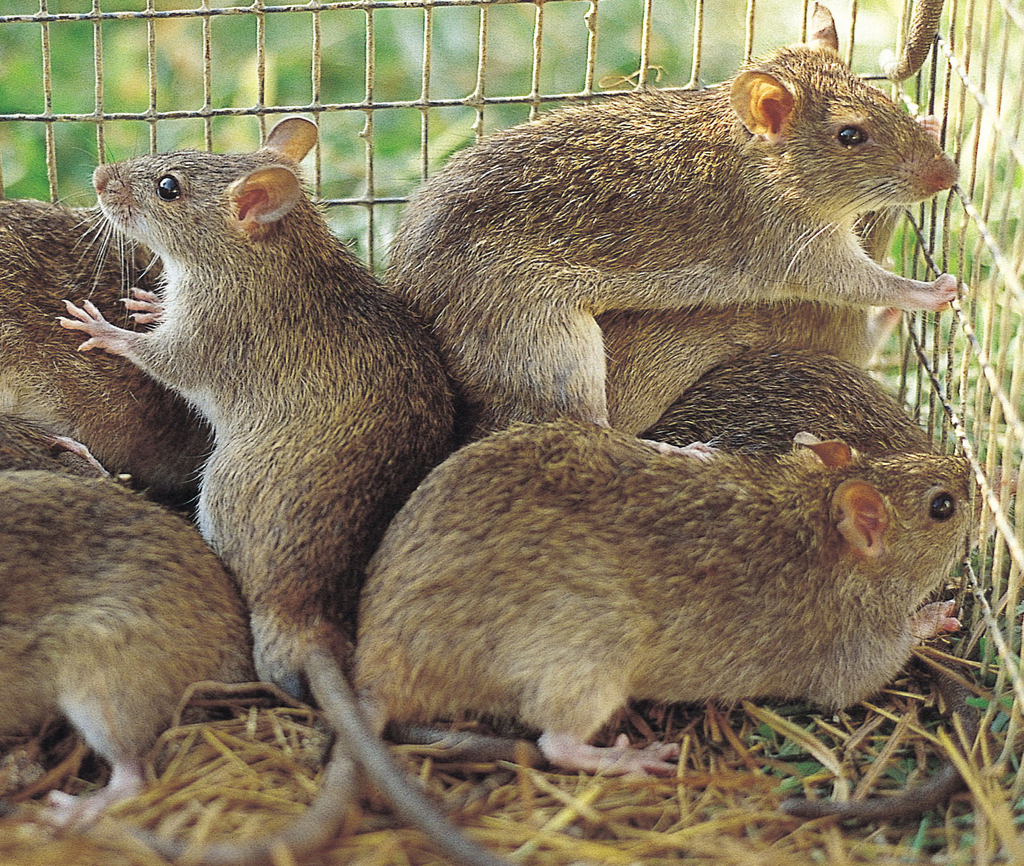
Ricefield Rat
Rattus argentiventer
The ricefield rat (Rattus argentiventer) is a species of rat found throughout Southeast Asia.
From the article Ricefield rat on Wikipedia (CC BY-SA), quoted section by section
Description
The ricefield rat is a medium-sized rat with a grizzled yellow-brown and black pelage. Its belly is gray in the midline with whiter flanks. The tail is uniformly medium brown. They have chisel-like incisor. The ricefield rat is between 304–400 mm (12.0–15.7 in) long with a tail length of 140–200 mm (5.5–7.9 in) and a skull length of 37–41 mm (1.5–1.6 in). The average weight of Rattus argentiventer is around 97 to 219 g (3.4 to 7.7 oz). Female have 12 mammae. Young have an orange-colored tuft in front of each ear.
Range & habitat
The ricefield rat can be found throughout Southeast Asia consists of Indochina region, Thailand, Peninsular Malaysia, Indonesia, Philippine, and New Guinea as major rodent pest in rice field area. Although not a part of staple human diet in Cambodia, a growing market has developed there with most exports going to Vietnam. Rat-catching season reaches its height after the rice harvest in June and July when rats have little to eat. That lack of food coincides with seasonal rains that force the rodents onto higher ground, where traps are set up to catch them.
Wikipedia: “Distribution”
What it does
The ricefield rat lives in large groups which consist of a dominant male and high ranking female. When attacked or disturbed they will make squeals and whistles sound. Rattus argentiventer's main diet includes termites, insects, grasshopper, snails, seeds, nuts, rice, vegetables, and fruits. They feed at night and move actively at dusk and dawn. During daytime, they can be seen among vegetation, weeds or maturing field. It undergoes 3 week gestation giving birth about 5 to 10 young per litter.
Wikipedia: “Behavior”
Listen
Looking for field recordings…
Where it lives
Recorded sightings
—
geo-referenced records in GBIF, from museums, herbaria and field observers.
Drag the globe to turn it. Dots are where records exist, not a range map; darker means more records.
In the stacks
Searching the stacks…
Every page naming Rattus argentiventer in the Biodiversity Heritage Library →
This page is assembled live from iNaturalist, GBIF, Wikipedia, the Source Library and the Internet Archive. It is not yet part of the hand-edited codex. iNaturalist taxon 44589.