- Animals
- ›Chordates
- ›Vertebrates
- ›Mammals
- ›Therians
- ›Marsupials
- ›Kangaroos, Possums, Wombats, and Allies
- ›Cuscuses, Brush-tailed Possums, and Pygmy Possums
- ›Cuscuses and Brush-tailed Possums
- ›Brush-tailed and Scaly-tailed Possums
- ›Trichosurus
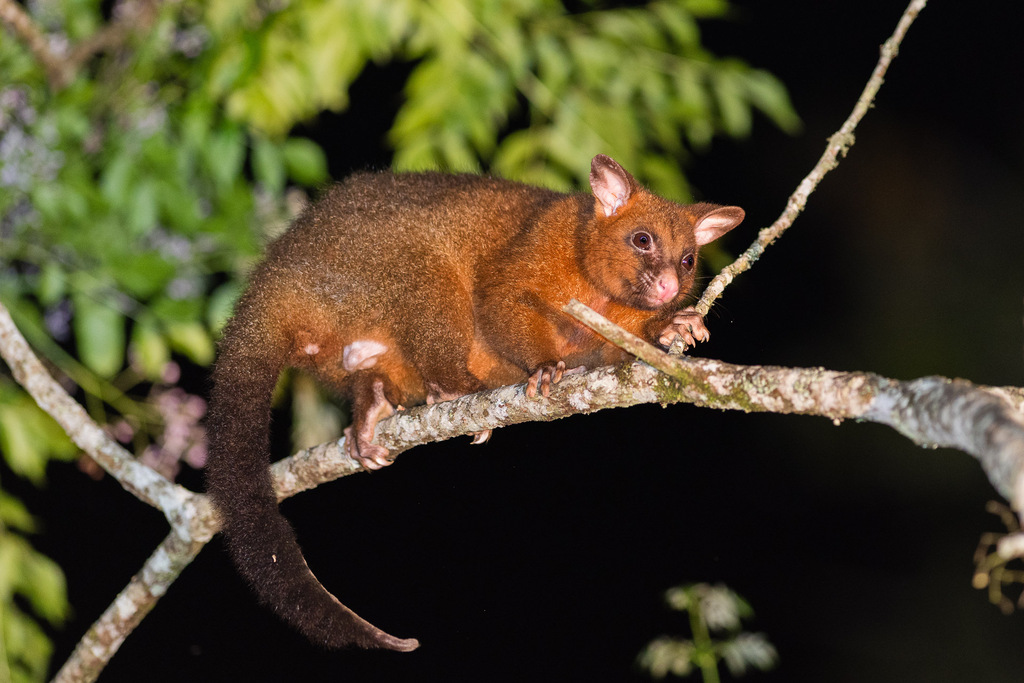
Coppery Brush-tailed Possum
Trichosurus johnstonii
The coppery brushtail possum (Trichosurus johnstonii) is a species of marsupial possum in the family Phalangeridae. Coppery brushtails are found within the Atherton Tablelands area of Queensland, in northeastern Australia. These mammals inhabit rainforest ecosystems, living within the tree canopy. Though they have a restricted distribution, they are locally common. This population is often considered a subspecies of T. vulpecula.
From the article Coppery brushtail possum on Wikipedia (CC BY-SA), quoted section by section
Description
Coppery brushtail possums have a typical length of 40–49 cm (16–19 in) and weigh 1.2–1.8 kg (2.6–4.0 lb), with males being larger and heavier than females.
What it does
Like the common brushtail possum, coppery brushtails are nocturnal, and live in dens, which are usually tree hollows. At night, they still spend half of their time resting to conserve energy, and the other half in foraging. In feeding experiments, in selecting their food, these possums may tend to select a mix of plant materials with detoxification requirements that are correlated or independent, rather than contradictory, thus maximizing their ability to process harmful plant byproducts. Dominance among individuals tends to place females above males, and larger over smaller individuals.
== References ==
Wikipedia: “Ecology”
Listen
Looking for field recordings…
Where it lives
Recorded sightings
—
geo-referenced records in GBIF, from museums, herbaria and field observers.
Drag the globe to turn it. Dots are where records exist, not a range map; darker means more records.
In the stacks
Searching the stacks…
Every page naming Trichosurus johnstonii in the Biodiversity Heritage Library →
This page is assembled live from iNaturalist, GBIF, Wikipedia, the Source Library and the Internet Archive. It is not yet part of the hand-edited codex. iNaturalist taxon 564497.