- Animals
- ›Chordates
- ›Vertebrates
- ›Mammals
- ›Therians
- ›Placental Mammals
- ›Ungulates, Carnivorans, and Allies
- ›Odd-toed Ungulates
- ›Equines
- ›Equus
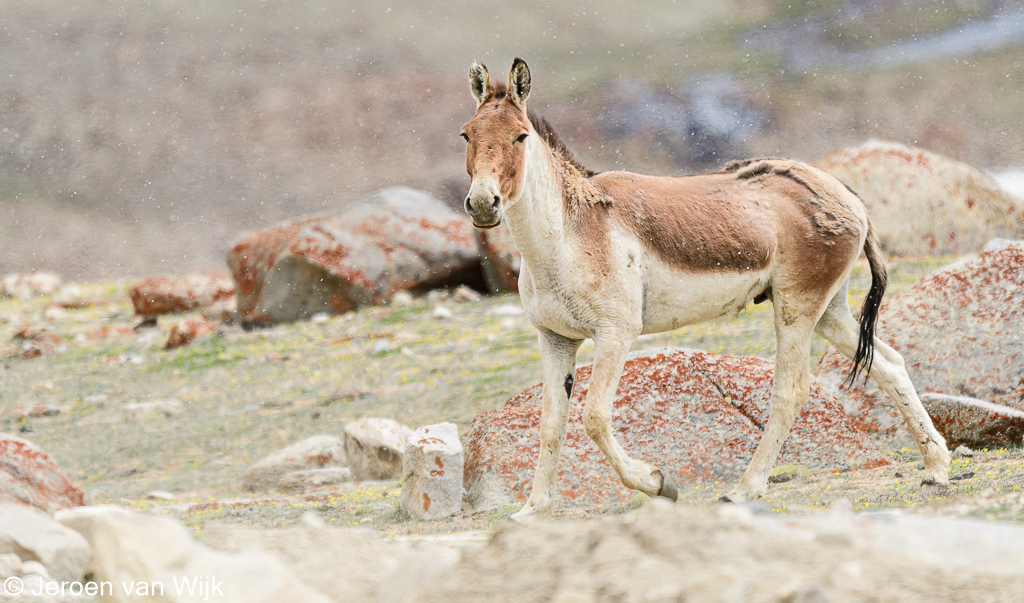
Kiang
Equus kiang
The kiang (Equus kiang) is the largest of the wild asses. It is native to the Tibetan Plateau, where it inhabits montane and alpine grasslands. Its current range is restricted to Ladakh in Jammu and Kashmir, plains of the Tibetan plateau and northern Nepal along the Tibetan border. Other common names for this species include Tibetan wild ass, khyang and gorkhar.
From the article Kiang on Wikipedia (CC BY-SA), quoted section by section
Description
The kiang is the largest of the wild asses, with an average height at the withers of 140 cm (55 in). They range from 132 to 142 cm (52 to 56 in) high at the withers, with a body 182 to 214 cm (72 to 84 in) long, and a tail of 32 to 45 cm (13 to 18 in). Kiangs have only slight sexual dimorphism, with the males weighing from 350 to 400 kg (770 to 880 lb), while females weigh 250 to 300 kg (550 to 660 lb). They have a large head, with a blunt muzzle and a convex nose. The mane is upright and relatively short. The coat is a rich chestnut colour, darker brown in winter and a sleek reddish brown in late summer, when the animal moults its woolly fur. The summer coat is 1.5 cm (0.59 in) long, and the winter coat is double that length. The legs, underparts, end of the muzzle, and the inside of the ears are all white. A broad, dark chocolate-coloured dorsal stripe extends from the mane to the end of the tail, which ends in a tuft of blackish brown hairs.
Range & habitat
The kiang is distributed in the Himalayas and Tibetan Plateau from northern Pakistan, Ladakh, Himachal Pradesh and Uttarakhand states of India to Qinghai, Gansu, southern Xinjiang and Sichuan regions of China. It inhabits alpine meadows and steppe country at elevations from 2,700 to 5,300 m (8,900 to 17,400 ft), preferring relatively flat plateaus, wide valleys, and low hills, dominated by grasses, sedges, and other short vegetation. In Pakistan, the kiang occurs in the area between the Oprang river and the Shaksgam River with its presence confirmed in Khunjerab National Park. There are also small numbers along the northern frontier of Nepal.
Wikipedia: “Distribution and habitat”
What it does
The kiang is a herbivore, feeding on grasses and sedges, especially Stipa, but also on other plants such as bog sedges, true sedges, and meadow grasses. When little grass is available, such as during winter or in the more arid margins of their native habitat, kiangs have been observed eating shrubs, herbs, and even Oxytropis roots dug from the ground. Although they do sometimes drink from waterholes, such sources of water are rare on the Tibetan Plateau, and they likely obtain most of their water from the plants they eat, or possibly from snow in winter. Kiangs sometimes gather in large herds, which may number several hundred individuals. However, these herds are not permanent groupings, but temporary aggregations, consisting either of young males only, or of mothers and their foals. Older males are typically solitary, defending a territory of about 0.5 to 5 km2 (0.19 to 1.93 sq mi) from rivals, and dominating any local groups of females. Territorial males sometimes become aggressive towards intruders, kicking and biting at them, but more commonly chase them away after a threat display that involves flattening the ears and braying.
Reproduction. Kiangs mate between late July and late August, when older males tend reproductive females by trotting around them, and then chasing them prior to mating. …
Wikipedia: “Behavior and ecology”
In human culture
Natural historian Chris Lavers points to travellers' tales of the kiang as one source of inspiration for the unicorn, first described in Indika by the Ancient Greek physician Ctesias. Ekai Kawaguchi, a Japanese monk who traveled in Tibet from July, 1900 to June 1902, reported:
As I have already said, khyang is the name given by the Tibetans to the wild horse of their northern steppes. More accurately it is a species of ass, quite as large in size as a large Japanese horse. In color it is reddish brown, with black hair on the ridge of the back and black mane and with the belly white. To all appearance it is an ordinary horse, except for its tufted tail. It is a powerful animal, and it is extraordinarily fleet. It is never seen singly, but always in twos or threes, if not in a herd of sixty or seventy. Its scientific name is Equus hemionis, but is for the most part called by its Tibetan name, which is usually spelled khyang in English. It has a curious habit of turning round and round, when it comes within seeing distance of a man. Even a mile and a quarter away, it will commence this turning round at every short stage of its approach, and after each turn it will stop for a while, to look at the man over its own back, like a fox. Ultimately it comes up quite close. …
Wikipedia: “In culture”
Listen
Looking for field recordings…
Where it lives
Recorded sightings
—
geo-referenced records in GBIF, from museums, herbaria and field observers.
Drag the globe to turn it. Dots are where records exist, not a range map; darker means more records.
In the stacks
Searching the stacks…
Every page naming Equus kiang in the Biodiversity Heritage Library →
This page is assembled live from iNaturalist, GBIF, Wikipedia, the Source Library and the Internet Archive. It is not yet part of the hand-edited codex. iNaturalist taxon 43338.