- Animals
- ›Chordates
- ›Vertebrates
- ›Mammals
- ›Therians
- ›Placental Mammals
- ›Ungulates, Carnivorans, and Allies
- ›Odd-toed Ungulates
- ›Equines
- ›Equus
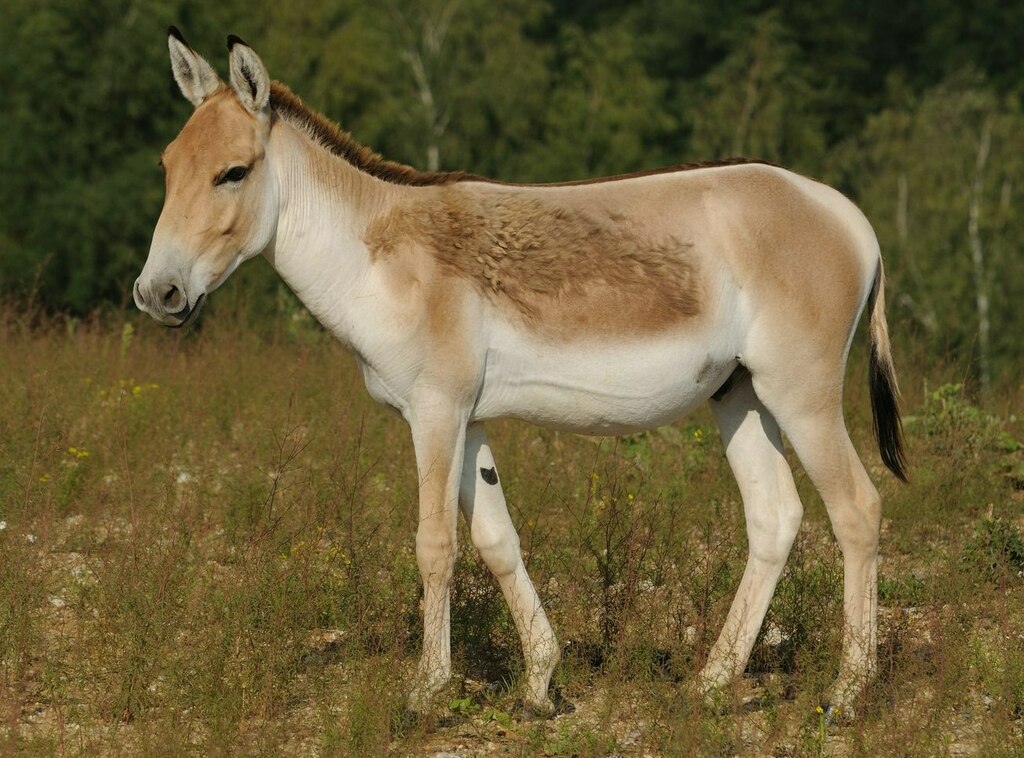
Onager
Equus hemionus
The onager (, ) (Equus hemionus), also known as hemione or Asiatic wild ass, is a species of the family Equidae native to Asia. A member of the subgenus Asinus, the onager was described and given its binomial name by German zoologist Peter Simon Pallas in 1775. Six subspecies are accepted.
The onager is reddish-brown or yellowish-brown and has a broad dorsal stripe on the middle of the back. It weighs about 200–260 kg (440–570 lb) and reaches about 2.1 m (6 ft 11 in) head-body length. It is among the fastest mammals, capable of running 64–70 km/h (40–43 mph).
From the article Onager on Wikipedia (CC BY-SA), quoted section by section
Description
The onager is generally reddish-brown during the summer, becoming yellowish-brown or greyish-brown in the winter. It has a black stripe bordered in white that extends down the middle of the back. The belly, the rump, and the muzzle are white, except for the Mongolian wild ass that has a broad black dorsal stripe bordered with white. It is about 200 to 260 kg (440 to 570 lb) in size and 2.1 to 2.5 m (6 ft 11 in to 8 ft 2 in) in head-body length. Male onagers are usually larger than females.
Wikipedia: “Characteristics”
Range & habitat
The onagers' favoured habitats consist of desert plains, semideserts, oases, arid grasslands, savannahs, shrublands, steppes, mountainous steppes, and mountain ranges. The Turkmenian kulan and Mongolian wild asses are known to live in hot and colder deserts. The IUCN estimates about 28,000 mature individuals in total remain in the wild. During the late Pleistocene era around 40,000 years ago, the Asiatic wild ass ranged widely across Europe and in southwestern to northeastern Asia. It is also known from Middle Pleistocene fossils from the Nefud Desert of Saudi Arabia. The onager is regionally extinct in Israel, Saudi Arabia, Iraq, Jordan, Syria, and southern regions of Siberia.
The Mongolian wild ass lives in deserts, mountains, and grasslands of Mongolia and Inner Mongolian region of northern China. A few live in northern Xinjiang region of northwestern China, most of which live mainly in Kalamaili Nature Reserve. It is the most common subspecies, but its populations have drastically decreased to a few thousand due to years of poaching and habitat loss in East Asia. The Gobi Desert is the onager's main stronghold. …
Wikipedia: “Distribution and habitat”
What it does
Asiatic wild asses are mostly active at dawn and dusk, even during the intense heat.
Social structure. Like most equids, onagers are social animals. Stallions are either solitary or live in groups of two or three. The males have been observed holding harems of females, but in other studies, the dominant stallions defend territories that attract females. Differences in behaviour and social structure likely are the result of changes in climate, vegetation cover, predation, and hunting. The social behaviour of the Asian wild ass can vary widely, depending on different habitats and ranges, and on threats by predators including humans. In Mongolia and Central Asia (E. h. hemionus and E. h. kulan), an onager stallion can adopt harem-type social groups, with several mares and foals in large home areas in the southwest, or in territory-based social groups in the south and southeast. Also, annual large hikes occur, covering 4.5 km2 (1.7 sq mi) to 40 km2 (15 sq mi), where hiking in summer is more limited than in the winter. Onagers also occasionally form large group associations of 450 to 1,200 individuals, but this usually only occurs in places with food or water sources. As these larger groups dissolve again within a day, no overarching hierarchy apart from the ranking of the individual herds seems to exist. …
Wikipedia: “Biology and behaviour”
In human culture
The first part of the scientific name derives from the Latin word equus which means horse and the second part from the Ancient Greek ἡμίονος, hēmíonos, from ἡμι-, hēmi-, 'half', and ὄνος, ónos, 'donkey'; thus, 'half-donkey' or mule. The term onager comes from the ancient Greek ὄναγρος, again from ὄνος, ónos, 'donkey', and ἄγριος, ágrios, 'wild'. The species was commonly known as Asian wild ass, in which case the term onager was reserved for the subspecies E. h. onager, more specifically known as the Persian onager. More recently, the species share the same name, onager.
Wikipedia: “Etymology”
Listen
Looking for field recordings…
Where it lives
Recorded sightings
—
geo-referenced records in GBIF, from museums, herbaria and field observers.
Drag the globe to turn it. Dots are where records exist, not a range map; darker means more records.
In the old herbals & bestiaries


In the stacks
Searching the stacks…
Every page naming Equus hemionus in the Biodiversity Heritage Library →
This page is assembled live from iNaturalist, GBIF, Wikipedia, the Source Library and the Internet Archive. It is not yet part of the hand-edited codex. iNaturalist taxon 43333.