- Animals
- ›Chordates
- ›Vertebrates
- ›Mammals
- ›Therians
- ›Placental Mammals
- ›Ungulates, Carnivorans, and Allies
- ›Even-toed Ungulates and Cetaceans
- ›Ruminants
- ›Deer
- ›New World Deer
- ›Roe and Water Deer
- ›Hydropotes
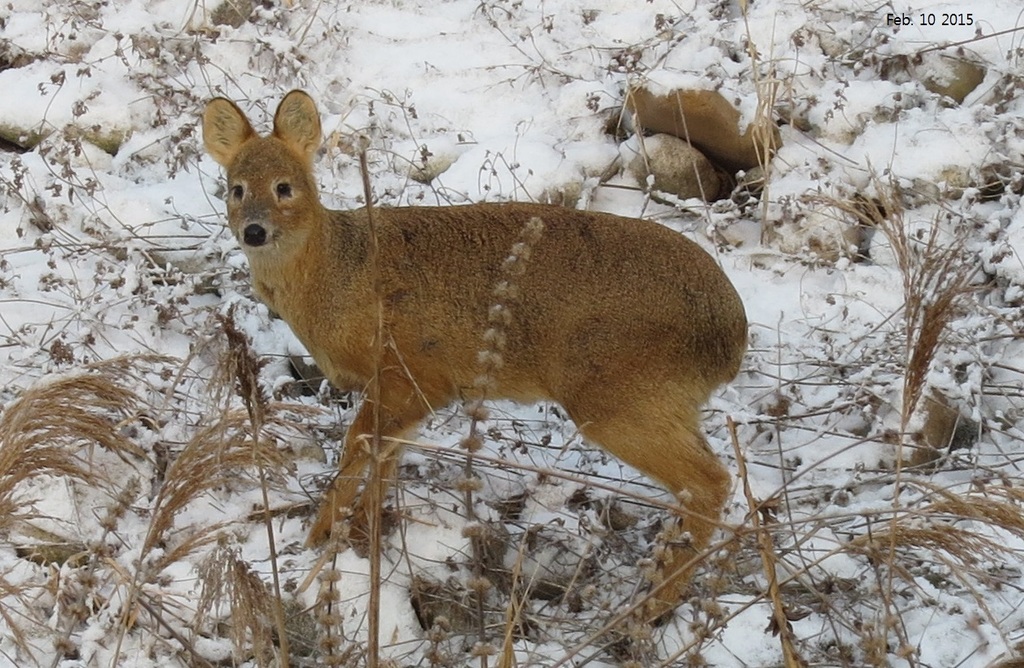
Water Deer
Hydropotes inermis
The water deer (Hydropotes inermis) is a small deer superficially more similar to a musk deer than a true deer. Native to China and Korea, there are two subspecies: the Chinese water deer (Hydropotes inermis inermis) and the Korean water deer (Hydropotes inermis argyropus). Despite its lack of antlers and certain other anatomical anomalies—including a pair of prominent tusks (downward-pointing canine teeth), it is classified as a cervid. Its unique anatomical characteristics have caused it to...
From the article Water deer on Wikipedia (CC BY-SA), quoted section by section
Range & habitat
Archeological studies indicate water deer were once distributed in a much broader range than currently during the Pleistocene and the Holocene periods; records have been obtained from eastern Tibet in the west, Inner Mongolia and northeastern China in the north, southeastern Korean Peninsula (Holocene) and Japanese archipelago (Pleistocene) in the east, southern China and northern Vietnam in the south. Water deer also inhabited Taiwan historically, however this population presumably became extinct as late as the early 19th century. Water deer are indigenous to the lower reaches of the Yangtze River, coastal Jiangsu province (Yancheng Coastal Wetlands), and islands of Zhejiang of east-central China, and in Korea, where the demilitarized zone has provided a protected habitat for a large number. The Korean water deer (H. i. argyropus) is one of the two subspecies of water deer. While the population of Chinese subspecies is critically endangered in China, the Korean subspecies is known to number 700,000 throughout South Korea. In China, water deer are found in Zhoushan Islands in the Zhejiang (600–800), Jiangsu (500–1,000), Hubei, Henan, Anhui (500), Guangdong, Fujian, Poyang Lake in Jiangxi (1,000), Shanghai, and Guangxi. They are now extinct in southern and western China. …
Wikipedia: “Habitat and distribution”
What it does
Apart from mating during the rutting season, water deer are solitary animals, and males are highly territorial. Each buck marks out his territory with urine and feces. Sometimes a small pit is dug and it is possible that in digging, the male releases scent from the interdigital glands on its feet. The male also scent-marks by holding a thin tree in his mouth behind the upper canines and rubbing his preorbital glands against it. Males may also bite off vegetation to delineate territorial boundaries. Water deer use their tusks for territorial fights and are not related to carnivores. Confrontations between males begin with the animals walking slowly and stiffly towards each other, before turning to walk in parallel 10–20 m (33–66 ft) apart, to assess one another. At this point, one male may succeed in chasing off his rival, making clicking noises during the pursuit. However, if the conflict is not resolved at the early stage, the bucks will fight. Each would try to wound the other on the head, shoulders, or back, by stabbing or tearing with his upper canines. The fight is ended by the loser, who either lays his head and neck flat on the ground or turns tail and is chased out of the territory. Numerous long scars and torn ears seen on males indicate that fighting is frequent. The fights are seldom fatal but may leave the loser considerably debilitated. …
Wikipedia: “Behaviour”
In human culture
The genus name Hydropotes corresponds to the ancient Greek word ὑδροπότης, meaning "water-drinker", and presumably refers to the preference of this cervid for rivers and swamps. The etymology of the species name corresponds to the Latin word inermis meaning unarmed, defenceless, itself constructed from the prefix in- meaning without, and the stem arma meaning defensive arms, armour, and presumably refers to the water deer's lack of antlers.
Wikipedia: “Etymology”
Listen
Looking for field recordings…
Where it lives
Recorded sightings
—
geo-referenced records in GBIF, from museums, herbaria and field observers.
Drag the globe to turn it. Dots are where records exist, not a range map; darker means more records.
In the stacks
Searching the stacks…
Every page naming Hydropotes inermis in the Biodiversity Heritage Library →
This page is assembled live from iNaturalist, GBIF, Wikipedia, the Source Library and the Internet Archive. It is not yet part of the hand-edited codex. iNaturalist taxon 42193.