- Animals
- ›Chordates
- ›Vertebrates
- ›Mammals
- ›Therians
- ›Placental Mammals
- ›Ungulates, Carnivorans, and Allies
- ›Even-toed Ungulates and Cetaceans
- ›Ruminants
- ›Deer
- ›Cervinae
- ›Typical Old World Deer
- ›Cervus
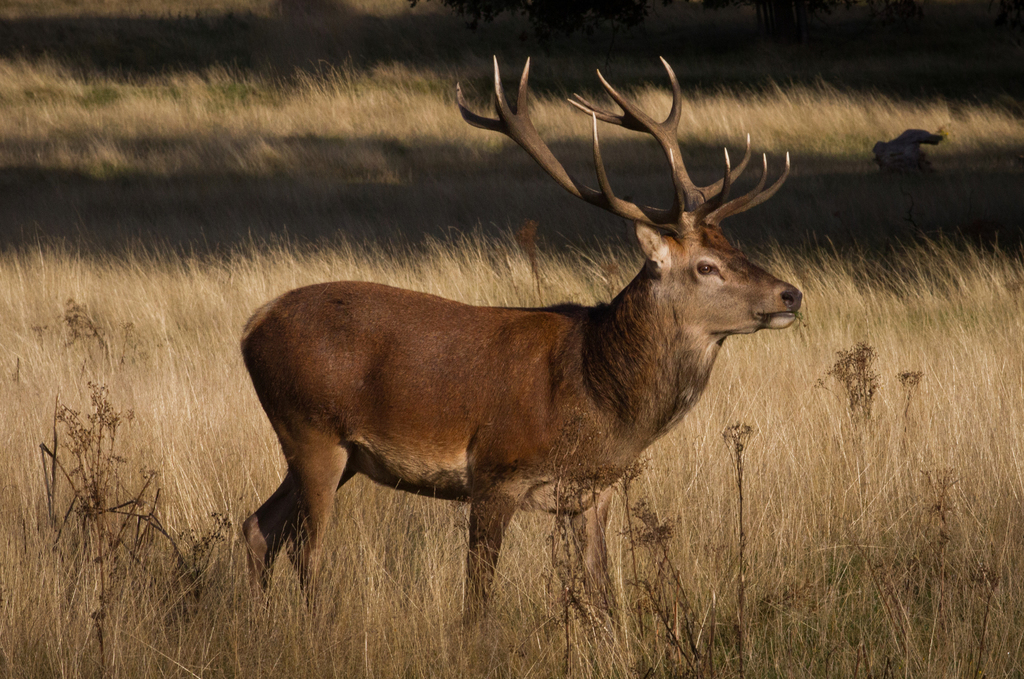
Red Deer
Cervus elaphus
The red deer (Cervus elaphus) is a species of deer in the genus Cervus. It is one of the largest deer species. A male red deer is called a stag or hart, and a female is called a hind. The red deer inhabits most of Europe, the Caucasus Mountains region, Anatolia, Iran, and parts of Western Asia. It also inhabits the Atlas Mountains of Northern Africa, being the only living species of deer to inhabit Africa. Red deer have been introduced to other areas, including Australia, New Zealand, the United States, Canada, Peru, Uruguay, Chile and Argentina. In many parts of the world, the meat (venison) from red deer is used as a food source.
The red deer is a ruminant, characterized by a four-chambered stomach. Genetic evidence indicates that the red deer, as traditionally defined, is a species group, rather than a single species, though exactly how many species the group includes remains disputed. The ancestor of the red deer probably originated in central Asia.
From the article Red deer on Wikipedia (CC BY-SA), quoted section by section
Description
The red deer is the fourth-largest extant deer species, behind the moose, elk, and sambar deer. It is a ruminant, eating its food in two stages and having an even number of toes on each hoof, like camels, goats, and cattle. European red deer have a relatively long tail compared with their Asian and North American relatives. Subtle differences in appearance are noted between the various subspecies of red deer, primarily in size and antlers, with the smallest being the Corsican red deer found on the islands of Corsica and Sardinia and the largest being the Caspian red deer (or maral) of Asia Minor and the Caucasus Region to the west of the Caspian Sea. The deer of central and western Europe vary greatly in size, with some of the largest deer found in the Carpathian Mountains in Central Europe. Western European red deer, historically, grew to large size given ample food supply (including people's crops), and descendants of introduced populations living in New Zealand and Argentina have grown quite large in both body and antler size. Large red deer stags, like the Caspian red deer or those of the Carpathian Mountains, may rival North American elk in size. Female red deer are much smaller than the males.
Size. …
What it does
Mature red deer (C. elaphus) usually stay in single-sex groups for most of the year. During the mating season, called the rut, mature stags compete for the attentions of the hinds and will then try to defend the hinds they attract. Rival stags challenge opponents by belling and walking in parallel. This allows combatants to assess each other's antlers, body size and fighting prowess. If neither stag backs down, a clash of antlers can occur, and stags sometimes sustain serious injuries. Red deer are among the mammals exhibiting homosexual behavior. Dominant stags urinate on themselves and follow groups of hinds during the rut, from August into early winter. The stags may have as many as 20 hinds to keep from other, less attractive males. Only mature stags hold harems (groups of hinds), and breeding success peaks at about eight years of age. Stags two to four years old rarely hold harems and spend most of the rut on the periphery of larger harems, as do stags over 11 years old. Young and old stags that do acquire a harem hold it later in the breeding season than those stags in their prime. Harem-holding stags rarely feed and lose up to 20% of their body weight. …
Wikipedia: “Behaviour”
In human culture
Red deer are widely depicted in cave art found throughout European caves, with some of the artwork dating from as early as 40,000 years ago, during the Upper Paleolithic. Siberian cave art from the Neolithic of 7,000 years ago has abundant depictions of red deer, including what can be described as spiritual artwork, indicating the importance of this mammal to the peoples of that region (Note: these animals were most likely wapiti (C. canadensis) in Siberia, not red deer). Red deer are also often depicted on Pictish stones (circa 550–850 AD), from the early medieval period in Scotland, usually as prey animals for human or animal predators. In medieval hunting, the red deer was the most prestigious quarry, especially the mature stag, which in England was called a hart.
Wikipedia: “Red deer in folklore and art”
Listen
Looking for field recordings…
Where it lives
Recorded sightings
—
geo-referenced records in GBIF, from museums, herbaria and field observers.
Drag the globe to turn it. Dots are where records exist, not a range map; darker means more records.
In the stacks
Searching the stacks…
Every page naming Cervus elaphus in the Biodiversity Heritage Library →
This page is assembled live from iNaturalist, GBIF, Wikipedia, the Source Library and the Internet Archive. It is not yet part of the hand-edited codex. iNaturalist taxon 204113.