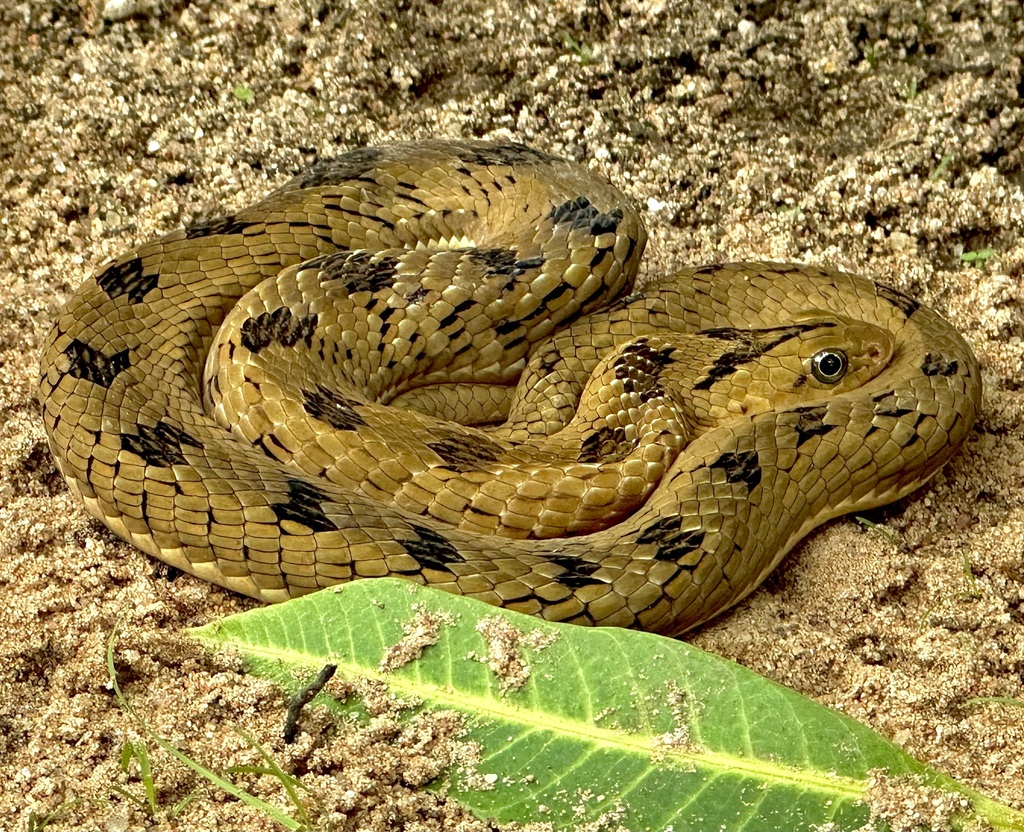
Spotted Night Adder
Causus maculatus
Causus maculatus is species of venomous snake in the subfamily Viperinae of the family Viperidae. The species is native to West Africa and Central Africa. There are no subspecies that are recognized as being valid. Common names include forest rhombic night adder, West African night adder, and spotted night adder.
From the article Causus maculatus on Wikipedia (CC BY-SA), quoted section by section
Description
C. maculatus is small and stout, with an average total length (tail included) of 30–60 cm (12–24 in). It grows to a maximum total length of about 70 cm (28 in), or perhaps slightly longer. The snout is obtuse with a rounded rostral scale. A single loreal is present. The circumorbital ring consists of 2–3 preoculars, 1–2 postoculars and 1–2 suboculars. There are 6 supralabials and 9–10 sublabials. Four sublabials are in contact with the sublinguals. There are 2–3 temporal scales. At midbody there are 17–19 rows of dorsal scales. The ventral scales number 118–137 in females and 124–144 in males. The subcaudal scales number 14–23 in females and 15–26 in males. Within the geographic range of this species, the ventral scale counts increase from south to north and from east to west. This diagnostic information is apparently according to Hughes (1977). Spawls and Branch (1995) give a slightly different description of the body scalation: at midbody there are 17–22 rows of dorsal scales, which have been described as soft and feebly keeled. …
Range & habitat
C. maculatus is found from Mauritania and Senegal east to western Ethiopia, south to DR Congo and northern Angola. The type locality is listed as "Liberia, Western Africa." Mallow et al. (2003) mostly quote Spawls and Branch (1995), giving the geographic range as West Africa and Central Africa, from Senegal east to Chad, southeast to the Democratic Republic of the Congo, and northeast into southeastern Sudan. It is also found in the river gorges and low country of southwestern Ethiopia, southwest to northern Angola and DR Congo.
Wikipedia: “Geographic range”
What it does
C. maculatus is terrestrial, but is known to climb into low bushes in pursuit of frogs. It is a relatively slow moving species of snake, but it can strike quickly, tending to lash rather than to stab. Despite its common names including the term "night adder", this species is known to be active at any time of the day, evening or night, and has sometimes been seen sunning itself. It is most active during the rainy season (March–October) when its prey is available, virtually disappearing during the dry season.
Wikipedia: “Behavior”
Toxicity
Bites from C. maculatus result in mild symptoms that include pain, moderate swelling, local lymphadenitis, and mild fever. Blistering has not been reported, while necrosis is rare and usually secondary. The symptoms disappear after two to three days and normally without any complications. No existing antivenins are known to counteract this venom.
Wikipedia: “Venom”
Where it lives
Recorded sightings
—
geo-referenced records in GBIF, from museums, herbaria and field observers.
Drag the globe to turn it. Dots are where records exist, not a range map; darker means more records.
In the stacks
Searching the stacks…
Every page naming Causus maculatus in the Biodiversity Heritage Library →
This page is assembled live from iNaturalist, GBIF, Wikipedia, the Source Library and the Internet Archive. It is not yet part of the hand-edited codex. iNaturalist taxon 96895.