- Animals
- ›Chordates
- ›Vertebrates
- ›Reptiles
- ›Snakes and Lizards
- ›Snakes
- ›Vipers
- ›True Vipers
- ›Vipera
- ›Vipera ammodytes
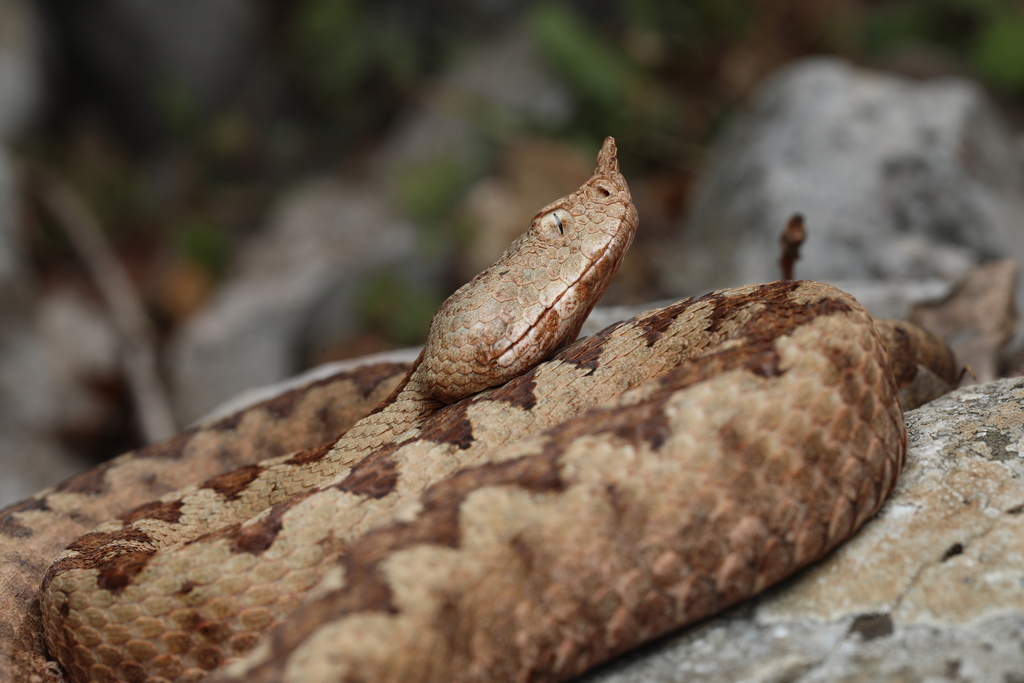
Long-nosed Viper
Vipera ammodytes
Vipera ammodytes, commonly known as horned viper, long-nosed viper, nose-horned viper, and sand viper, is a species of viper found in northern Italy, the Balkans, and parts of Asia Minor. Like all other vipers, it is venomous. It is reputed to be the most dangerous of the European vipers due to its large size, long fangs (up to 13 mm) and high venom toxicity. The specific name, ammodytes, is derived from the Greek words ammos, meaning "sand", and dutes, meaning "burrower" or "diver", despite its preference for rocky habitats. Five subspecies are currently recognized, including the nominate subspecies described here.
From the article Vipera ammodytes on Wikipedia (CC BY-SA), quoted section by section
Description
V. ammodytes grows to an average total length (snout-tail) of 85 cm (33.5 in), although individuals usually measure less than 75 cm (29.5 in). Maximum length also depends on locality, with northern forms distinctly larger than southern ones. In one field study on Golem Grad island (in North Macedonia), for example, females averaged 35 cm., and males at 37 cm.; the largest captured during the study was a male, at 66 cm. long. This indicates some degree of regional or insular dwarfism. The head is covered in small, irregular scales, that are either smooth or only weakly-keeled; a pair of large supraocular scales also extends beyond the posterior margin of the eye. Ten to thirteen small scales surround each eye, and two rows separate the eye from the supralabials. The nasal scale is large, single (rarely divided), and separated from the rostral by a single nasorostral scale. The rostral scale is wider than it is long. The most distinctive characteristic is a single "horn" on the snout, just above the rostral scale. It consists of approximately nine to seventeen small scales, arranged in two (occasionally three or four) transverse rows. It grows to a length of about 5 mm (0.20 in) and is actually soft and flexible. In southern subspecies, the horn sits vertically upright, while in V. a. …
Range & habitat
North-eastern Italy, Slovenia, Croatia, Bosnia-Herzegovina, Serbia, Montenegro, Kosova, Albania, Macedonia, Greece (including Cyclades), southern Austria, Romania, Bulgaria, Turkey, Georgia and Syria.
The type locality is listed as "Oriente". Schwarz (1936) proposed that the type locality be restricted to "Zara" (Zadar, Croatia).
Wikipedia: “Geographic range”
What it does
This species has no particular preference for its daily activity period. At higher altitudes, it is more active during the day. At lower altitudes, it may be found at any time of the day, becoming increasingly nocturnal as daytime temperatures rise. Despite its reputation, this species is generally lethargic, not at all aggressive, and tends not to bite without considerable provocation. If surprised, wild specimens may react in a number of different ways. Some remain motionless and hiss loudly, some hiss and then flee, while still others will attempt to bite immediately. Vipera ammodytes hibernates in the winter for a period of 2 to 6 months depending on environmental conditions.
Wikipedia: “Behaviour”
Toxicity
This is likely the most dangerous snake to be found in Europe. In some areas it is at least a significant medical risk. The venom can be quite toxic, based on tests conducted solely on mice, but varies over time and among different populations. Brown (1973) gives an LD50 for mice of 1.2 mg/kg IV, 1.5 mg/kg IP and 2.0 mg/kg SC. Novak et al. (1973) give ranges of 0.44–0.82 mg/kg and IV and 0.19–0.64 mg/kg IP. Minton (1974) states 6.6 mg/kg SC. The venom has both proteolytic and neurotoxic components and contains hemotoxins with blood coagulant properties, similar to and as powerful as in crotaline venom. Other properties include anticoagulant effects, hemoconcentration and hemorrhage. Bites promote symptoms typical of viperid envenomation, such as pain, swelling and discoloration, all of which may be immediate. There are also reports of dizziness and tingling. The venom is rarely deadly when hospital care is available. Humans respond rapidly to this venom, as do mice and birds. Lizards are less affected, while amphibians may even survive a bite. European snakes, such as Coronella and Natrix, are possibly immune. Vipera ammodytes venom is used in the production of antivenin for the bite of other European vipers and the snake is farmed for this purpose.
Wikipedia: “Venom”
Where it lives
Recorded sightings
—
geo-referenced records in GBIF, from museums, herbaria and field observers.
Drag the globe to turn it. Dots are where records exist, not a range map; darker means more records.
In the stacks
Searching the stacks…
Every page naming Vipera ammodytes in the Biodiversity Heritage Library →
This page is assembled live from iNaturalist, GBIF, Wikipedia, the Source Library and the Internet Archive. It is not yet part of the hand-edited codex. iNaturalist taxon 1701177.