 NL·0465
Herbarium of the Nature Library
- Name
- Gekko gecko
- Family
- Gekkonidae
- Native to
- Northeastern India and Bangladesh through southern China and Southeast Asia to Indonesia and the Philippines; introduced in Florida, Hawaii and elsewhere
- Habitat
- Tropical forest, Rocky outcrops, Towns and buildings
Tokay gecko
Gekko gecko
Also calledTokek (Indonesian/Malay) · Tukkae ตุ๊กแก (Thai) · Gé jiè 蛤蚧 (Chinese) · Tắc kè (Vietnamese)
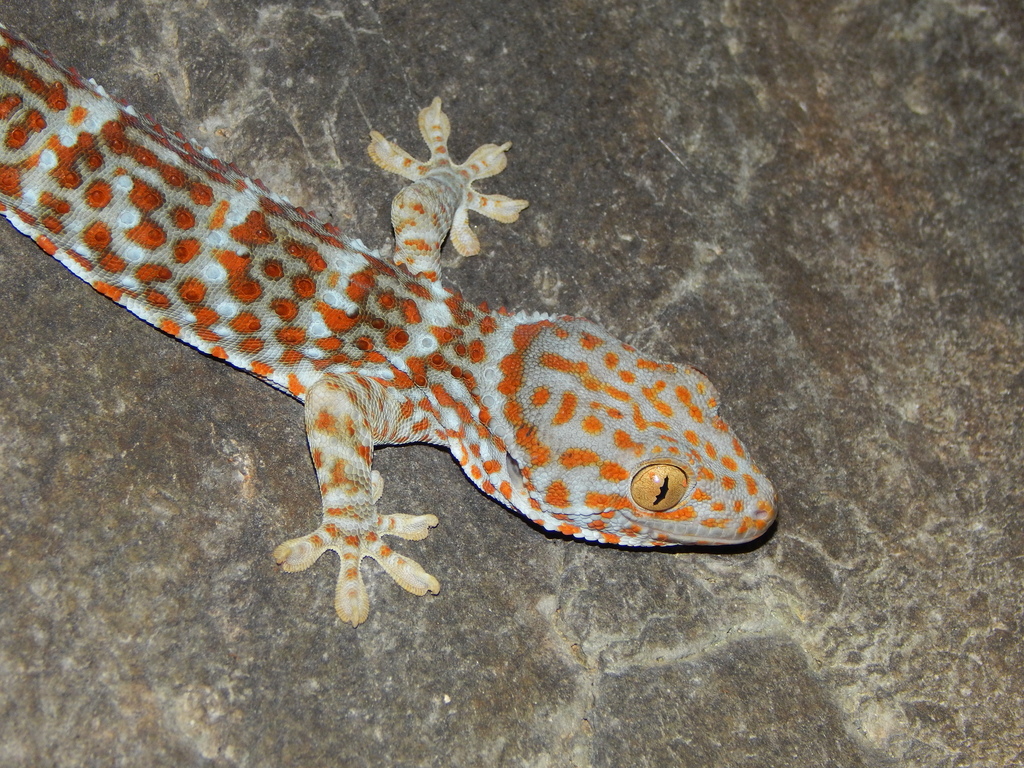
A large, blue-grey and orange-spotted gecko of Asia, named for its loud 'to-kay' call. It runs up walls and glass on toes covered in microscopic hairs, and is one of the most heavily traded reptiles in traditional medicine.
The tokay gecko is a nocturnal arboreal gecko in the genus Gekko, the true geckos. It is native to Asia and some Pacific Islands. Wikipedia
What it can do
- iSticks to smooth surfaces using millions of tiny hairs (setae) on its toes, which grip by van der Waals forces
- iiHas a strong bite that can hold on for minutes
- iiiCan drop its tail to escape and regrow it
In the field
Field marks
- aLarge, heavy-headed gecko, blue-grey with orange to red spots
- bBig eyes with vertical pupils
- cWide toe pads
- dLoud 'to-kay' call at night
- Voice
- A loud, repeated 'to-kay' or 'geck-o', often preceded by a chuckling rattle; carries far at night
- Not to be confused with
- Smaller house geckos (Hemidactylus) are pale and plain. The related Gekko smithii has green eyes and pale rather than orange-red spots. No other gecko in its range is as large or as loud.
- Where to see it
- Buildings and forest throughout Southeast Asia; often heard at night in guesthouses in Thailand, Malaysia, Bali
- When
- Resident; calls year-round, especially in the wet season
Listen
Looking for field recordings…
Life & habits
- Diet
- Insects, spiders, other geckos, small mammals and birds
- Habitat
- Tree trunks, cliffs and buildings
- Size
- Up to ~35 cm including tail
- Lifespan
- ~10 years or more
Males call loudly at night from walls and trees to defend territories. When threatened it opens its mouth wide, barks and bites hard.
In the medicine cabinet
| Tradition | Use |
|---|---|
| Traditional Chinese medicine | Dried, split tokay (gé jiè) used in tonics for cough, asthma and as a 'kidney tonic' |
Weight of evidence
Traditional. Long historical use; little or no modern clinical evidence.
Where it lives
Recorded sightings
—
geo-referenced records in GBIF, from museums, herbaria and field observers.
Native range
Northeastern India and Bangladesh through southern China and Southeast Asia to Indonesia and the Philippines; introduced in Florida, Hawaii and elsewhere
Drag the globe to turn it. Dots are where records exist, not a range map; darker means more records.
In the old herbals & bestiaries
Woodcuts and engravings matched from the Source Library’s scanned books by name. Plates marked “relative” show a close kin rather than this exact species. Click a plate to read the page it came from, with translation.

In the stacks
Searching the stacks…
Every page naming Gekko gecko in the Biodiversity Heritage Library →
Marginalia
Its call gave it its name in many Southeast Asian languages, such as tokek and tukko. In parts of Thailand and Indonesia, hearing a tokay call seven times in a row is said to bring good luck.
Curiosity
Gecko feet have inspired adhesives that can be peeled off and reused many times without losing their grip.
Kinship

Photographs: iNaturalist contributors under the licences shown. Records: GBIF.org. Historical plates: Source Library (CC BY-SA 4.0; originals public domain). Summary text: Nature Library editors and Wikipedia (CC BY-SA). Medicinal and edibility notes are historical and educational, not advice. iNaturalist taxon 34615.