- Animals
- ›Chordates
- ›Vertebrates
- ›Reptiles
- ›Snakes and Lizards
- ›Snakes
- ›Colubrid Snakes
- ›Dipsadine Snakes
- ›Leptodeira
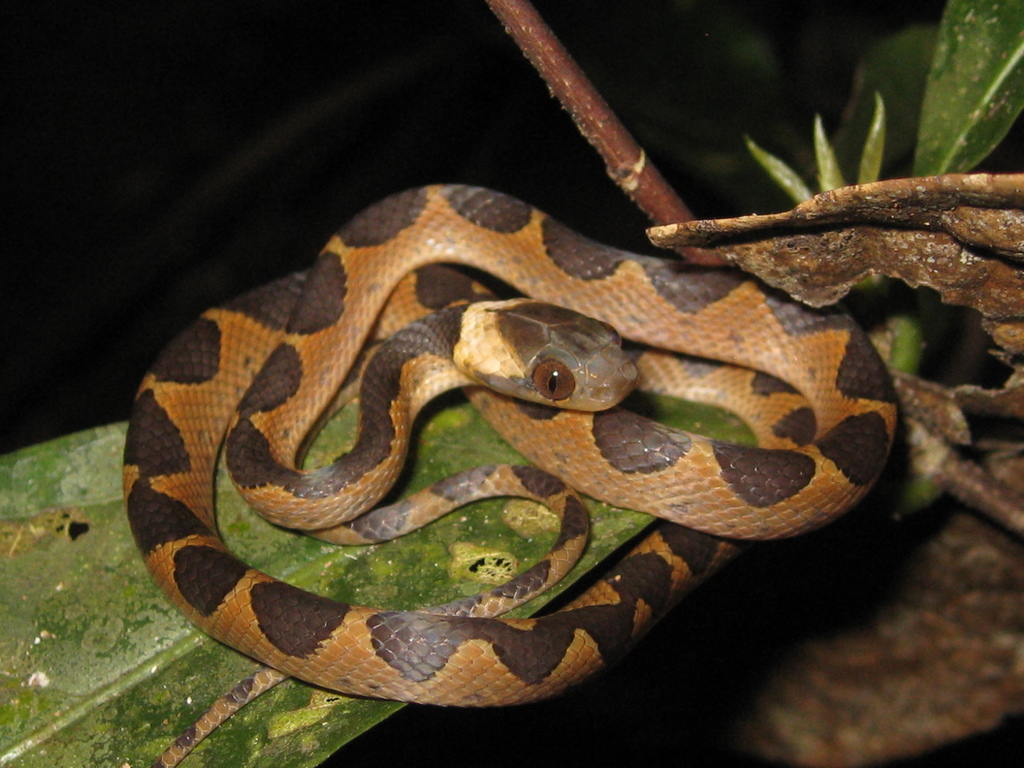
South American Banded Cat-eyed Snake
Leptodeira annulata
Leptodeira annulata, also known commonly as the banded cat-eyed snake, is a species of mildly venomous, rear-fanged, snake in the subfamily Dipsadinae of the family Colubridae. The species is endemic to the New World.
From the article Leptodeira annulata on Wikipedia (CC BY-SA), quoted section by section
Description
Adults of L. annulata have a total length (tail included) of about 750 mm (30 in) and are very slender. The head is distinct from the neck, and the large eyes have vertically elliptic pupils. The back is yellowish or brown with a series of dark brown or blackish spots often confluent into an undulous or zigzag stripe.
Range & habitat
L. annulata is found in Mexico, Central America, and South America, including the offshore islands of Margarita, and Trinidad and Tobago.
Wikipedia: “Geographic range”
What it does
L. annulata preys on frogs, frog eggs, tadpoles, salamanders, and small reptiles such as lizards (including anoles) and smaller snakes, as well as fish. It may also feed on fledgling birds.
Wikipedia: “Diet”
Toxicity
L. annulata has a pair of enlarged, grooved teeth at the rear of each upper jaw (maxilla), and produces a mild venom.. The venom affects the snake's natural prey (mainly small frogs and small lizards). The snake tends not to bite humans when handled, but when it does, the venom has relatively mild effects in most individuals; some describe it as a slight irritating/itching sensation with slight swelling. The snake is not considered a risk to human health.
Wikipedia: “Venom”
Where it lives
Recorded sightings
—
geo-referenced records in GBIF, from museums, herbaria and field observers.
Drag the globe to turn it. Dots are where records exist, not a range map; darker means more records.
In the stacks
Searching the stacks…
Every page naming Leptodeira annulata in the Biodiversity Heritage Library →
This page is assembled live from iNaturalist, GBIF, Wikipedia, the Source Library and the Internet Archive. It is not yet part of the hand-edited codex. iNaturalist taxon 29718.