- Animals
- ›Chordates
- ›Vertebrates
- ›Reptiles
- ›Snakes and Lizards
- ›Snakes
- ›Colubrid Snakes
- ›Dipsadine Snakes
- ›Leptodeira
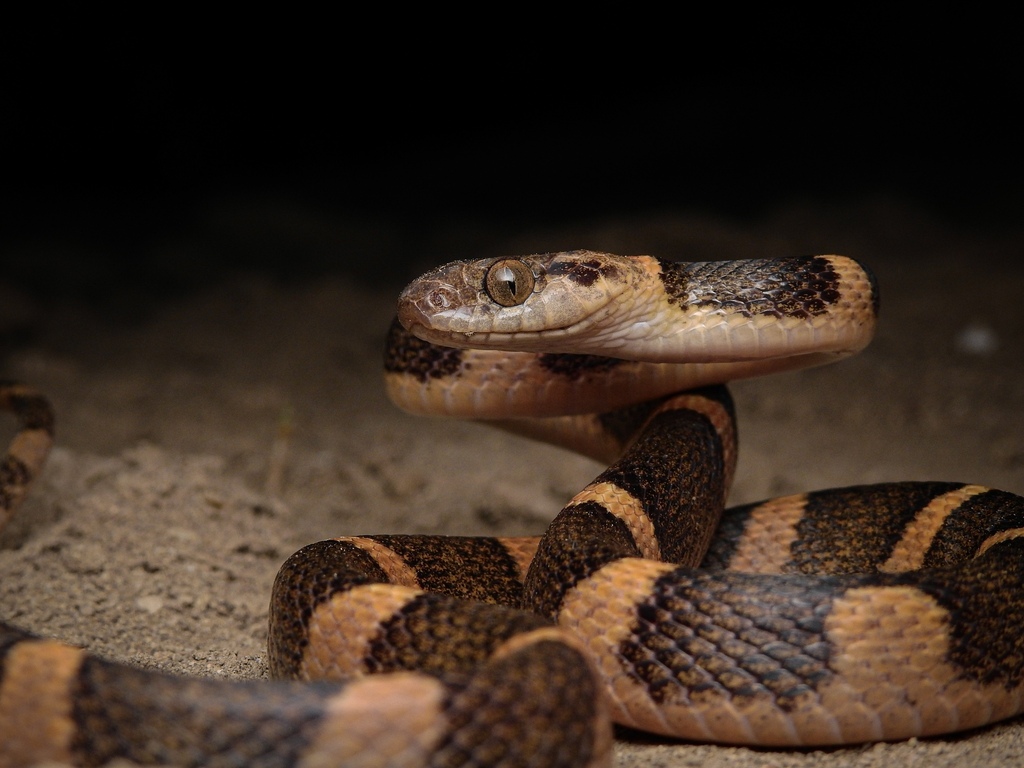
Northern Cat-eyed Snake
Leptodeira septentrionalis
Leptodeira septentrionalis, the northern cat-eyed snake, is a species of medium-sized, slightly venomous snake, found from southern Texas to northern Colombia.
From the article Leptodeira septentrionalis on Wikipedia (CC BY-SA), quoted section by section
Description
The northern cat eye is medium size (up to 1 m [3.3 ft]). In general females are slightly longer than males. They have smooth scales, with a dark brown line or spot beside the eye and dark brown blotches (which can fuse to form a zigzag) running down their backs. These spots may vary in pattern geographically. Its head is distinctly wider than its neck and it has large bulging eyes with reddish irises and light brown elliptical pupils.
Wikipedia: “Appearance”
Range & habitat
The northern cat eye is found in North America: US (S Texas), Mexico (Chiapas, Nuevo León, Quéretaro, Oaxaca, Puebla, Coahuila, Jalisco, Campeche, Yucatán, Quintana Roo, Nayarit), Guatemala, Honduras, Belize, El Salvador, Nicaragua, and Costa Rica. It is found at elevations of 0–1,940 m (0–6,365 ft) above sea level. Within Costa Rica it is found on both Caribbean and Pacific coasts, including in Golfo Dulce, up to 1,200 m (3,900 ft) above sea level in a wide variety of habitats but most common at edges of ponds where amphibians breed.
== References ==
Wikipedia: “Distribution”
What it does
The northern cat eye is primarily arboreal and entirely nocturnal. At night, it hunts for frogs and their eggs and tadpoles; it is particularly known for feeding on those of the red-eyed tree frog. It swallows eggs, tadpoles, and small frogs alive but kills larger frogs with mild venom from its enlarged, grooved rear fangs. It will also consume lizards, toads, salamanders, small fish, and mice. When threatened it is able to flatten its head and spread its jaws although it rarely bites people.
Wikipedia: “Behaviour”
Where it lives
Recorded sightings
—
geo-referenced records in GBIF, from museums, herbaria and field observers.
Drag the globe to turn it. Dots are where records exist, not a range map; darker means more records.
In the stacks
Searching the stacks…
Every page naming Leptodeira septentrionalis in the Biodiversity Heritage Library →
This page is assembled live from iNaturalist, GBIF, Wikipedia, the Source Library and the Internet Archive. It is not yet part of the hand-edited codex. iNaturalist taxon 29724.