- Animals
- ›Chordates
- ›Vertebrates
- ›Reptiles
- ›Snakes and Lizards
- ›Lizards
- ›Iguanas and Allies
- ›Iguanas, Anoles, and Allies
- ›Iguanas and Chuckwallas
- ›Ctenosaura
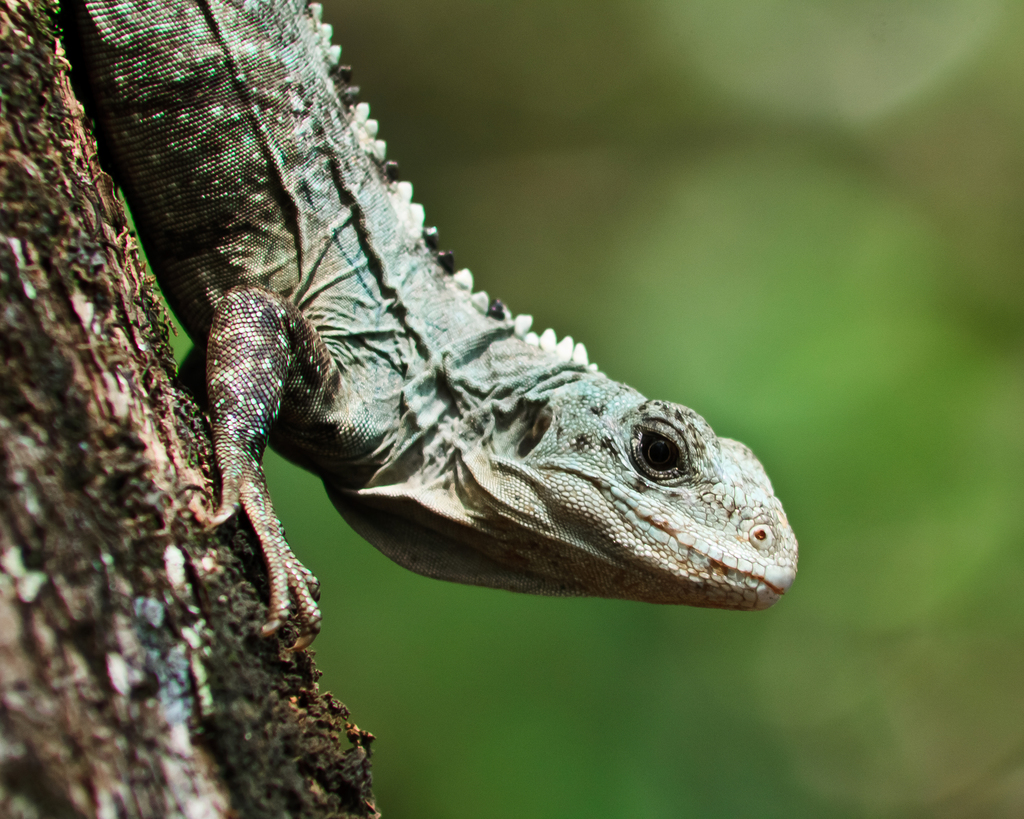
Baker's Spiny-tailed Iguana
Ctenosaura bakeri
Ctenosaura bakeri, also known as the Utila spiny-tailed iguana, Baker's spinytail iguana, swamper or wishiwilly del suampo, is a critically endangered species of spinytail iguana endemic to the island of Utila, one of the Islas de la Bahía off the coast of Honduras in the Caribbean.
The Utila iguana is the only species of iguana and one of only two species of lizard to exclusively inhabit brackish mangrove swamps, forced there due to competition from larger species. It is the smallest of the three species of iguana found on Utila, and unique among spiny-tailed iguanas as it is born a dark color as opposed to bright green or yellow. It is arboreal and primarily herbivorous, although it can be an opportunistic carnivore. Males may grow up to 76 centimeters (30 in) in length, while females are smaller, with a length of up to 56 centimeters (22 in). Eggs are laid in sandy beaches and hatch about 60–76 days later, with the hatchlings returning to live in the mangrove forests.
From the article Ctenosaura bakeri on Wikipedia (CC BY-SA), quoted section by section
Description
The Utila iguana has a grey-brown to black coloring when young, the only species of spiny-tail iguana with such a dark color when young. Other members of the genus have a green or yellow coloring when young and turn darker with age. As this animal matures it can be a blue or light gray in color, depending on heat conditions or even the animal's temper. Males achieve a maximum total length (including tail) of 76 centimeters (30 in), while females are typically 30% smaller at 56 centimeters (22 in) total length. Males have a small dewlap and a dorsal crest made up of 56 large dorsal spines, making the animal sexually dimorphic. This dorsal crest consists of white and black spines arranged in alternating groups of two or three of the same color.
Diet. Like most iguanids, Ctenosaura bakeri is primarily herbivorous, eating flowers, leaves, stems, and fruit, but they will opportunistically eat smaller animals, eggs, and arthropods that inhabit the mangroves. It has been observed eating smaller green iguanas (Iguana iguana) and geckos such as Hemidactylus frenatus.
Reproduction. Adults make their homes within holes in various mangrove trees and maintain an arboreal existence whereas the young are strictly terrestrial for the first year of their lives. …
Range & habitat
Endemic to Utila, an island off the northern Honduras coast, Ctenosaura bakeri is an inhabitant of 8 square kilometres (3.1 sq mi) of mangrove forests. Unique among iguanids and rare among reptiles, it is believed that C. bakeri was pushed into the mangrove swamps due to competition from the larger, more aggressive C. similis, which typically inhabits the drier habitats on Utila. It has interbred with this very species and produced viable offspring. From evolutionary and ecological perspectives, inhabiting brackish mangrove forests entails very specific adaptations of diet, behavior, and resource utilization. It is one of only two known species of lizard, the other being a species of anole, Anolis utilensis, that lives solely in mangrove forests.
Wikipedia: “Distribution and habitat”
Where it lives
Recorded sightings
—
geo-referenced records in GBIF, from museums, herbaria and field observers.
Drag the globe to turn it. Dots are where records exist, not a range map; darker means more records.
In the stacks
Searching the stacks…
Every page naming Ctenosaura bakeri in the Biodiversity Heritage Library →
This page is assembled live from iNaturalist, GBIF, Wikipedia, the Source Library and the Internet Archive. It is not yet part of the hand-edited codex. iNaturalist taxon 35319.