- Animals
- ›Chordates
- ›Vertebrates
- ›Reptiles
- ›Snakes and Lizards
- ›Lizards
- ›Glass, alligator, monitor lizards and allies
- ›Beaded Lizards
- ›Heloderma
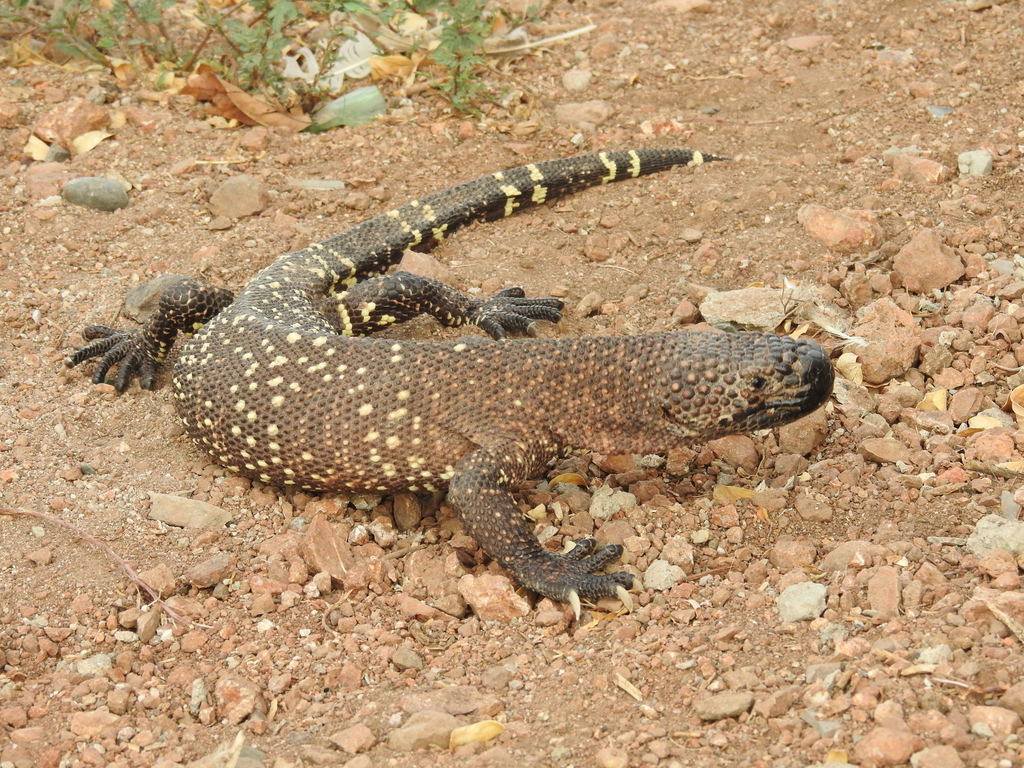
Beaded Lizard
Heloderma horridum
The Mexican beaded lizard (Heloderma horridum) or beaded lizard is a species of venomous lizard in the family Helodermatidae, one of the two species of venomous beaded lizards found principally in Mexico and southern Guatemala. It and the other members of the same genus, including the Gila monster (Heloderma suspectum), are the only lizards known to have evolved an overt venom delivery system. The Mexican beaded lizard is larger than the Gila monster, with duller coloration, black with yellowish bands. As it is a specialized predator that feeds primarily upon eggs, the primary use of its venom is still a source of debate among scientists. This venom has been found to contain several enzymes useful for manufacturing drugs in the treatment of diabetes, and research on the pharmacological use of its venom is ongoing.
Threatened throughout its range by overcollection and habitat loss, it is a CITES protected species. The Guatemalan beaded lizard (H. charlesbogerti) is one of the rarest lizards in the world, with a wild population of fewer than 200.
From the article Mexican beaded lizard on Wikipedia (CC BY-SA), quoted section by section
Description
Adult beaded lizards range from 57 to 91 cm (22 to 36 in) in length. They are substantially larger than the Gila monster, which only reaches lengths of 30 to 56 cm (12 to 22 in). The snout-to-vent length of a beaded lizard averages 33 to 48 cm (13 to 19 in). The average body mass of an adult beaded lizard is 800 g (1.8 lb), about 45% heavier than the average mass of a Gila monster, with large specimens exceeding 2,000 g (4.4 lb). Maximum weight known is 4,000 g (8.8 lb) Although males are slightly larger than females, the beaded lizards are not sexually dimorphic. Both males and females are stocky with broad heads, although the males' heads tend to be broader. The beaded lizards' scales are small, beadlike, and not overlapping. Except for the underside, the majority of its scales are underlaid with bony osteoderms.
Their base color is black and marked with varying amounts of yellow spots or bands. The beaded lizards have short tails, which are used to store fat so they can survive during months of estivation. Unlike many other lizards, this tail does not regenerate if broken. Beaded lizards have forked, pink tongues that they use to smell, with the help of a Jacobson's organ; they stick their tongues out to gather scents and touch them to the opening of the organ when the tongue is retracted.
Range & habitat
Beaded lizards are found in the Pacific drainages from southern Sonora to southwestern Guatemala and two Atlantic drainages, from central Chiapas to southeastern Guatemala. Their habitats are primarily in the desert, tropical deciduous forests, and thorn scrub forests, but are found in pine-oak forests, with elevations from sea level to 1500 m. In the wild, the lizards are only active from April to mid-November, spending about an hour per day above the ground.
The Mexican beaded lizard H. horridum is found in Mexico, from Sonora to Oaxaca. The Rio Fuerte beaded lizard (H. exasperatum) is found from southern Sonora to northern Sinaloa. The Chiapan beaded lizard (H. alvarezi) is found in northern Chiapas and the depression of the Río Lagartero in Huehuetenango to northwestern Guatemala. The ranges of these three species overlap, making them sympatric. The Guatemalan beaded lizard (H. charlesbogerti) is the only allopatric one, separated from the nearest population (H. alvarezi) by 250 km of unsuitable habitat. The Guatemalan beaded lizard is the most endangered of the species, if not of all lizards; it is found only in the dry valley of the Río Motagua in northeastern Guatemala; fewer than 200 are believed to exist in the wild.
Wikipedia: “Habitat and range”
What it does
The beaded lizard is a specialized vertebrate nest predator, feeding primarily on bird and reptile eggs. A semiarboreal species, it is found climbing deciduous trees in search of prey when encountered above ground. It occasionally preys upon small birds, mammals, frogs, lizards, and insects. Steve Angeli and Robert Applegate, noted captive breeders of the beaded lizard, have remarked that captive specimens do best on a diet of small vertebrates such as mice and rats. Confiscated wild-caught specimens can be made to feed by using egg on the prey item.
Wikipedia: “Diet”
Toxicity
The venom glands of the beaded lizard are modified salivary glands located in the reptile's lower jaw. Each gland has a separate duct leading to the base of its grooved teeth. When biting, the beaded lizard hangs on its victim and chews to get its venomous saliva into the wound. Although its jaw grip is strong, its unsocketed teeth are easily broken off at their bases. The beaded lizard's venom is a weak hemotoxin, and although human deaths are rare, it can cause respiratory failure. It consists of a number of components, including L-amino acid oxidase, hyaluronidase, phospholipase A, serotonin, and highly active kallikreins that release vasoactive kinins. The venom contains no enzymes that significantly affect coagulation. Almost all documented human bites (eight in the past century) have resulted from prodding captive lizards with a finger or bare foot. While invertebrates are essentially immune to the effects of this venom, effects on vertebrates are more severe and varied. In mammals such as rats, major effects include a rapid reduction in carotid blood flow followed by a marked fall in blood pressure, respiratory irregularities, tachycardia, and other cardiac anomalies, as well as hypothermia, edema, and internal hemorrhage in the gastrointestinal tract, lungs, eyes, liver, and kidneys. …
Wikipedia: “Venom”
Where it lives
Recorded sightings
—
geo-referenced records in GBIF, from museums, herbaria and field observers.
Drag the globe to turn it. Dots are where records exist, not a range map; darker means more records.
In the stacks
Searching the stacks…
Every page naming Heloderma horridum in the Biodiversity Heritage Library →
This page is assembled live from iNaturalist, GBIF, Wikipedia, the Source Library and the Internet Archive. It is not yet part of the hand-edited codex. iNaturalist taxon 35006.