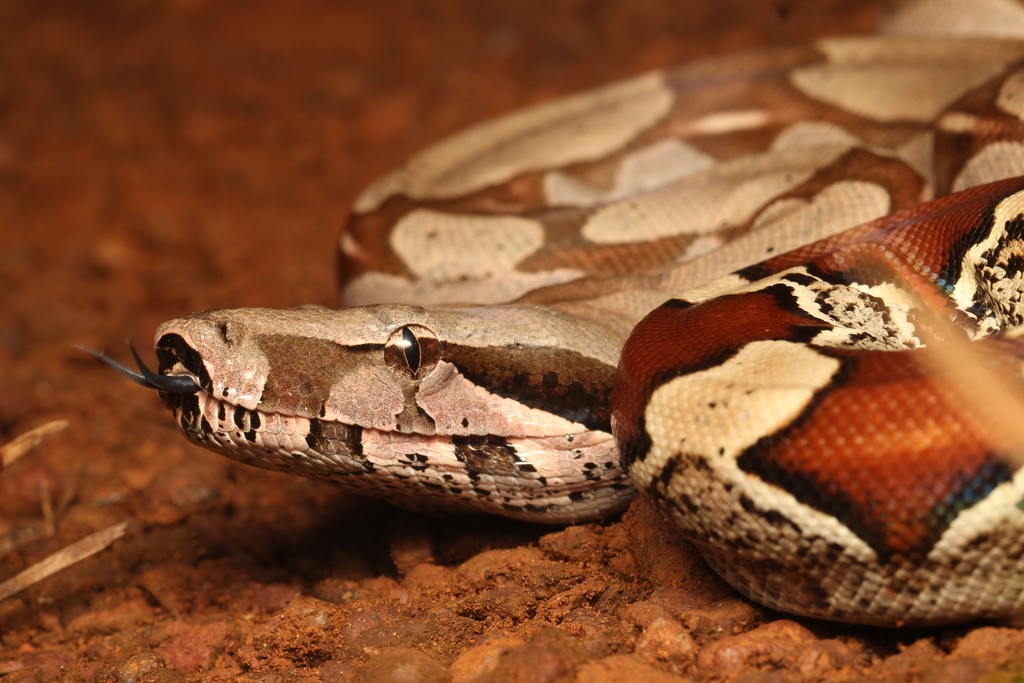
Boa Constrictor
Boa constrictor
The boa constrictor (Boa constrictor), also called the red-tailed boa or the common boa, is a species of large, non-venomous, heavy-bodied snake that is frequently kept and bred in captivity. The boa constrictor is a member of the family Boidae, found in tropical North, Central, and South America, as well as some islands in the Caribbean. A staple of private collections and public displays, its color pattern is highly variable yet distinctive. Nine subspecies are currently...
From the article Boa constrictor on Wikipedia (CC BY-SA), quoted section by section
Range & habitat
Depending on the subspecies, Boa constrictor can be found through South America north of 35°S (Colombia, Ecuador, Peru, Venezuela, Trinidad and Tobago, Guyana, Suriname, French Guiana, Brazil, Bolivia, Uruguay, and Argentina), and many other islands along the coasts of South America. Introduced populations exist in Cozumel, extreme southern Florida, and St. Croix in the U.S. Virgin Islands. The type locality given is "Indiis"—a mistake, according to Peters and Orejas-Miranda (1970). B. constrictor flourishes in a wide variety of environmental conditions, from tropical rainforests to arid semidesert country. However, it prefers to live in rainforest due to the humidity and temperature, natural cover from predators, and vast amount of potential prey. It is commonly found in or along rivers and streams, as it is a very capable swimmer. Boa constrictors also occupy the burrows of medium-sized mammals, where they can hide from potential predators.
Wikipedia: “Distribution and habitat”
What it does
Boa constrictors generally live on their own and do not interact with any other snakes unless they want to mate. They are nocturnal, but they may bask during the day when night-time temperatures are too low. As semi-arboreal snakes, young boa constrictors may climb into trees and shrubs to forage; however, they become mostly terrestrial as they become older and heavier. Boa constrictors strike when they perceive a threat. Their bite can be painful, especially from large snakes, but is rarely dangerous to humans. Specimens from Central America are more irascible, hissing loudly and striking repeatedly when disturbed, while those from South America tame down more readily. Like all snakes, boa constrictors in a shed cycle are more unpredictable, because the substance that lubricates between the old skin and the new makes their eyes appear milky, blue, or opaque so that the snake cannot see very well, causing it to be more defensive than it might otherwise be.
Hunting and diet. Their prey includes a wide variety of small to medium-sized mammals and birds. The bulk of their diet consists of rodents (such as squirrels, mice, rats and agoutis), but frogs, larger lizards (such as ameivas, iguanas and tegus) and mammals as big as monkeys, marsupials (opossums), introduced mongooses, armadillos, wild pigs, young brocket deer and ocelots are also reported to have been consumed. …
Wikipedia: “Behavior”
Where it lives
Recorded sightings
—
geo-referenced records in GBIF, from museums, herbaria and field observers.
Drag the globe to turn it. Dots are where records exist, not a range map; darker means more records.
In the stacks
Searching the stacks…
Every page naming Boa constrictor in the Biodiversity Heritage Library →
This page is assembled live from iNaturalist, GBIF, Wikipedia, the Source Library and the Internet Archive. It is not yet part of the hand-edited codex. iNaturalist taxon 32093.